
Interview with painter Theodoros Markellos in To Radiofono magazine (1957)
Press Clipping
— 1957
ΤΟ ΡΑΔΙΟΦΩΝΟ , Αθήνα
Markellos's work.
with five honorary distinctions. From 1954 to 1956, he studied on a scholarship at the Higher School of Fine Arts in San Fernando, Madrid, and from 1960 to 1962, he again studied on a scholarship at the École Nationale Supérieure des Beaux-Arts in Paris. Solo exhibitions: In 1956 at the "Chantre" Asturian Gallery in Madrid, in 1958 at the Exhibition Hall in Athens, in 1963 at the "Spinetti" Gallery in Florence. Group exhibitions: Galerie Étoile Salon, Salon d'Automne, International Exhibition of Contemporary Art in Terni, Madrid. International Exhibition in Vienna, Grand Modern Art, Paris. Quadriennale d'Europa in Rome, "Zygos" Gallery, UK "Olympia," as well as in the Panhellenic Exhibitions. At the State Italian Exhibition, Premio Montedoro, he was awarded a silver medal. His works are found in collections in Greece and abroad.
We asked the painter Theodoros Markellos about his work. The well-known artist told us: "Art expresses what language cannot express. I fully agree with this view, which is why I will be very reluctant to elaborate on my views on art, and specifically on my own work, in a few words. Nevertheless, I will try... I started with a true love for painting, and from the very beginning, I understood that one must devote oneself completely to it to have even a small hope of eventually achieving a result that justifies the effort. I believed that a lot of work was needed to master my technical and expressive means and to cultivate my painting's stability. Thus, I work hard, studied, and copied the great masters.
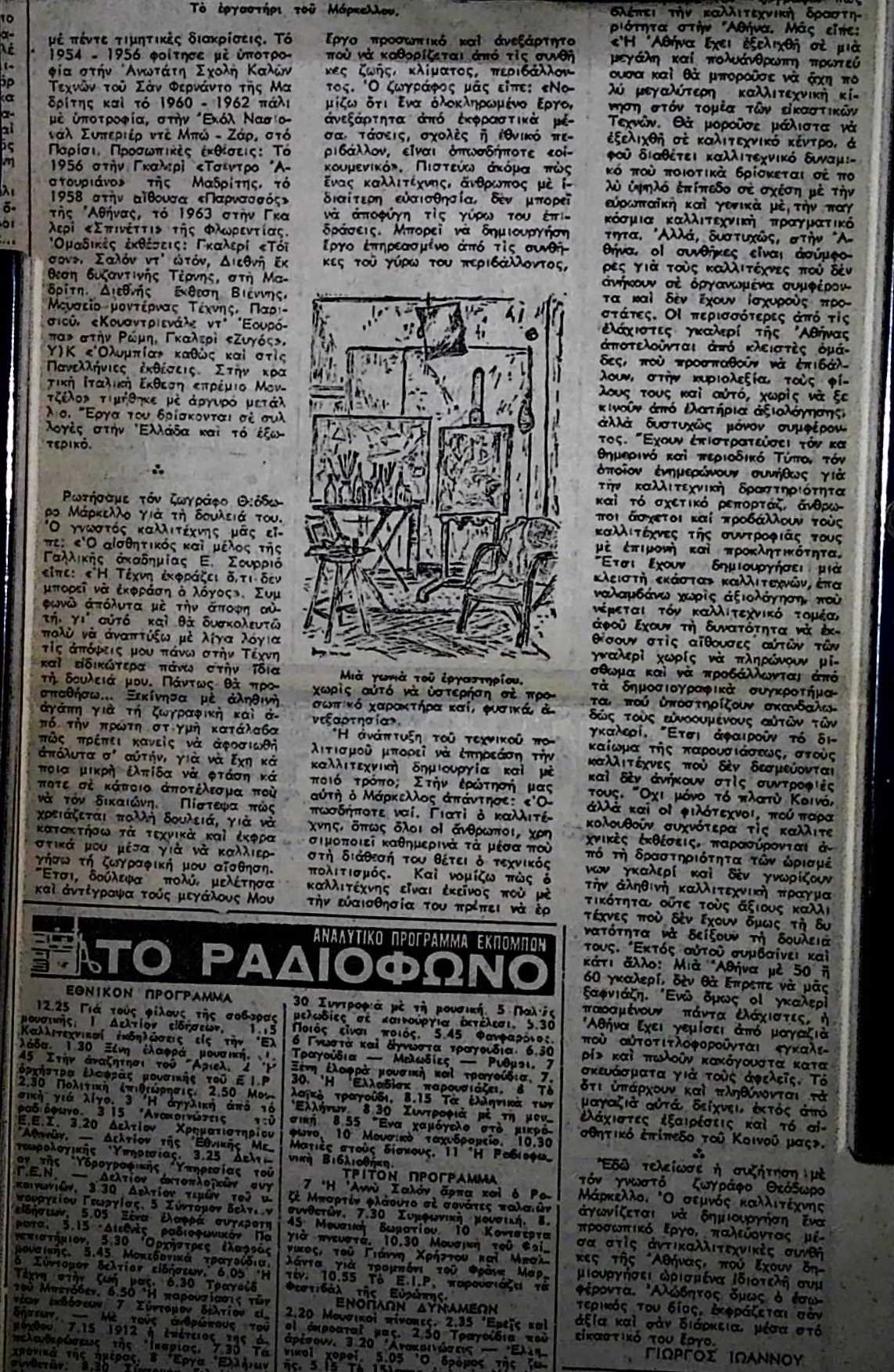
A woman from the studio.
without this detracting from personal character and, of course, independence.
How can the development of technical civilization affect artistic creation, and in what way? To this question, Markellos answered: "Absolutely yes. Because the artist, like people, uses daily the means provided by technical civilization. And I believe that the artist is the one who, with his specialty, must..."
He resumed his artistic activity in Athens. He told us: “Athens has developed into a large, populous metropolis and could have a much greater artistic movement in the field of the Visual Arts. It could even evolve into an artistic center, since it possesses artistic potential that is qualitatively at a much higher level compared to the vague and generally global artistic reality. But, unfortunately, in Athens, the conditions are unfavorable for artists who do not belong to organized interests and do not have powerful patrons. Most of the few galleries in Athens consist of closed groups that try to literally impose their friends, and this, without being driven by a history of evaluation, but unfortunately only by interests. They have enlisted the daily and periodical press, the usual source of information on artistic activity and related reporting, people who interrupt and promote the artists of their circle with insistence and provocation. Thus, they have created a closed caste of artists, a guild without evaluation, that dominates the artistic field, since they have the ability to exhibit in the missions of these galleries without paying rent and to be promoted by the journalistic groups that scandalously support the consciences of these galleries. Thus, they deprive artists who do not mingle and do not belong to their circles of the right to present their work. Not only the general public, but also art lovers, who more frequently attend art exhibitions, are misled by the activities of certain galleries and do not know the true artistic reality, nor are they shown artists who do not have the opportunity to show their work. Besides this, something else happens: An Athens with 50 or 60 galleries should not help us. While two galleries, or perhaps always the same ones, have always been lucky, Athens has filled with shops that call themselves galleries and sell ordinary crafts for the naive. The fact that these shops exist and multiply shows, besides the shopkeepers’ exceptions, the aesthetic level of our public.”
The discussion with the well-known painter Theodoros Markellos has ended. The modest artist is recognized for creating a personal body of work, struggling against the anti-artistic conditions in Athens, which have created a distinct and interesting interest. However, his artistic style is expressed in value and as a successor within his visual art.
THE RADIO
NATIONAL PROGRAM
12:25 For friends of chamber music. 1:15 Artistic events in Greece. 1:30 A chamber music piece. 2:45 In memory of Ariel. 2:45 Chamber music concert by the E.I.R. 2:30 Political review. 2:50 Music for a while. 3 The English from the radio. 3:15 Announcements by the E.E.S. 3:20 Athens Stock Exchange Bulletin. 3:25 Bulletin of the Newspapers. Service of the K.E.N. 3:30 Bulletin of election results. 3:30 Price bulletin of the Agricultural Register. 5 Brief news bulletin. 5:05 A chamber music piece by composers. 5:30 Chamber music orchestra. 5:45 Unique songs. 6:05 Art in life. 6:30 Preparation of the Mestoden. 6:50 Preparation of the Mestoden. 7 Brief news bulletin. — With the people of the evening. 7:15 1912 the anniversary of the great population of Ikaria. 7:30 Chronicles of the first 8 Works of Greece standing. 8:30 Brief news bulletin.
DETAILED BROADCAST PROGRAM
30 Companionship with music. 5 Melodies again in new performance. 5:30 Who is who. 5:45 Fanaranos. 6:30 Known and unknown songs. 6:30 Songs — Melodies — Rhythms. 7:30 The Greek presentation. 8 The logical song. 8:15 The Greeks of the Greeks. 8:55 A joy in the small voice. 10 Musical post office. 10:30 Glances at the records. 11 The Radio Library.
THIRD PROGRAM
7 Annie Salon harp and Rosy Bastren kissed in old Bastren. 7:30 Literary music. 8:45 Chamber music. 10 Contest for wind instruments. 10:30 Music of Foilindo, Yannis Christou and Ballad for tropa by Frank Marten. 10:55 The E.I.R. presents the Festivals of Europe.
NATIONAL FORCES
2:20 Music table. 2:35 Ruins and inside the scrap. 2:30 Songs that are best. 3:20 Announcements — Greek dance. 5:05 The road — Greek dance. 5:15 The Greeks of the Greeks.
GIORGOS IOANNOU
← View all 679 archival documents · Biography of Theodoros Markellos