
Report on Theodor Markelos in Primorski dnevnewspaper (1969)
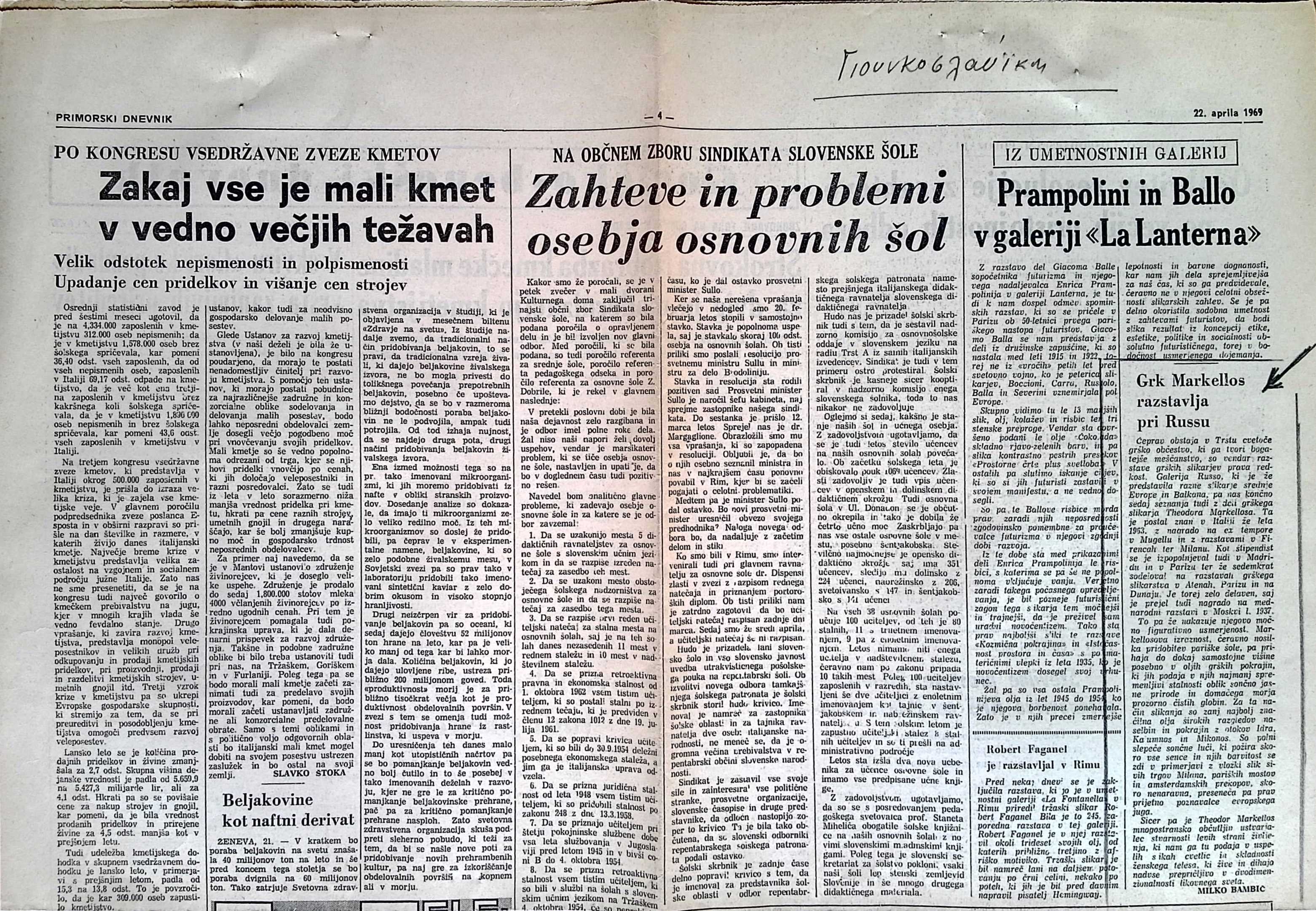
Press Clipping
— 1957
Primorski dnevnik , Trieste
NEW YEAR'S GAZETTE
- 4 -
April 22, 1969
AFTER THE CONGRESS OF THE PAN-Hellenic UNION OF FARMERS
Why the small farmer
is facing increasingly greater difficulties
High rate of literacy and semi-literacy
Drop in agricultural product prices and rise in machinery prices
The Central Statistical Service, six months ago, found that
of the 4,334,000 workers in agriculture,
312,000 people are literate; that
in agriculture there are 1,578,000 people without
a school certificate, which means
36.40% of all workers, that of
all literate people working
in Italy, 69.17% belong to agriculture, that more than a third
of workers in agriculture do not have
a school certificate, which means 43.6%
of all workers in agriculture
in Italy.
At the third congress of the Pan-Hellenic
Union of Farmers, which represents in
Italy approximately 500,000 workers in
agriculture, the great crisis that has struck all
agricultural sectors was expressed. In the main report
of the union's vice-president, deputy E-
sposta, and in the extensive discussion, figures and conditions were presented under
which Italian
farmers live today. The greatest burden of the crisis in
agriculture is represented by the great
delay in the educational and social
sector of southern Italy. Therefore, it should not surprise us that at the
congress the largest discussion was about the
rural population of the south,
where in many areas feudal conditions still prevail. The second
issue hindering the development of agriculture is the monopolistic control of
large landowners and large companies in
the market and sale of agricultural
products, in the production, sale
and distribution of agricultural machinery, artificial fertilizers, etc. The third cause
of the crisis in agriculture is the rules
of the European Economic Community,
which aim to allow during the
restructuring and upgrading of agriculture mainly the development
of large estates.
Last year, the quantity of
sales of products and animals decreased
by 2.7%. The total value of
real value dropped from 5,659.9
to 5,427.3 billion lire, or by
4.1%. At the same time, prices for purchasing machinery and fertilizers
increased, meaning that the value
of sold products and adjusted
animals was 4.5% less than the
previous year.
The share of agricultural income in the total Pan-Hellenic income
last year, compared to the previous year, dropped from
15.3% to 13.8%. This led to 309,000 people leaving agriculture.
SLAVKO STOKA
Proteins
as a petroleum substitute
GENEVA, 21. — Soon, global protein consumption will reach 40 million tons annually, and before the end of this century, consumption will rise to 60 million tons. This is stated by the World Health Organization, which strives to support every initiative aimed at finding new ways to obtain new foods, whether through the exploitation of agricultural lands on land or at sea.
AT THE GENERAL ASSEMBLY OF THE SLOVENIAN SCHOOL UNION
Demands and problems
of primary school staff
As we have already mentioned, on Friday evening in the small hall
of the Cultural Center, the thirteenth general assembly of the Slovenian School Union was completed, where reports on the work carried out were presented and a new board of directors was elected. Among the reports presented were the report of the deputy secondary school representative, the report of the deputy pedagogical unit representative, and the report of the deputy for primary schools Z.
Dobrile, who mainly said the following:
In the previous economic period, our
activity was very dynamic and
the board had its hands fully occupied.
Unfortunately, our efforts did not yield enough
results, however, many problems concerning the staff of primary
schools have been raised, and we hope that
they will be resolved positively in the near future.
I will detail the main
problems concerning the staff of
primary schools, which the
board has fought for:
1. To legislate the positions of 5 teaching directorates for primary
schools with Slovenian as the language of instruction and to publish a special
competition to fill these positions.
2. To legislate the position of the existing
school inspector for primary
schools and to publish a competition to fill this position.
3. To publish the first regular teacher competition for permanent positions in
primary schools, as in these
schools today there are 11 vacant positions in the regular number and 10 positions in the excess number.
4. To recognize the retroactive legal and economic permanent position from
October 1, 1962, for all those teachers who became permanent after
a special competition, as provided for in
Article 12 of Law 1012 of July 19, 1961.
5. The injustice towards teachers, who until September 30, 1954, held a special financial status but were stripped of it by the Italian administration, must be corrected.
6. Permanent legal status must be recognized from the year 1948 for all those teachers who acquired permanent positions in accordance with Law 248 of March 13, 1958.
7. When calculating pensionable service, teachers must be credited with all years of service in Yugoslavia prior to 1945 and in the former Zone B until October 4, 1954.
8. Retroactive permanent status must be recognized for all those teachers who were serving in schools with Slovenian as the language of instruction in Trieste on October 4, 1954, provided they have not been transferred.
The union has exerted all its efforts and has engaged all political parties, educational organizations, Slovenian newspapers, and other representatives to take decisive action against this injustice. The situation was so intense that the Slovenian members of the provincial school council submitted their resignations.
The school inspector recently made a partial correction of this injustice by appointing a representative of the school authorities to the provincial council.
FROM THE ART GALLERIES
Prampolini and Ballo
at the “La Lanterna” gallery
With the exhibition of works by Giacomo Balla, co-founder of Futurism, and his successor Enrico Prampolini at the Lanterna gallery, the echo of the commemorative exhibitions that began in Paris for the 50th anniversary of the Futurists’ first Parisian appearance has reached us as well. Giacomo Balla is presented to us with works from his family heritage, created between 1915 and 1922—that is, not from the “hot” five years before the world war, when the five painters, Boccioni, Carrà, Russolo, Balla, and Severini, unsettled half of Europe.
In total, we see here only 13 smaller paintings, oils, collages, and drawings, and three murals. However, only the oils “Čoko.ada,” with harmonious brown-green shades, and the painting with contrasting color transitions “Space of Lines plus Light” are fully completed. In the remaining works, we sense the pursuit of the goals that the Futurists had set in their own manifesto, but which were not always achieved.
Nevertheless, these drawings by Balla, perhaps precisely due to their simplicity, are historically significant for researchers of Futurism in its early developmental period.
From this period, among the exhibited works of Enrico Prampolini, there are only two drawings that do not fully fit into them. Most likely due to this slow defining process, the Futurist impulse of this painter was so strong and long-lasting that it survived Neoclassicism. Thus, the best paintings of this exhibition are "Cosmic Topography" and "Simultaneous Existence of Space and Time" with material collages from the year 1935, when Neoclassicism reached its peak.
Unfortunately, all the remaining oils by Prampolini from the years 1945 to 1959, when his combative spirit faded. Therefore, these works are dominated by calmer scenes and landscapes featuring the islands of Idra, Kaumnos, and Mikonos. They are filled with blinding sunlight that swallows almost all shadows, and their colorfulness appears almost nonexistent compared to the paintings of the shadowy squares of Milan, the bridges of Paris, and the canals of Amsterdam, but pleasantly surprises connoisseurs of the European South.
However, Theodor Marketlos is a multifaceted observer of the reality of life's left sides, presenting us with successful paintings of flowers and the harmony of the female body, which live and breathe convincingly in the two-dimensional reality of the visual arts world.
MILKO BAMBIC
The Greek Markellos
exhibits
at Russo
Although there is a prosperous Greek community in Trieste, consisting of a wealthier urban element, exhibitions of Greek painters are truly rare. The Russo Gallery, which has already presented various painters from Central Europe and the Balkans, now introduces us to the Greek painter Theodor Markellos. He became known in Italy as early as 1953 with an award for ex tempore painting in Mugello and with exhibitions in Florence and Milan. As a scholarship holder, he improved his skills in Madrid and Paris and has participated seven times in exhibitions of Greek painting in Athens, Paris, and Vienna. He is therefore very active, having also received an award at an international exhibition in Moscow in 1937. This already indicates his strong presence. Markellos’s expression, although influenced by the Parisian school, reaches a sufficiently independent level, especially in his oil paintings of Greek landscapes, which he presents with minimal alteration of the forms of the sunlit, clear nature and the pure marine depth. For this style of painting, the most characteristic oils are the broad views of settlements and landscapes with the islands of Idra, Kaumnos, and Mikonos. They are filled with blinding sunlight, which swallows almost all shadows, and their colorfulness appears almost nonexistent compared to the paintings of the shadowy squares of Milan, the bridges of Paris, and the canals of Amsterdam, but pleasantly surprises connoisseurs of the European South.
Robert Faganel
has exhibited in Rome
A few days ago, the exhibition organized by the Triestine painter Robert Faganel at the art gallery “La Fontanella” in Rome concluded. This was the 245th consecutive exhibition at this gallery. Robert Faganel exhibited about thirty of his oil paintings, of which approximately one-third featured African themes. The Triestine painter was on a long trip to the African continent last year, following roughly the routes that the writer Hemingway had taken long ago.
Yunkoglavika
← View all 679 archival documents · Biography of Theodoros Markellos