
Report on Theodor Markelos in Revista Oriente, 1957
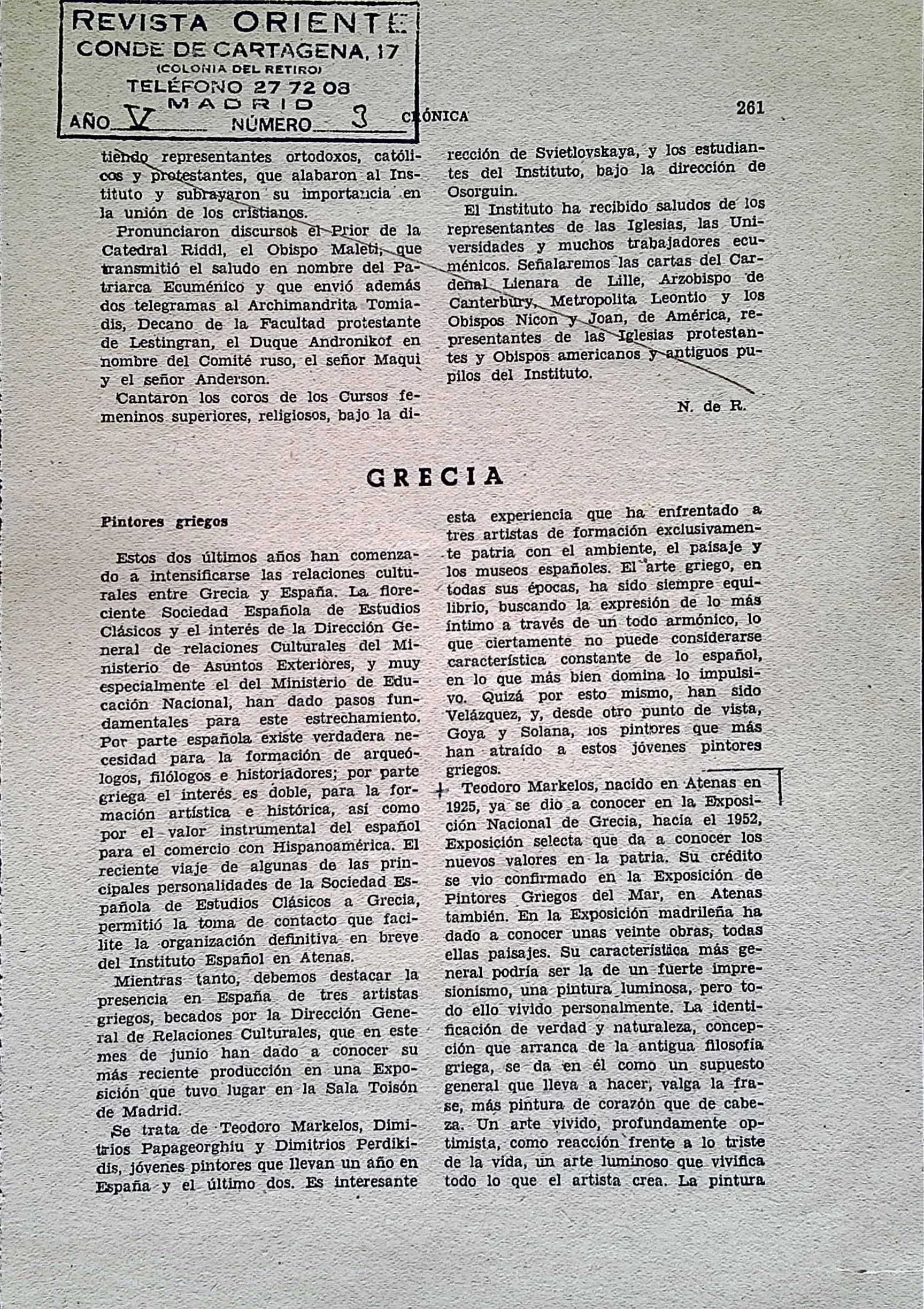
Press Clipping
— 1957
Revista Oriente , Madrid
GREECE
Greek Painters
Over the last two years, cultural relations between Greece and Spain have intensified. The flourishing Spanish Society for Classical Studies, along with the interest shown by the General Directorate of Cultural Relations of the Ministry of Foreign Affairs, and particularly that of the Ministry of National Education, have taken fundamental steps toward this closeness. From the Spanish side, there is a genuine need for the training of archaeologists, philologists, and historians; from the Greek side, the interest is twofold: for artistic and historical formation, as well as for the instrumental value of the Spanish language in trade with Hispanic America. The recent visit of some key members of the Spanish Society for Classical Studies to Greece enabled the contact that facilitated the final planning of the Spanish Institute in Athens.
Among other things, we must highlight the presence in Spain of three Greek artists, scholars of the General Directorate of Cultural Relations, who this past June presented their most recent creations at an exhibition held at the Toisón Hall in Madrid.
These artists are Theodoros Markellos, Dimitrios Papageorgiou, and Dimitrios Perdikidis, young painters who have been in Spain for one year, and the latter for two. This experience, which brought three artists with exclusively patriotic training into contact with the environment, landscape, and museums of Spain, is noteworthy. Greek art, in all its periods, has always been characterized by balance, seeking to express the innermost through a harmonious whole, something that certainly cannot be considered a fixed characteristic of Spanish art, where the impulsive tends to dominate. Perhaps for this very reason, Velázquez, and from another perspective, Goya and Solana, are the painters who most attracted these young Greek artists.
Theodoros Markellos, born in Athens in 1925, had already made his appearance at the National Exhibition of Greece around 1952, a selective exhibition that highlights new values in the homeland. His reputation was confirmed at the Exhibition of Greek Marine Painters, also in Athens. At the Madrid exhibition, he presented approximately twenty works, all landscapes. His most general characteristic could be described as intense impressionism, a luminous painterly style, but all experienced personally. The identification of truth and nature, a perception derived from ancient Greek philosophy, exists in him as a general premise leading to—let us allow the phrase—more painting of the heart than of the mind. A lived art, deeply optimistic, as a reaction to the sorrow of life, a luminous art that revitalizes everything the artist creates. The painting
← View all 679 archival documents · Biography of Theodoros Markellos