
Review of Th. Markellos exhibition at Gallery Argo (1992)
Press Clipping
— 1957
Ρισοπράγματις , Αθήνα
THEODOROS MARKELOS
"Risking the Actual II 21-3-1992
He lets the painting "speak"
Gallery "Argo"
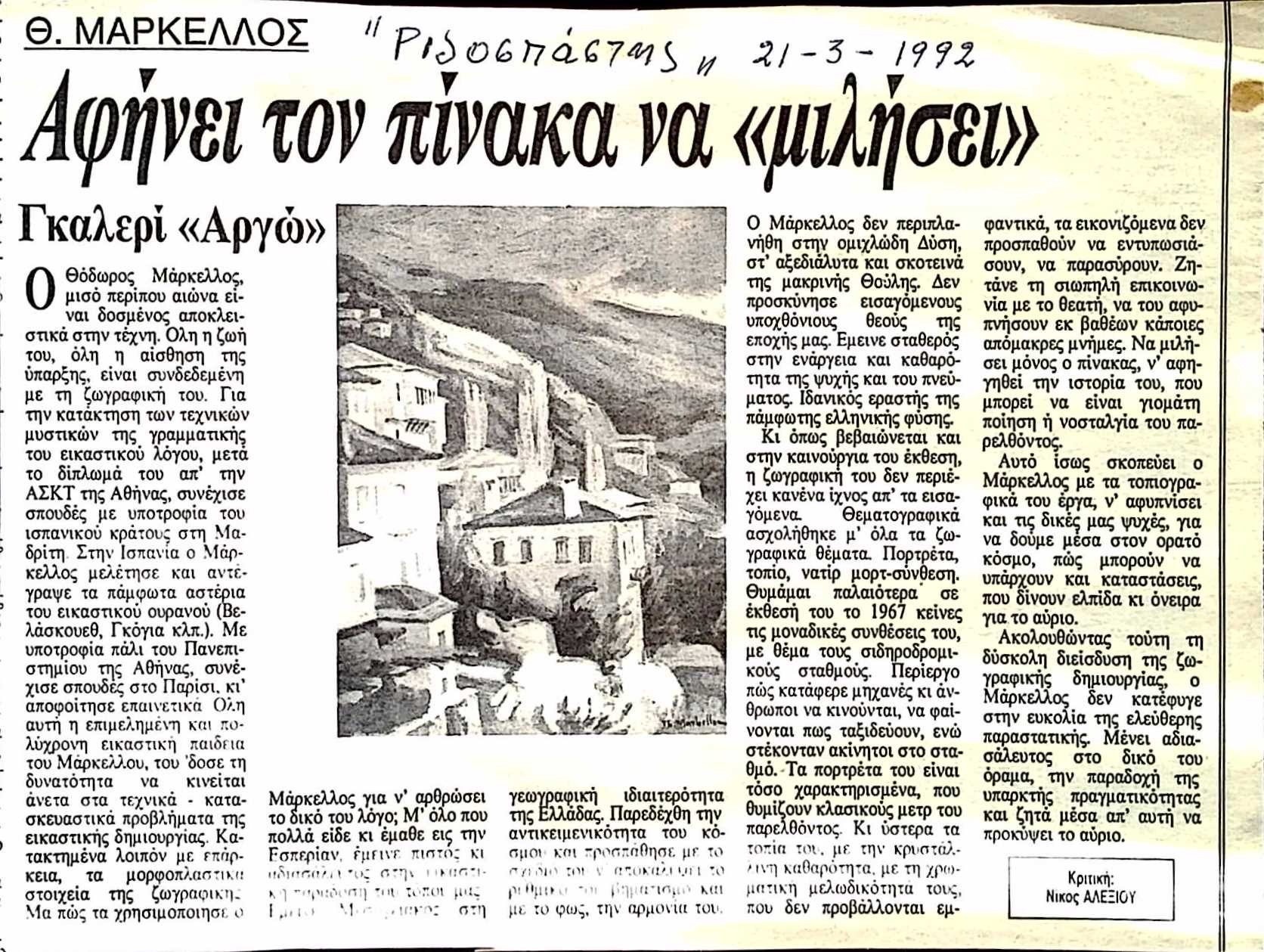
Theodoros Markellos has been devoted exclusively to art for approximately half a century. His entire life, his very sense of existence, is intertwined with his painting. To master the technical secrets of the grammar of visual language, after receiving his diploma from the Athens School of Fine Arts (ASKT), he continued his studies on a Spanish state scholarship in Madrid. In Spain, Markellos studied and copied the brightest stars of the visual sky (Velázquez, Goya, etc.). With another scholarship, this time from the University of Athens, he continued his studies in Paris and graduated again. This meticulous and long-standing visual education of Markellos gave him the ability to navigate comfortably the technical and constructive problems of visual creation. Having thus adequately mastered the formal and plastic elements of painting, how did Markellos use them to articulate his own voice? Although he saw and learned much in the West, he remained faithful and inseparable from the visual tradition of our land. Markellos is rooted in the geographical particularity of Greece. He accepted the objectivity of the world and tried, through his drawing, to reveal the rhythm of the landscape, and through light, its harmony. Markellos did not wander in the misty West, in the indissoluble and dark realms of distant Thule. He did not worship imported chthonic gods of our time. He remained steadfast in the vividness and purity of soul and spirit. An ideal lover of the radiant Greek nature. And as confirmed in his new exhibition, his painting contains no trace of imports. Thematically, he engaged with all painting genres: portraits, landscapes, still-life compositions. I remember from an earlier exhibition in 1967 those unique compositions of his, themed around railway stations. It is curious how he managed to make machines and people appear to move, as if traveling, while standing still at the station. His portraits are so characteristic that they remind one of the classical masters of the past. And then his landscapes, with their crystalline clarity and chromatic melodiousness, which are not ostentatiously displayed; the depicted subjects do not strive to impress or sweep the viewer away. They seek silent communication with the viewer, to awaken from the depths some distant memories. To let the painting speak for itself, to narrate its story, which may be full of poetry or nostalgia for the past. This is perhaps what Markellos aims for with his topographical works: to awaken our own souls, so that we may see within the visible world how there can exist states that offer hope and dreams for tomorrow. Following this difficult penetration of painting creation, Markellos did not resort to the ease of free representation. He remains unshakable in his own vision, the acceptance of existing reality, and seeks from within it to emerge the tomorrow.
Review:
Nikos ALEXIOU
← View all 679 archival documents · Biography of Theodoros Markellos