
Review of Theodor Markelos in ORIENTE (1957)
Press Clipping
— 1957
ORIENTE , Madrid
262
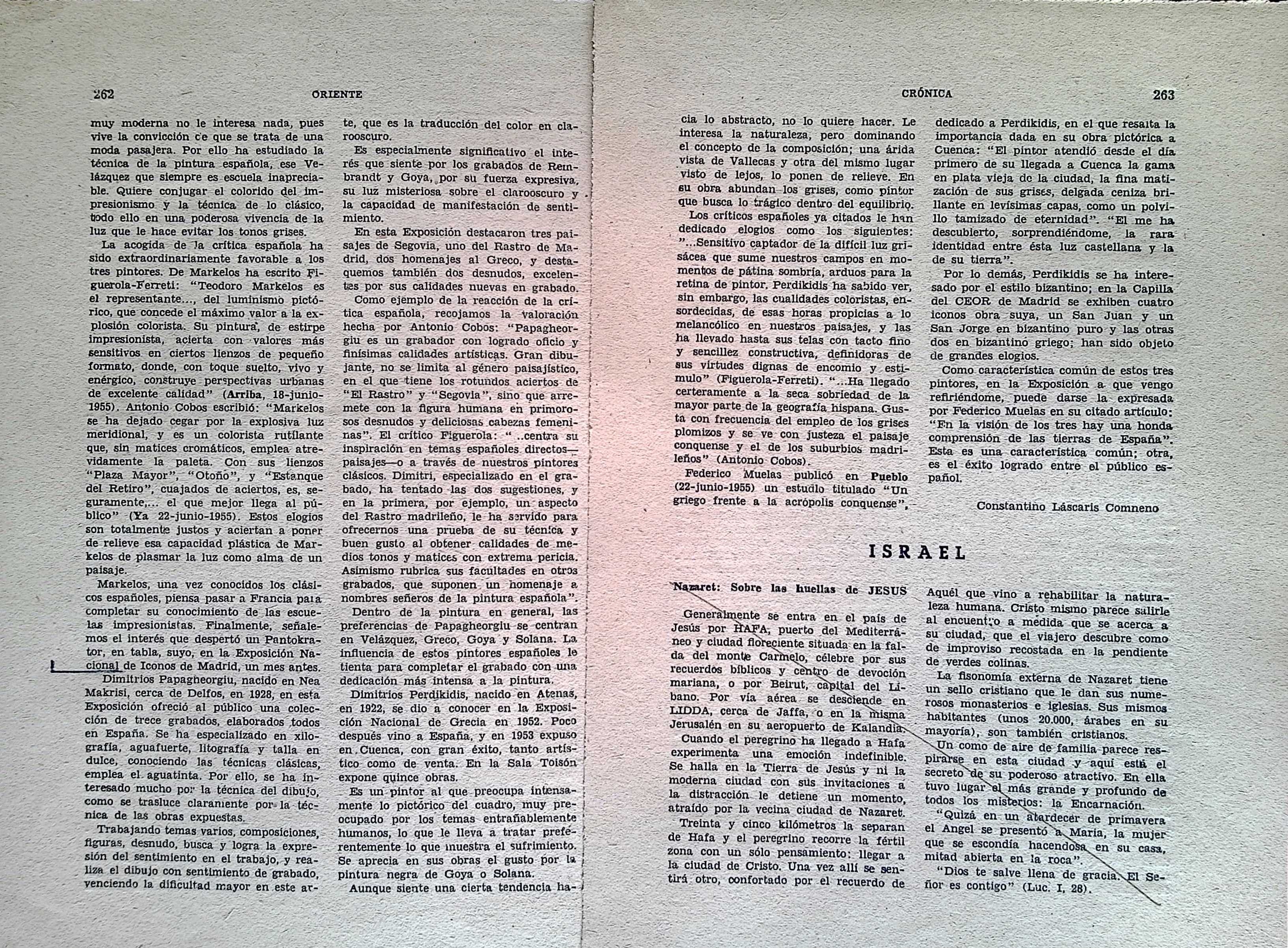
DAWN
The very contemporary does not interest him at all, as he lives with the conviction that it is a passing fashion. For this reason, he has studied the technique of Spanish painting, that of Velázquez, which always constitutes an invaluable school. He wants to combine the color palette of Impressionism with the technique of Classicism, all of which is embodied in a dynamic experience of light, leading him to avoid grayish tones.
The reception by Spanish criticism was extremely favorable toward the three painters. Regarding Markellos, Figuerola-Ferretti wrote: “Theodoros Markellos is the representative... of chromatic lighting, which gives maximum value to explosive colorfulness. His painterly manner, of Impressionist origin, achieves more sensitive nuances in certain small-scale canvases, where, with a free, lively, and active brushstroke, he constructs urban perspectives of exceptional quality” (Arriba, June 18, 1955). Antonio Campos wrote: “Markellos has allowed himself to be blinded by the explosive meridian light and is a brilliant colorist who, without chromatic nuances, boldly uses his palette. With his canvases 'Plaza Mayor', 'Otoño', and 'Estanque del Retiro', full of successes, he is certainly... the one who reaches the public best” (Ya, June 22, 1955). These praises are absolutely fair and succeed in highlighting Markellos’s plastic ability to capture light as the soul of a landscape.
After becoming acquainted with the Spanish classics, Markellos considers moving to France to complete his knowledge of the Impressionist schools. Finally, it is worth noting the interest aroused by his own Pantocrator on a wooden panel at the National Exhibition of Images in Madrid, a month earlier.
Dimitrios Papageorgiou, born in Nea Makri near Delphi in 1928, presented to the public at this Exhibition a collection of thirteen engravings, all executed in Spain. He specialized in woodcut, aquatint, lithography, and sculpture in soft wood; knowing the classical techniques, he uses aquatint. For this reason, he has shown great interest in the technique of drawing, as clearly seen in the technique of the exhibited works.
Working on various themes, compositions, forms, and nudes, he seeks and achieves the expression of emotion in his work, executing the drawing with an engraver’s consciousness, overcoming the greatest difficulty in this art, which is the translation of color into light and dark areas (chiaroscuro).
His preference for the engravings of Rembrandt and Goya is particularly significant, due to their expressive power, their mysterious light on the chiaroscuro, and their ability to convey emotion.
In this Exhibition, three landscapes of Segovia stood out, one from the Rastro in Madrid, two tributes to El Greco, as well as two nudes, remarkable for their new qualities in engraving.
As an example of the reaction of the Spanish criticism, let us mention the assessment made by Antonio Campos: “Papageorgiou is an engraver with successful skill and excellent artistic qualities. A great draftsman, he does not limit himself to the landscape genre, in which he has his decisive successes 'El Rastro' and 'Segovia', but attacks the human form with wonderful nudes and pleasant female heads.” The critic Figuerola: “...he stirs his inspiration on direct Spanish themes—or through our classic painters. Dimitris, specialized in engraving, tried both challenges, and in the first, for example, a view of the Rastro in Madrid, served him to offer us proof of his technique and good taste, achieving qualities of middle tones and shades with excellent skill. Also, he certifies his abilities in other engravings, which constitute a tribute to significant names in Spanish painting.”
In painting in general, Papageorgiou’s preferences focus on Velázquez, El Greco, Goya, and Solana. The influence of these Spanish painters tempts him to complete the engraving with a more intense dedication to painting.
Dimitrios Perdikidis, born in Athens in 1922, became known at the National Exhibition of Greece in 1952. A little later he came to Spain and in 1953 presented works in Cuenca, with great success, both artistic and commercial. In the Toisón hall he exhibits fifteen works.
He is a painter deeply concerned with the pictorial element of the canvas, intensely engaged with profoundly human themes, which leads him to preferentially focus on what reveals pain. In his works, a preference for the dark painting of Goya or Solana is evident.
Although he feels a tendency toward abstraction, he does not pursue it. He is interested in nature, but dominated by the concept of composition; a barren view of the Vaqueira and another of the same place from afar highlight this. Grays dominate his works, as a painter who seeks the tragic within balance.
The Spanish critics mentioned earlier have dedicated eulogies to him, such as: “...A sensitive observer of the difficult gray light that immerses our fields in moments of shadowy patina, challenging for the painter’s retina. Perdikidis, however, managed to see the silent color properties of these hours favorable to melancholy in our landscapes, and has transferred them to his canvases with delicate sensitivity and constructive simplicity, definitive virtues worthy of praise and encouragement” (Figuerola-Ferreti). “...Indeed, he has reached the dry austerity of most of Spanish geography. He often prefers the use of leaden grays, and the landscape of Cuenca and the suburbs of Madrid is seen with precision” (Antonio Campos).
Federico Muelas published a study titled “A Greek Facing the Acropolis of Cuenca” in Pueblo (June 22, 1955),
CHRONICLES
263
dedicated to Perdikidis, in which he highlights the importance given to his pictorial work in Cuenca: “From the first day of his arrival in Cuenca, the painter, facing the city’s palette in old silver, the subtle shade of its grays, a fine ash-like glow in slightly layered tones, like dust passed through the sieve of eternity.” “He revealed to me, with surprise, the rare identity between this Castilian light and the light of his homeland.”
Furthermore, Perdikidis has shown interest in the Byzantine style; four icons of his own creation are exhibited at the CEOR’s Kapnitsa in Madrid, a Saint John and a Saint George in pure Byzantine style, and the other two in Greek-Byzantine style; they have received high praise.
A common characteristic of these three painters, in the exhibition I am referring to, can be described as what was expressed by Federico Muelas in the aforementioned article: “In the vision of the three, there is a deep understanding of the lands of Spain.” This is one shared trait; another is the success they achieved among the Spanish public.
Konstantinos Laskaris Komnenos
ISRAEL
Nazareth: In the Footsteps of JESUS
Generally, visitors enter the land of Jesus through Haifa, a Mediterranean port and prosperous city located at the foot of Mount Carmel, famous for its biblical memories and as a center of Marian devotion, or through Beirut, the capital of Lebanon. By air, they descend into Lydda, near Jaffa, or directly into Jerusalem, at the Qalandia airport.
When the pilgrim arrives in Haifa, they experience an indescribable emotion. They are in the Land of Jesus, and neither the modern city with its invitations for entertainment stops them for a moment, as they are drawn to the nearby city of Nazareth.
Thirty-five kilometers separate it from Haifa, and the pilgrim crosses the fertile region with only one thought: to reach the city of Christ. Upon arrival, they will feel different, comforted by the memory of Him who came to restore human nature. Christ Himself seems to come out to meet them as they approach His city, which the traveler discovers as if by magic, resting on the slope of green hills.
The external appearance of Nazareth bears a Christian stamp given by the many monasteries and churches. Its inhabitants (approximately 20,000, mostly Arabs) are also Christians.
An atmosphere of familial warmth seems to permeate this city, and here lies the secret of its strong appeal. Here took place the greatest and deepest of all mysteries: the Incarnation.
“Perhaps at a spring sunset, the Angel appeared to Mary, the woman who hid laboriously in her home, half-open to the rock.”
“Hail, full of grace. The Lord is with you” (Luke 1:28).
← View all 679 archival documents · Biography of Theodoros Markellos