
Review of Theod. Markellos exhibition in Avgi newspaper (1958)
Press Clipping
— 1958
ΑΥΓΗ , Αθήνα
'AUGI' 27 Feb. 1958
VISUAL ARTS
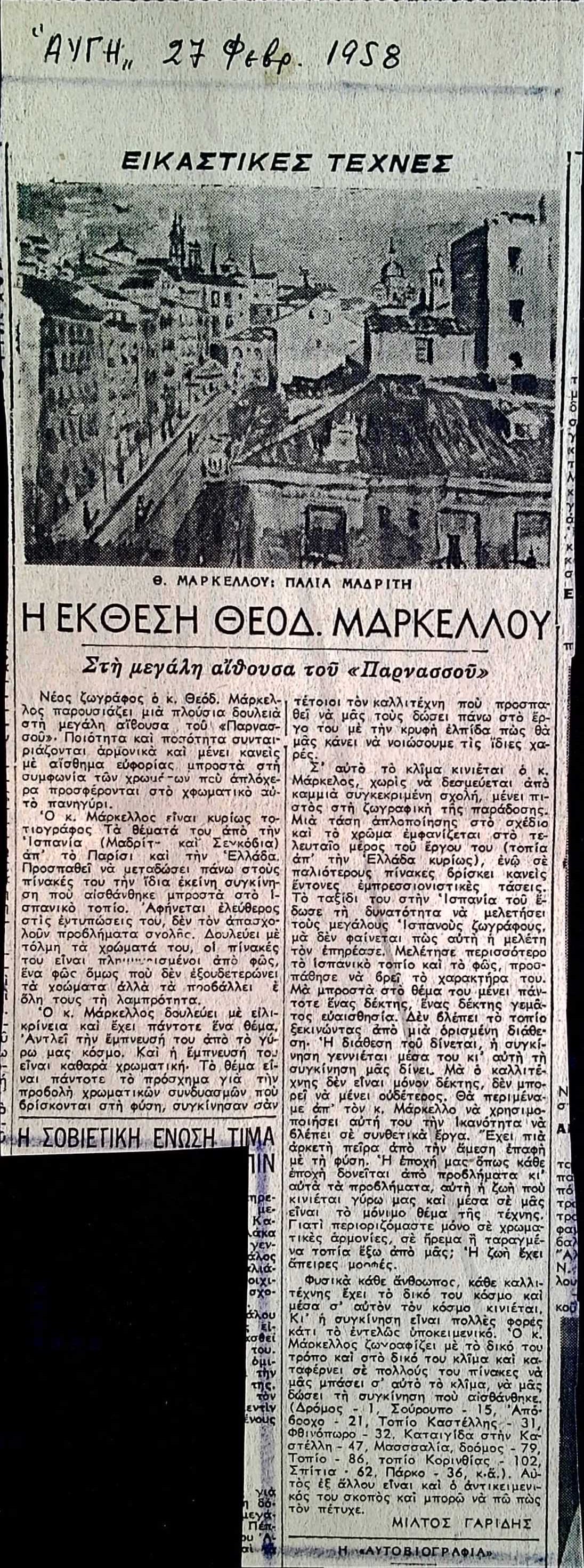
TH. MARKELOS: OLD MADRID
THE EXHIBITION OF THEOD. MARKELOS
In the large hall of "Parnassos"
The young painter Mr. Theod. Markellos presents a rich body of work in the large hall of "Parnassos". Quality and quantity harmonize perfectly, leaving one with a sense of euphoria before the harmony of colors generously offered in this earthy festival.
Mr. Markellos is primarily a landscape painter. His subjects come from Spain (Madrid and Seville), Paris, and Greece. He strives to convey onto his canvases the very same emotion he felt before the Spanish landscape. He surrenders freely to his impressions, unconcerned with school-related problems. He handles his colors boldly; his paintings are filled with light, yet a light that does not neutralize the colors but rather highlights them in all their brilliance.
Mr. Markellos works with sincerity and always has a subject. He draws his inspiration from the world around us. And his inspiration is purely chromatic. The subject is always the pretext for showcasing color combinations found in nature, which moved the artist as such, and he tries to give them to us through his work with the hidden hope that they will make us feel the same joys.
In this atmosphere moves Mr. Markellos, unbound by any specific school, remaining faithful to the painting of tradition. A tendency toward simplification in design and color appears in the later part of his work (mainly landscapes from Greece), whereas in earlier paintings one finds strong impressionistic tendencies. His trip to Spain gave him the opportunity to study the great Spanish painters, but it does not seem that this study influenced him. He studied the Spanish landscape and light more, attempting to capture its character. But before his subject, he always remains a receiver, a receiver full of sensitivity. He does not view the landscape starting from a predetermined mood. His mood is given, the emotion is born within him, and he gives us this emotion. But the artist is not only a receiver; he cannot remain neutral. We would expect Mr. Markellos to use this ability of his to see in synthetic works. He already has sufficient experience from direct contact with nature. Our era, like every era, is shaken by problems, and these problems, this life that
It moves around us and within us;
it is the permanent theme of art.
Why do we limit ourselves only to color
harmonies, to calm or turbulent
landscapes outside of us? Life has
infinite forms.
Physically, every person, every artist
has their own world and moves
within that world. And emotion is often
something entirely subjective. Mr.
Markellos paints in his own
way and in his own atmosphere, and
manages in many of his paintings to
immerse us in that atmosphere, to give
us the emotion he felt.
(Road - 1, Dusk - 15, Paved Road - 21,
Kastelli Landscape - 31,
Autumn - 32, Storm in Kas-
telli - 47, Marseille, road - 79,
Landscape - 86, Corinthia landscape - 102,
Houses - 62, Park - 36, etc.). This
is also his objective goal elsewhere, and I can say that
he achieved it.
MILTO GARIDIS
THE "AUTOBIOGRAPHY"
VISUAL ARTS
TH. MARKELOS: OLD MADRID
THE EXHIBITION OF THEOD. MARKELOS
In the large hall of "Parnassos"
The young painter Mr. Theod. Markellos presents a rich body of work in the large hall of "Parnassos". Quality and quantity harmonize perfectly, leaving one with a sense of euphoria before the harmony of colors generously offered in this earthy festival.
Mr. Markellos is primarily a landscape painter. His subjects come from Spain (Madrid and Seville), Paris, and Greece. He strives to convey onto his canvases the very same emotion he felt before the Spanish landscape. He surrenders freely to his impressions, unconcerned with school-related problems. He handles his colors boldly; his paintings are filled with light, yet a light that does not neutralize the colors but rather highlights them in all their brilliance.
Mr. Markellos works with sincerity and always has a subject. He draws his inspiration from the world around us. And his inspiration is purely chromatic. The subject is always the pretext for showcasing color combinations found in nature, which moved the artist as such, and he tries to give them to us through his work with the hidden hope that they will make us feel the same joys.
In this atmosphere moves Mr. Markellos, unbound by any specific school, remaining faithful to the painting of tradition. A tendency toward simplification in design and color appears in the later part of his work (mainly landscapes from Greece), whereas in earlier paintings one finds strong impressionistic tendencies. His trip to Spain gave him the opportunity to study the great Spanish painters, but it does not seem that this study influenced him. He studied the Spanish landscape and light more, attempting to capture its character. But before his subject, he always remains a receiver, a receiver full of sensitivity. He does not view the landscape starting from a predetermined mood. His mood is given, the emotion is born within him, and he gives us this emotion. But the artist is not only a receiver; he cannot remain neutral. We would expect Mr. Markellos to use this ability of his to see in synthetic works. He already has sufficient experience from direct contact with nature. Our era, like every era, is shaken by problems, and these problems, this life that
It moves around us and within us;
it is the permanent theme of art.
Why do we limit ourselves only to color
harmonies, to calm or turbulent
landscapes outside of us? Life has
infinite forms.
Physically, every person, every artist
has their own world and moves
within that world. And emotion is often
something entirely subjective. Mr.
Markellos paints in his own
way and in his own atmosphere, and
manages in many of his paintings to
immerse us in that atmosphere, to give
us the emotion he felt.
(Road - 1, Dusk - 15, Paved Road - 21,
Kastelli Landscape - 31,
Autumn - 32, Storm in Kas-
telli - 47, Marseille, road - 79,
Landscape - 86, Corinthia landscape - 102,
Houses - 62, Park - 36, etc.). This
is also his objective goal elsewhere, and I can say that
he achieved it.
MILTO GARIDIS
THE "AUTOBIOGRAPHY"
← View all 679 archival documents · Biography of Theodoros Markellos