
Ellinikos Vorras: Critique of young painters exhibition and theater, 1957
Press Clipping
— 1958
ΕΛΛΗΝΙΚΟΣ ΒΟΡΡΑΣ , Θεσσαλονίκη
“GREEK NORTH”
25 DEC. 1957
GREEK AND FOREIGN ART
“A Japanese painter had celebrated his centenary since his birth, and when one of his dinner companions asked him if he was satisfied with the results of his labor and study over the past hundred years, he answered with some expression of discouragement that not only was he not satisfied with the outcomes of a century of study devoted to painting, but if he could obtain from God a loan of another hundred years, then he could say that he had entered the meaning of true creation and could capture with his palette the idealization of beauty. And what is beauty? According to the prevailing opinion, it is the phenomenon that satisfies our aesthetic faculty. And what is aesthetic faculty? It is the inner sense that creates the judgment for the quality of the artistic rendering of an art object, whether it copies a natural object or idealizes it, or creates a color harmony without an object to evoke emotion in the spirit, the eye, or the soul of the viewer (abstractionism). And when I see a portrait with double technical skill and rendering in shape, expression, and composition, I experience an emotion, because my aesthetic faculty is satisfied and simultaneously my judgment finds satisfaction to immediately express my admiration for the artist for the ability that the Highest bestowed upon him to render the object in its entirety and give me the illusion of reality or the impression of idealization. When I see a polymorphic composition, I additionally appreciate the painter’s imagination. But when I see the painting from the exhibition of young painters under no. 37, which the painter Mr. Mavridis titled “bird,” an immediate reaction arises in my aesthetic senses, because the artist does not tell me: spill ink or color on a prepared background and name it the emotion of the moment and hang it with hooks—but rather limits my imagination to a specific object, in this case, telling me that I, the viewer, must reconstruct the image of the bird in this mess. So must I stop seeing the bird as Nature created it, or must I stop seeing Mr. Mavridis’s painting as a bird, thereby committing disobedience to the painter’s commands,”
Whoever has distanced himself from the natural object through his palette in an arbitrary manner, invokes Nature in his title as a panacea, because the perceptible world surrounding him is depressingly the source of all inspiration, whether it be an object, a feeling, an idea, an inspiration, a sound, or a representation.
But to return to the Japanese painter, the host asked him whether a tailor could become an orator, or a barber a surgeon, or a sun solve higher algebraic problems, and naturally, he answered no. He also asked him whether a common mortal could paint the Assumption of the Virgin by El Greco, or the Sistine Chapel by Michelangelo, or
NOTE BY PAINTER K. SALTA ON THE EXHIBITION OF THE 32 YOUNG PAINTERS. — THE NEW WORK OF THE ALEXANDRAKI TROUPE. — THE KALIS KALO TROUPE CONTINUES ITS PERFORMANCES. — WHAT THE THESSALONIKI THEATER IS PREPARING. — THE SUCCESSES OF TENOR PAKONSTANTINOU
THE LATEST NEWS OF THE GREEK CINEMA
the Feast by Giorgione, he likewise answered no. Also, whether a twenty-something so-called "modern" painter could overturn the fabric of human aesthetic capacity and force us to admit that he has revealed the painting of heroic delirium, the Japanese painter answered no. No, he answered when asked if he could overturn the concept of greatness enclosed by Egyptian art, the classical art of Greek antiquity, up to the painting of Maurice Goya, or Titian, or Raphael, or Sebastiano del Piombo.
Another hall without even having hung it. And it is perhaps the best work among several other good ones, or among the 83 works. So, should no one weep for the plight of the new generation of our modern painters? Should no one wonder what this pitiful exploitation of Art will bring us, which deserves to stand as the starting point of a New Renaissance of a new Cosmogony in Art and a liberation from the anguish of nervousness that grips today's humanity?".
THE FIFTH WORK
OF THE ALEXANDRAKI TROUPE
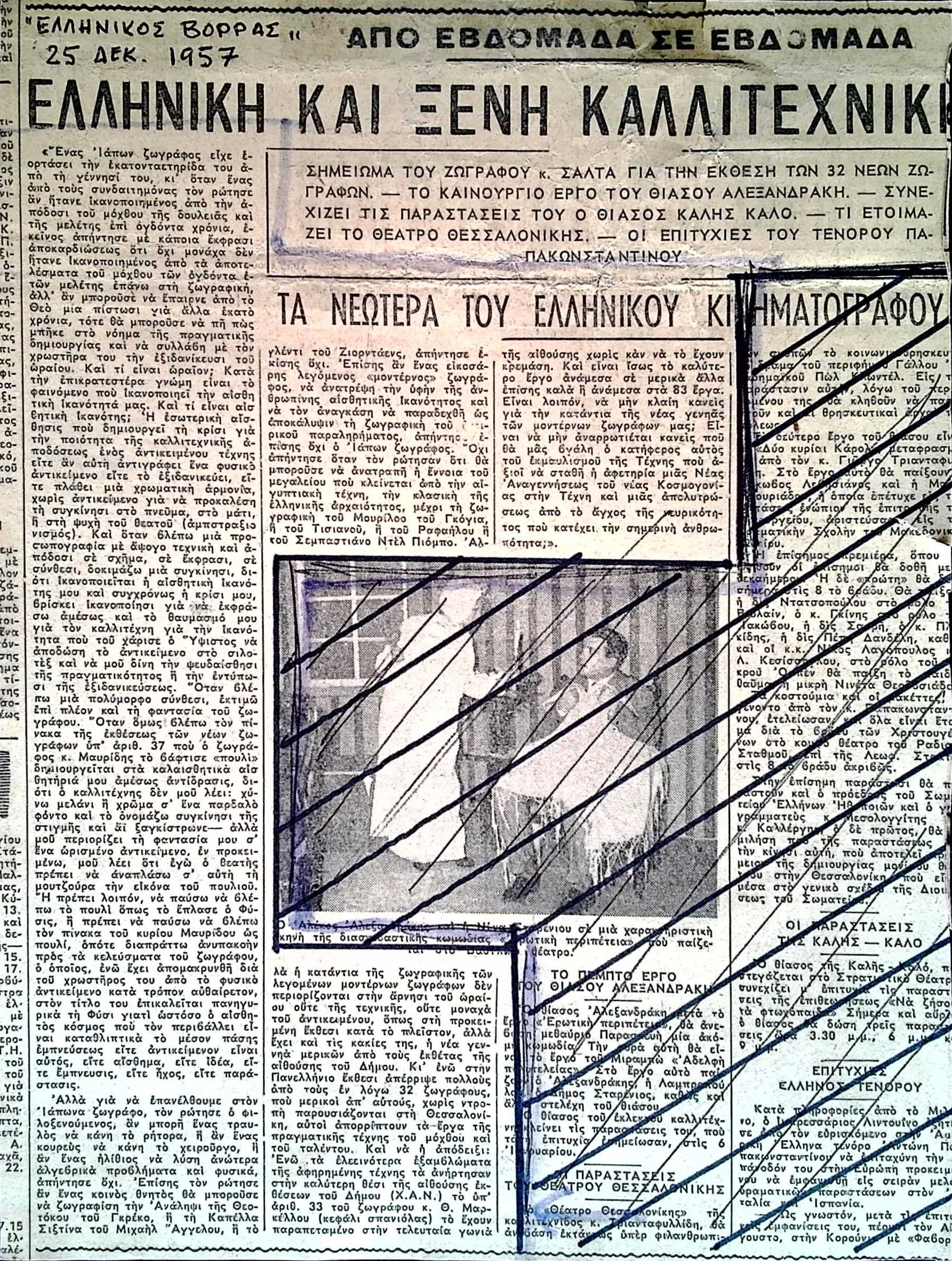
The Alexandraki Troupe, after the work "Erotic Adventure," will stage a new comedy this coming Friday. At this time, the work will be Mirabeau's "Sister of Perfection." In this work, painter Starenios, Kalis, and other members of the troupe perform.
The company of the distinguished artist concludes its performances, which have been met with unbroken success, on June 6.
THE PERFORMANCES
OF THE THESSALONIKI THEATRE
The “Thessaloniki Theatre” of artist Mr. Triantafyllidis will stage an extraordinary performance for charitable purposes.
THE PERFORMANCES
OF KALI — KALO
The company of Kali — Kalo, housed at the Military Theatre, continues its successful run of the play “Let the Poor Children Live.” Today and tomorrow, the company will give three performances at 3:30 p.m., 6 p.m., and 9 p.m.
SUCCESS OF A GREEK TENOR
According to information from Milan, impresario Aindonio has invited the Greek tenor Antonis Popakonstantinou, currently based in America, to extend his tour in Europe in order to appear in a series of dramatic performances in Italy and Spain.
Alekos Alexandrakis and Nika Tsarenio in a characteristic scene of the adapted comedy “Erotic Adventure,” which is being performed at the Royal Theatre.
← View all 679 archival documents · Biography of Theodoros Markellos