
Review of the 1st Exhibition of Corinthian Artists (1960)
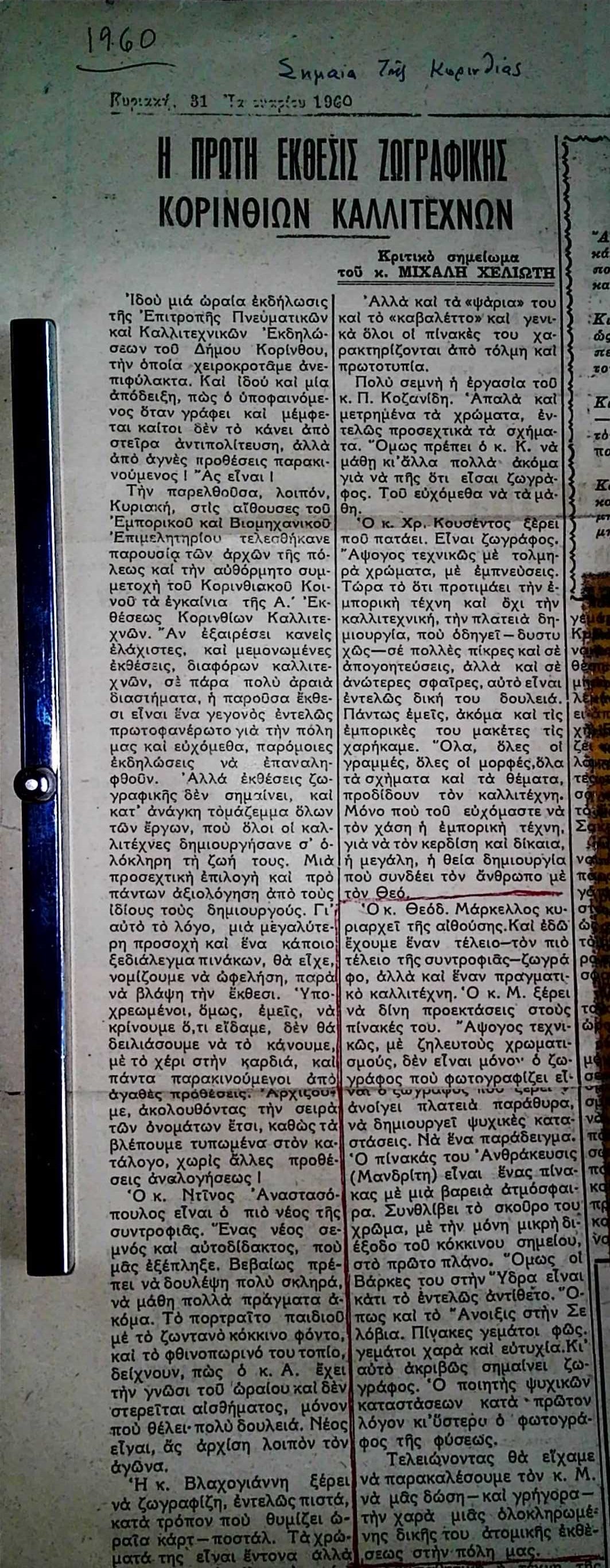
Press Clipping
— 1960
Συμαία Τού Κυρινδίας , Κόρινθος
1960
Symaia of Kyrintias
Sunday, 31 March 1960
THE FIRST EXHIBITION OF PAINTING
BY CORINTHIAN ARTISTS
Critical Note
by Mr. Michalis Cheliotis
Here is a beautiful exhibition by the Committee for Intellectual and Artistic Events of the Municipality of Corinth, which we applaud unreservedly. And here is also proof that the undersigned, when writing and criticizing, does not do so out of sterile opposition, but is driven by pure intentions! So be it.
Thus, last Sunday, in the halls of the Chamber of Commerce and Industry, the inauguration of the 1st Exhibition of Corinthian Artists took place in the presence of the city authorities and with the enthusiastic participation of the Corinthian public. If one excludes a few isolated exhibitions by various artists at very rare intervals, the present exhibition is a completely unprecedented event for our city, and we hope that similar exhibitions will be repeated. However, a painting exhibition does not necessarily mean a collection of all the works that the artists have created throughout their lives. A careful selection and, above all, evaluation by the creators themselves. For this reason, we believe that greater attention and some curation of the paintings would have benefited rather than harmed the exhibition. Nevertheless, being obliged to judge what we saw, we will not hesitate to do so, with a hand on our heart, and always motivated by good intentions: We begin, following the order of names as they appear printed in the catalog, without any other intentions of selection!
Mr. Dinos Anastasopoulos is the youngest of the group. A young, modest, and self-taught artist who surprised us. Of course, he must work very hard and learn many more things. The portrait of a child with vivid red light and his autumn landscape show that Mr. A. has a sense of beauty and is not devoid of feeling; he just needs a lot of work. He is young, so let him begin the struggle.
Mrs. Blachogianni knows how to paint, completely faithfully, in a manner reminiscent of beautiful postcards. Her colors are intense, but
And his "fish" and his "easel," and generally all his paintings, are characterized by boldness and originality.
The work of Mr. P. Kozanidis is very modest. The colors are soft and measured, the shapes entirely careful. However, Mr. K. must learn many more things before one can say that you are a painter. We wish him well in learning them.
Mr. Ch. Kousentos knows exactly what he is doing. He is a painter. A flawless technician with bold colors and inspiration. The fact that he prefers commercial art over artistic creation—the broad, open-ended kind that unfortunately leads to many sorrows and disappointments, but also to other spheres—is entirely his own choice. Nevertheless, we have even enjoyed his commercial mock-ups. Everything—all the lines, all the forms, all the shapes and subjects—betrays the artist. We only wish that he might abandon commercial art so that he may rightfully win the great, divine creation that connects man with God.
Mr. Theod. Markellos dominates the gallery. Here we have a perfect—indeed, the most perfect among our peers—painter, but also a true artist. Mr. M. knows how to give depth to his canvases. A flawless technician with enviable color palettes, he is not merely a painter who photographs reality, but one who knows how to open wide windows, to create psychological states. Take an example. The painting “Anthrakousis (Mandritis)” is a work with a heavy atmosphere. It crushes with its dark color, offering only a small exit through a red spot in the foreground. However, his “Boats in Hydra” are something entirely different. So are “The Sea” and “Spring in Seldia.” Paintings full of light, full of joy and happiness. And this precisely means being a painter. First and foremost, a poet of psychological states, and only secondarily a photographer of nature.
In conclusion, we would like to ask Mr. M. to give us—soon—the joy of a complete, fair individual exhibition of his work in our city.
← View all 679 archival documents · Biography of Theodoros Markellos