
Interview with Theodoros Markellos in ETHNOS (1967)
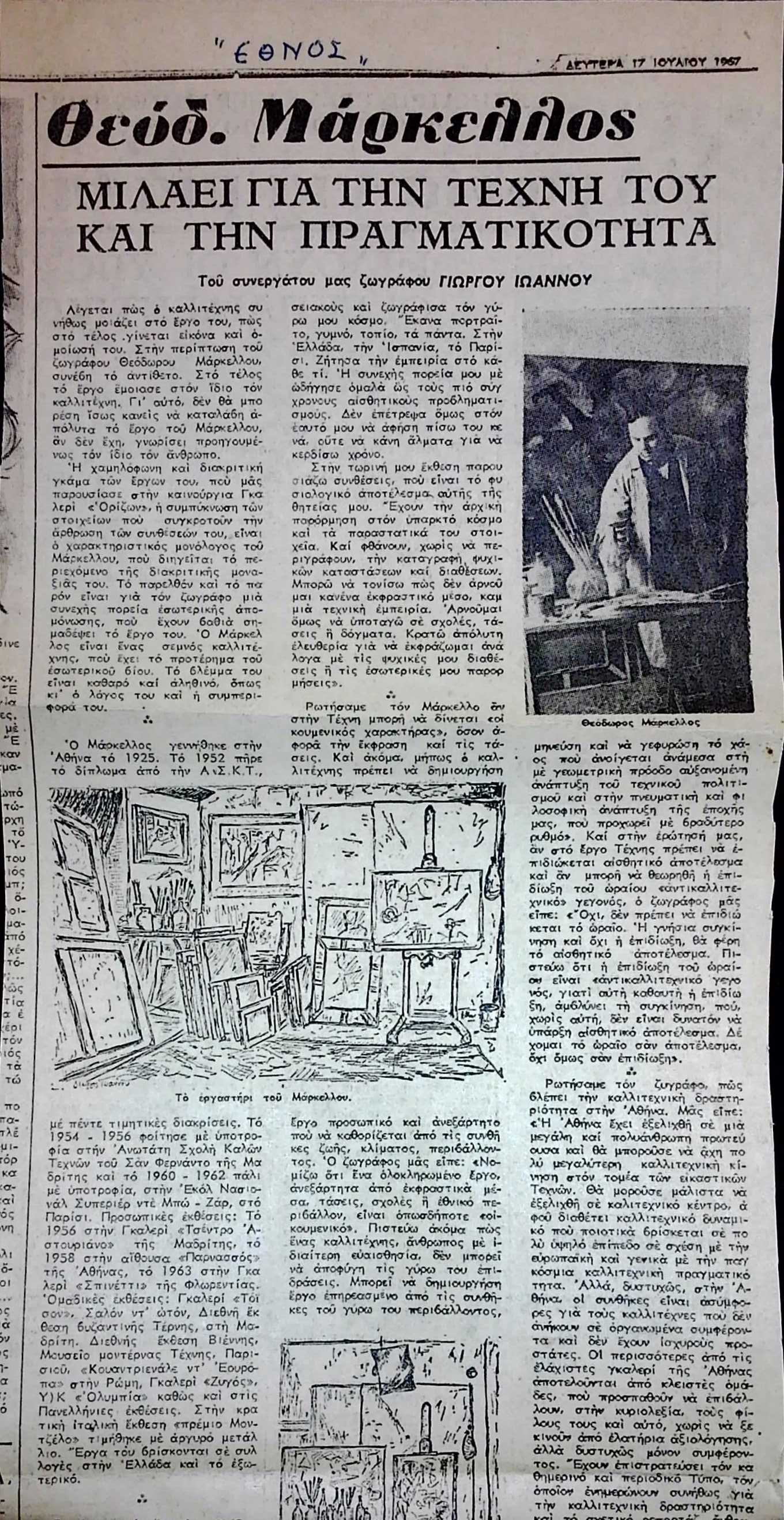
Press Clipping
— 1967
ΕΘΝΟΣ , Αθήνα
"NATION"
MONDAY, JULY 17, 1967
Theod. Markellos
SPEAKS ABOUT HIS ART
AND REALITY
By our collaborator, painter YIORGOS IOANNOU
It is said that the artist usually resembles his work, that in the end he becomes an image and imitation of it. In the case of painter Theodoros Markellos, the opposite occurred. In the end, the work came to resemble the artist himself. For this reason, perhaps no one will be able to fully understand Markellos’s work without having previously gotten to know the man himself.
The low-key and discreet tone of his works, which he presented at the new Gallery "Orizon," and the condensation of the elements that form the structure of his compositions, constitute Markellos’s characteristic monologue, narrating the content of his discreet solitude. For the painter, the past and the present are a continuous path of internal isolation, which holds deep significance in his work. Markellos is a modest artist who possesses the advantage of inner peace. His gaze is clear and gentle, as is his speech and behavior.
Markellos was born in Athens in 1925. In 1952, he received his diploma from the Athens School of Fine Arts (A.S.K.T.),
Markellos’s studio.
with five honorary distinctions. From 1954 to 1956, he studied on a scholarship at the Royal Academy of Fine Arts of San Fernando in Madrid, and from 1960 to 1962, again on a scholarship, at the École Nationale Supérieure des Beaux-Arts in Paris. Solo exhibitions: In 1956 at the Gallery "Centro Asturiano" in Madrid, in 1958 at the "Parnassos" hall in Athens, in 1963 at the Gallery "Spinetti" in Florence. Group exhibitions: Gallery "Toison," Salon d'Automne, International Exhibition of Dissenting Artists in Terni, Madrid. International Exhibition in Vienna, Museum of Modern Art, Paris. "Quadriennale d'Europa" in Rome, Gallery "Zygos," Cultural Center "Olympia," as well as at the official Italian exhibition "Premio Montiglio," where he was awarded a silver medal. His works are held in collections in Greece and abroad.
shocks, and I painted the world around me. I did portraits, nudes, landscapes, everything. In Greece, Spain, Paris. I sought experience in everything. My continuous progress smoothly led me to the most contemporary aesthetic problems. However, I did not allow myself to leave gaps behind, nor to make leaps to save time.
In my current exhibition, I present compositions that are the natural result of this period of my career. They draw their initial impulse from the real world and its representational elements. And they reach, without describing, the recording of mental states and moods. I can emphasize that I do not deny any expressive means, any technical experience. However, I refuse to submit to schools, theories, or dogmas. I maintain absolute freedom to express myself according to my mental dispositions or my inner impulses.
We asked Markellos whether art can have a communal character, beyond expression and moods. And furthermore, whether the artist should create
Theodoros Markellos
a bridge and span the gap that opens between the geometric progress and increasing development of technical civilization and the spiritual and philosophical development of our era, which proceeds at a slower pace. And in our question, whether aesthetic results should be sought in the Work of Art and whether the pursuit of the sublime can be considered an "anti-artistic" fact, the painter told us: "No, the sublime should not be pursued. Genuine emotion, and not pursuit, will bring the aesthetic result. I believe that the pursuit of the sublime, because this pursuit itself neglects emotion, without which it is impossible for an aesthetic result to exist. I accept the sublime as a result, but not as a pursuit."
We asked the painter how he views artistic activity in Athens. He told us: "Athens has developed into a large and populous capital and could have a much larger artistic movement in the field of Visual Arts. It could even develop into an artistic dynamic that is qualitatively at a very high level in relation to European and generally global artistic reality. But, unfortunately, in Athens the conditions are unfavorable for artists who do not belong to organized interests and do not have strong protectors. Most of the few galleries in Athens consist of closed circles, which try to literally impose their friends, and this, without starting from criteria of evaluation, but unfortunately only of interest. They have enlisted the daily and periodical press, which they inform with
MONDAY, JULY 17, 1967
Theod. Markellos
SPEAKS ABOUT HIS ART
AND REALITY
By our collaborator, painter YIORGOS IOANNOU
It is said that the artist usually resembles his work, that in the end he becomes an image and imitation of it. In the case of painter Theodoros Markellos, the opposite occurred. In the end, the work came to resemble the artist himself. For this reason, perhaps no one will be able to fully understand Markellos’s work without having previously gotten to know the man himself.
The low-key and discreet tone of his works, which he presented at the new Gallery "Orizon," and the condensation of the elements that form the structure of his compositions, constitute Markellos’s characteristic monologue, narrating the content of his discreet solitude. For the painter, the past and the present are a continuous path of internal isolation, which holds deep significance in his work. Markellos is a modest artist who possesses the advantage of inner peace. His gaze is clear and gentle, as is his speech and behavior.
Markellos was born in Athens in 1925. In 1952, he received his diploma from the Athens School of Fine Arts (A.S.K.T.),
Markellos’s studio.
with five honorary distinctions. From 1954 to 1956, he studied on a scholarship at the Royal Academy of Fine Arts of San Fernando in Madrid, and from 1960 to 1962, again on a scholarship, at the École Nationale Supérieure des Beaux-Arts in Paris. Solo exhibitions: In 1956 at the Gallery "Centro Asturiano" in Madrid, in 1958 at the "Parnassos" hall in Athens, in 1963 at the Gallery "Spinetti" in Florence. Group exhibitions: Gallery "Toison," Salon d'Automne, International Exhibition of Dissenting Artists in Terni, Madrid. International Exhibition in Vienna, Museum of Modern Art, Paris. "Quadriennale d'Europa" in Rome, Gallery "Zygos," Cultural Center "Olympia," as well as at the official Italian exhibition "Premio Montiglio," where he was awarded a silver medal. His works are held in collections in Greece and abroad.
shocks, and I painted the world around me. I did portraits, nudes, landscapes, everything. In Greece, Spain, Paris. I sought experience in everything. My continuous progress smoothly led me to the most contemporary aesthetic problems. However, I did not allow myself to leave gaps behind, nor to make leaps to save time.
In my current exhibition, I present compositions that are the natural result of this period of my career. They draw their initial impulse from the real world and its representational elements. And they reach, without describing, the recording of mental states and moods. I can emphasize that I do not deny any expressive means, any technical experience. However, I refuse to submit to schools, theories, or dogmas. I maintain absolute freedom to express myself according to my mental dispositions or my inner impulses.
We asked Markellos whether art can have a communal character, beyond expression and moods. And furthermore, whether the artist should create
Theodoros Markellos
a bridge and span the gap that opens between the geometric progress and increasing development of technical civilization and the spiritual and philosophical development of our era, which proceeds at a slower pace. And in our question, whether aesthetic results should be sought in the Work of Art and whether the pursuit of the sublime can be considered an "anti-artistic" fact, the painter told us: "No, the sublime should not be pursued. Genuine emotion, and not pursuit, will bring the aesthetic result. I believe that the pursuit of the sublime, because this pursuit itself neglects emotion, without which it is impossible for an aesthetic result to exist. I accept the sublime as a result, but not as a pursuit."
We asked the painter how he views artistic activity in Athens. He told us: "Athens has developed into a large and populous capital and could have a much larger artistic movement in the field of Visual Arts. It could even develop into an artistic dynamic that is qualitatively at a very high level in relation to European and generally global artistic reality. But, unfortunately, in Athens the conditions are unfavorable for artists who do not belong to organized interests and do not have strong protectors. Most of the few galleries in Athens consist of closed circles, which try to literally impose their friends, and this, without starting from criteria of evaluation, but unfortunately only of interest. They have enlisted the daily and periodical press, which they inform with
← View all 679 archival documents · Biography of Theodoros Markellos