
Review of Theodoros Markellos exhibition by Nikos Alexiou (1967)
Press Clipping
— 1967
Νίκος Αλεξίου
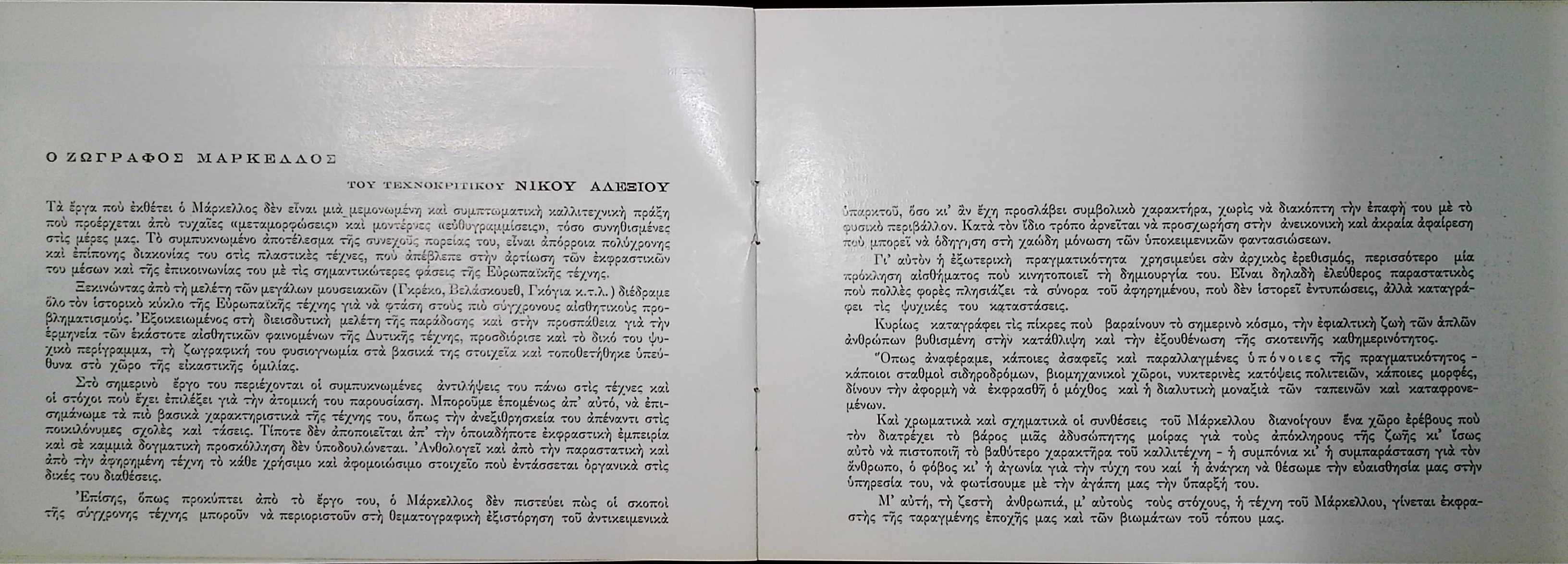
THE PAINTER MARKELOS
BY ART CRITIC NIKOS ALEXIOU
The works exhibited by Markellos are not an isolated and accidental artistic act stemming from random "transformations" and modern "alignments," so common in our times. The condensed result of his continuous journey is the outcome of his long and arduous service to the plastic arts, aimed at refining his expressive means and his communication with the most significant phases of European art.
Starting from the study of the great museum masters (Greco, Velázquez, Goya, etc.), he traversed the entire historical cycle of European art to reach the most contemporary aesthetic concerns. Familiar with the penetrating study of tradition and the effort to interpret the aesthetic phenomena of Western art at each stage, he defined his own psychological profile, the physiognomy of his painting in its basic elements, and responsibly positioned himself within the space of visual discourse.
His current work contains his condensed perceptions of art and the goals he has chosen for his individual presentation. We can therefore highlight the most essential characteristics of his art, such as his non-dogmatism towards various schools and trends. He does not renounce any expressive experience, nor does he submit to any dogmatic attachment. He anthologizes every useful and assimilable element from both representational and abstract art that organically fits into his own dispositions.
Furthermore, as evident from his work, Markellos does not believe that the aims of contemporary art can be limited to the thematic narration of the objectively existing, however symbolic it may have become, without breaking contact with the natural environment. In the same way, he refuses to adhere to non-figurative and extreme abstraction that could lead to the chaotic isolation of subjective fantasies.
For him, external reality serves as an initial stimulus, more of a challenge to emotion that mobilizes his creation. He is, in other words, a free representational artist who often approaches the borders of abstraction, one who does not narrate impressions but records his psychological states.
He primarily records the sorrows that weigh upon today's world, the nightmare life of ordinary people
immersed in the depression and exhaustion of a dark everyday life.
As we have mentioned, certain vague and altered implications of reality—
some railway stations, industrial areas, night views of cities, certain figures—
provide the occasion to express the toil and dissolving loneliness of the humble and despised.
Both chromatically and formally, Markellos’s compositions open up a space of darkness
traversed by the weight of an unrelenting fate for the outcasts of life, and perhaps
this confirms the deepest character of the artist—compassion and solidarity with
humanity, fear and anxiety for their fate, and the need to place our sensitivity
at their service, to illuminate their existence with our love.
With this, with warm humanity, with these goals, Markellos’s art becomes an
expression of our troubled era and the experiences of our land.
← View all 679 archival documents · Biography of Theodoros Markellos