
Theodore Markellos Exhibition Catalog 1967
Exhibition Material
— 1967
Dimitris Lamprinopoulos , Athens
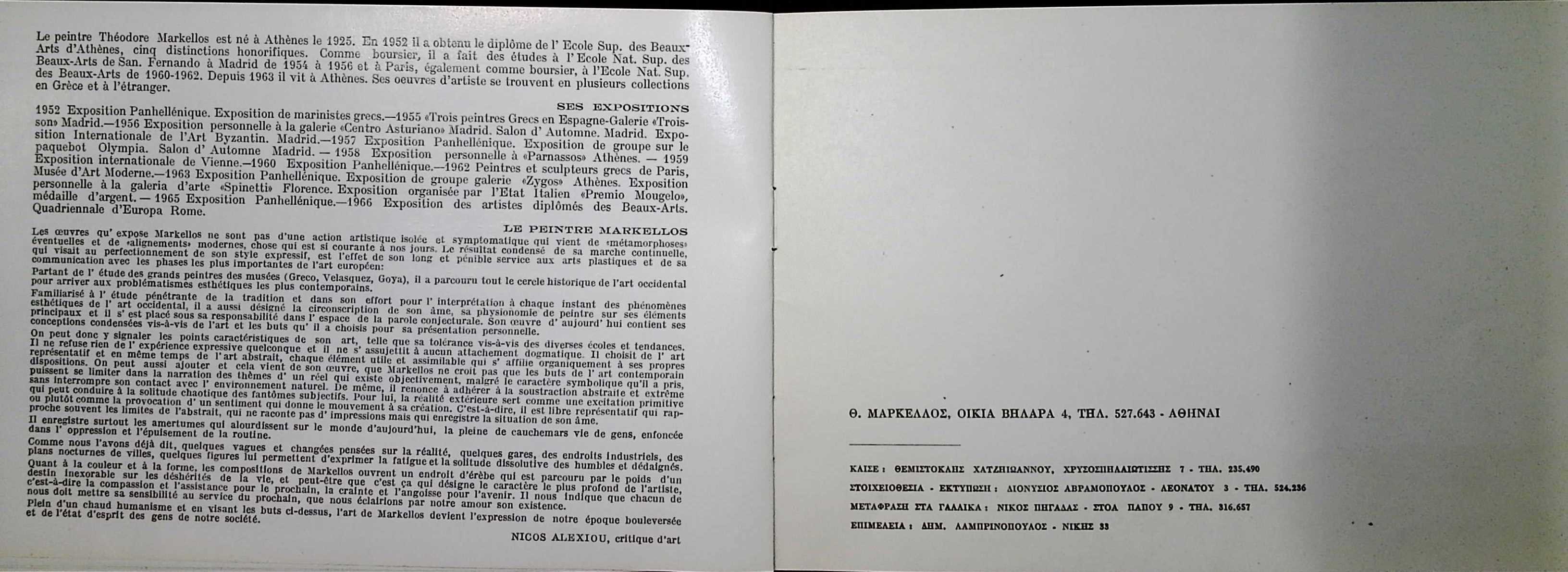
The painter Theodoros Markellos was born in Athens in 1925. In 1952, he graduated from the Athens School of Fine Arts with five honorary distinctions. As a scholarship recipient, he studied at the Royal Academy of Fine Arts of San Fernando in Madrid from 1954 to 1956 and in Paris, also as a scholarship recipient, at the Royal Academy of Fine Arts from 1960 to 1962. He has resided in Athens since 1963. His works are held in various collections in Greece and abroad.
HIS PUBLICATIONS
1952 Panhellenic Exhibition. Exhibition of Greek Seascapes.—1955 “Three Greek Painters in Spain,” Galerie “Trois-son,” Madrid.—1956 Solo exhibition at Galerie “Centro Asturiano,” Madrid. Autumn Exhibition. Madrid. International Exhibition of Byzantine Art. Madrid.—1957 Panhellenic Exhibition. Group exhibition on the ship Olympia. Autumn Exhibition, Madrid.—1958 Panhellenic Exhibition.—1959 International Exhibition of Vienna.—1960 Panhellenic Exhibition.—1962 Greek Painters and Sculptors in Paris, Museum of Modern Art.—1963 Panhellenic Exhibition. Group exhibition at Galerie “Zygos,” Athens. Solo exhibition at Galerie “Spinetti,” Florence. Exhibition organized by the Italian State “Premio Mougelo,” silver medal.—1965 Panhellenic Exhibition.—1966 Exhibition of Academy of Fine Arts Graduates. Quadrennial Exhibition of Europe, Rome.
THE PAINTER MARKELOS
The works exhibited by Markellos are not the result of an isolated and characteristic artistic act stemming from possible “transformations” and contemporary “alignments,” something so common in our days. The condensed outcome of his continuous journey, aimed at perfecting his expressive style, is the result of his long and arduous dedication to the visual arts and his engagement with the most significant phases of European art:
Starting from the study of the great painters in the museums (El Greco, Velázquez, Goya), he traversed the entire historical cycle of Western art to reach the most contemporary aesthetic problems.
Familiar with the sparse study of tradition and in his effort to interpret every moment of the aesthetic phenomena of Western art, he also defined the boundaries of his soul, the physiognomy of his painting in its basic elements, and placed himself under responsibility in the space of hypothetical discourse. His work today contains his condensed perceptions regarding art and the goals he has chosen for his personal presentation.
Therefore, we can highlight the characteristic points of his art, such as his tolerance towards various schools and trends. He does not deny any experience of expression and does not submit to any dogmatic attachment. He selects from representational art and simultaneously from abstract art, every useful and absorbable element that organically fits into his own predispositions. We can also add, and this emerges from his work, that Markellos does not believe that the goals of contemporary art can be limited to the narration of themes of a reality that exists objectively, despite the symbolic character it has taken, which can lead to the chaotic loneliness of subjective phantoms. Similarly, he rejects attachment to extreme abstract abstraction or rather as a challenge of a feeling that gives motion to his creation. That is, he is a free representational artist who often approaches the boundaries of the abstract, who does not narrate impressions but records the state of his soul.
He mainly records the bitternesses that weigh on the world today, the nightmare-filled life of people, who are trapped in oppression and the exhaustion of routine.
As we have already mentioned, some vague and changing thoughts about reality, some stations, industrial spaces, night visuals of cities, some figures allow him to express the fatigue and dissolving loneliness of the humble and despised. Regarding color and form, Markellos' compositions open a space of darkness crossed by the weight of an unrelenting fatalistic fate for the wronged of life, and perhaps this characterizes the deepest character of the artist, namely compassion and help towards the neighbor, fear and anxiety for the future. He shows us that each of us must place our sensitivity in the service of the neighbor, so that we may illuminate their existence with our love.
Full of warm humanism and aiming at the above goals, Markellos' art becomes the expression of our mixed-up era and the psychology of the people in our society.
Nikos Alexiou, art critic
TH. MARKELOS, OIKIA VILARA 4, TEL. 527.643 - ATHENS
CAISS: THEMISTOKLES HATZIOANNOU, CHRYSOSPILAIOTISSIS 7 - TEL. 235.490
TYPOGRAPHY - PRINTING: DIONYSIOS ABRAMOPOULOS - LEONATOU 3 - TEL. 524.236
FRENCH TRANSLATION: NIKOS PIGALAS - STOLA PAPPOU 9 - TEL. 316.657
EDITORIAL SUPERVISION: DEM. LAMPRINOPOULOS - NIKIS 33
← View all 679 archival documents · Biography of Theodoros Markellos