
Review of exhibitions by Mongini, Thomas, Markellos, Massimo, Barraco and Grazzini in Il Lavoro newspaper (1969)
Press Clipping
— 1969
Il Lavoro , Firenze
THE WORK 22-3-1969
Exhibitions by Mongini, Thomas, Markellos, Massimo, Barraco and Grazzini
Six sincere palettes
rich in freshness
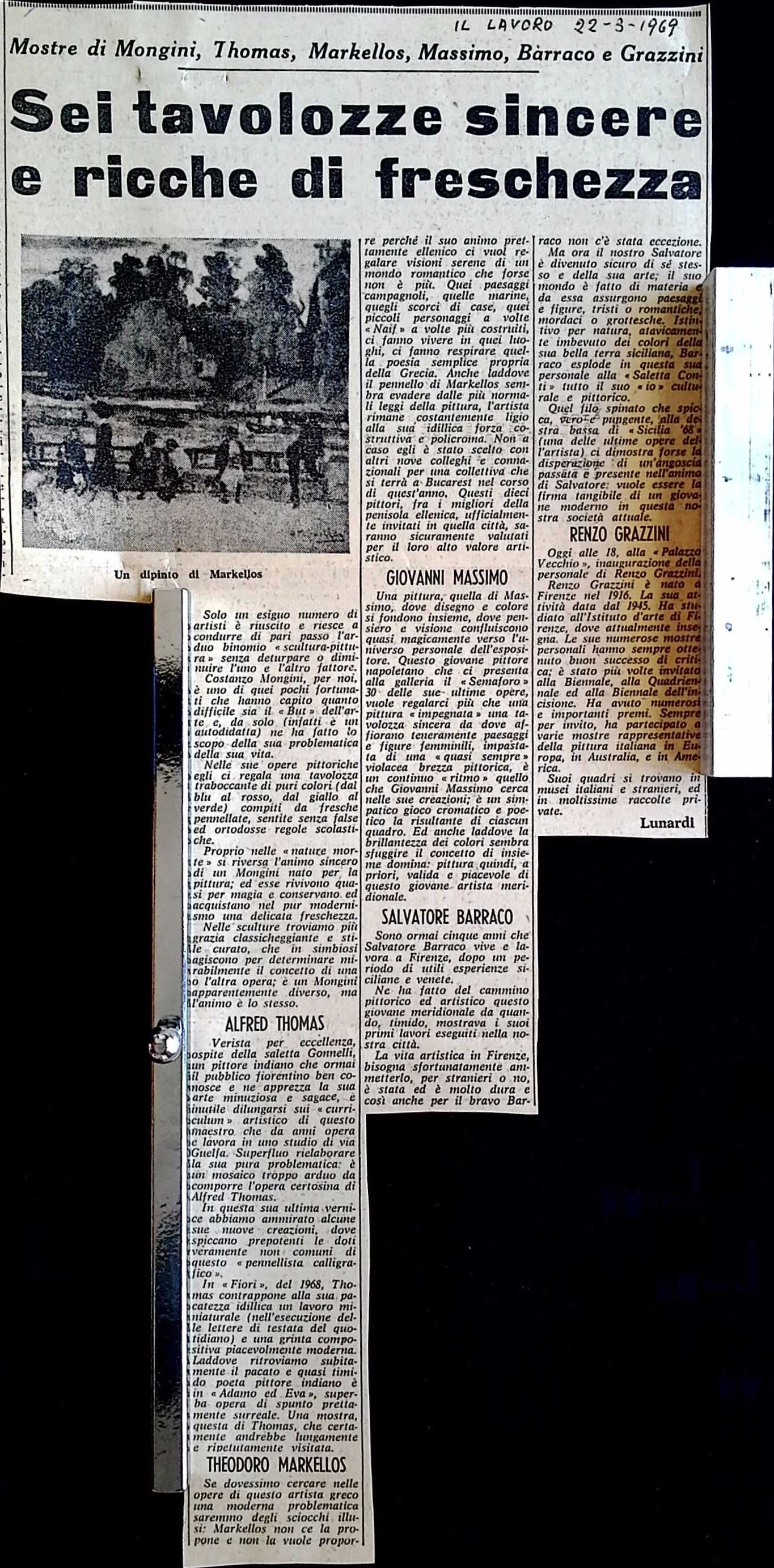
A painting by Markellos
Only a small number of artists have managed and continue to manage to combine simultaneously the difficult skill of "sculptural-painting" without distorting or diminishing either factor. Costanzo Mongini, for us, is one of the few fortunate ones who have understood how difficult the "But" of art is, and, alone (since he is self-taught), has made it the goal of his reflection and life.
In his pictorial creations he offers us a palette overflowing with pure colors (from blue to red, from yellow to green), full of fresh brushstrokes, felt without false and orthodox scholastic rules.
It is precisely in the "still lifes" that the sincere soul of a Mongini born for painting is expressed; and these revive almost magically, maintaining and acquiring within pure modernism a sensitive freshness.
In the sculptures we find more classicizing grace and studied style, rather than magical symbols to wonderfully define the meaning of one or another work; it is an apparently different Mongini, but the soul is the same.
ALFRED THOMAS
The absolute realist, hosted in the Gonnelli salon, an Indian painter whom the Florentine public now knows well and appreciates for his detailed and incisive art. It is superfluous to expand on the "biography" of this master, who has been working for years in a studio on via Guelfa. It is excessive to process again his pure reflection: the methodical work of Alfred Thomas is a mosaic that is very difficult to assemble.
In this latest exhibition of his we admired some of his new creations, where the truly unusual abilities of this "calligraphic brushworker" stand out with aggression.
In "Flowers," from 1968, Thomas contrasts his idyllic calm with a miniature work (in the execution of the newspaper headlines) and a composite boldness that is pleasantly modern.
Where we immediately rediscover the calm and almost timid poet-painter Indian, is in "Adam and Eve," a wonderful work with pure surrealist inspiration. An exhibition, that of Thomas, which one should certainly visit extensively and repeatedly.
THEODORO MARKELLOS
If we were to try and find a modern concern in the works of this Greek artist, we would be naive and misguided: Markellos does not propose it nor does he wish to. Because his strictly Greek spirit desires to gift us with serene visuals of a romantic world that perhaps no longer exists. These rural landscapes, these seascapes, these corners of houses, these small characters, sometimes "naïve," other times more structured, make us live in those places, make us breathe that simple poetry that characterizes Greece. Even where Markellos's brush seems to escape the most common rules of painting, the artist remains steadfastly faithful to his idyllic constructive and colorful power. It is no coincidence that he has been selected along with nine other colleagues and compatriots for a group exhibition to be held in Bucharest during the coming years. These ten painters, among the best of the Greek peninsula, officially invited to that city, will surely be appreciated for their high artistic value.
GIOVANNI MASSIMO
A painting, that of Massimo, where drawing and color unite, where thought and vision converge almost magically towards the exhibitor's personal universe. This young painter from Naples, who presents 30 of his latest works at the "Semaforo" gallery, wants to gift us more than an "entangled" painting, a sincere palette where landscapes and female figures gently emerge, shaped by an "almost always" violet artistic aura. It is a continuous "rhythmic" search that Giovanni Massimo pursues in his creations; it is a pleasant chromatic and poetic game that is the result of each canvas. And even where the brilliance of the colors seems to escape, the notion of unity prevails: painting, therefore, a priori, valid and pleasant from this young artist of the south.
SALVATORE BARRACO
Five years have passed since Salvatore Barraco has lived and worked in Florence, after a period of useful experiences in Sicily and Venice.
This young man from the south has traversed a significant artistic and painterly path since the time when, shyly, he presented his first works executed in our city.
The artistic life in Florence, unfortunately, we must admit, for foreigners or not, was and is very harsh, and so it was for the worthy Barako.
There was no exception for Barako. But now our savior has become sure of himself and his art; his world consists of matter, from which landscapes and figures emerge, sad or romantic, biting or grotesque. Instinctive by nature, atavically imbued with the colors of his beautiful Sicilian land, Barako enclosed in this personal exhibition at the "Saletta Conti" all of his "ego," cultural and painterly.
This barbed wire that stands out, truly tender, on the lower right side of "Sicilia '68" (one of the artist's last works) perhaps shows us the breaking of an anxiety that has passed and is present in Salvatore's spirit: he wants to be the visible signature of a young contemporary in our society today.
RENZO GRACINI
Today at 18:00, at the "Palazzo Vecchio," the opening of Renzo Gracini's personal exhibition. Renzo Gracini was born in Florence in 1916. His activity began in 1945. He studied at the Florence Institute of Art, where he teaches today. His many personal exhibitions have always garnered good critical success; he has participated many times in the Biennale, the Quadriennale, and the Engraving Biennale. He has received many significant awards. Always by invitation, he has participated in various representative exhibitions of Italian painting in Europe, Australia, and America.
His works are found in Italian and foreign museums, as well as in many private collections.
Lunardi
← View all 679 archival documents · Biography of Theodoros Markellos