
Himeria: Exhibitions and artistic maturation (1975)
Press Clipping
— 1975
Ημερεία , Αθήνα
No. ....5
The "Argos of the Press
of the East
FOUNDED IN 1911
SOPHOCLES STREET NO. 7
TELEPHONE 32.10.310
CLIPPINGS FROM GREEK
NEWSPAPERS AND PERIODICALS
DAILY
Clipping
Date -9 FEB. 1975
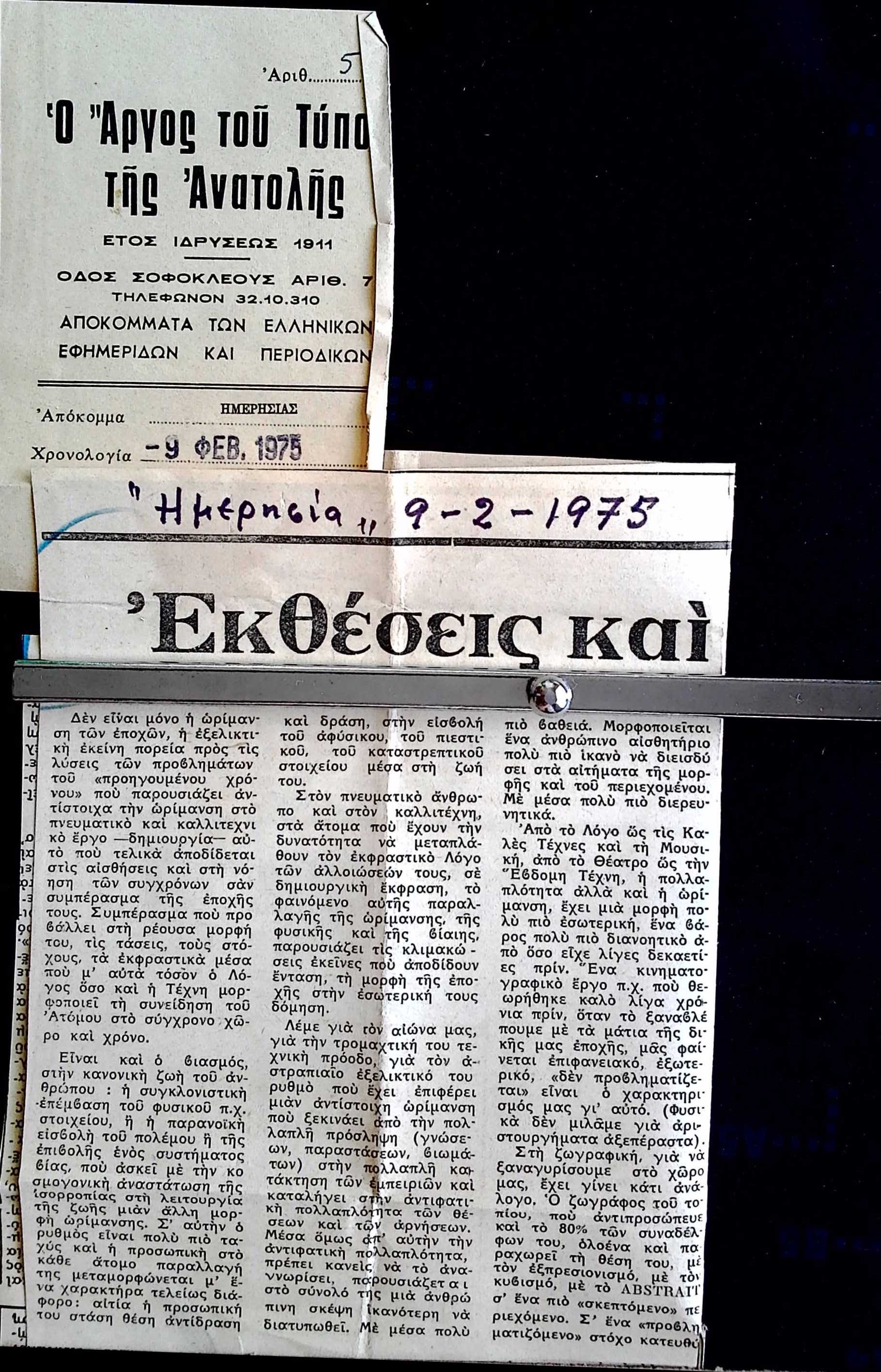
"Daily", 9-2-1975
Exhibitions and
It is not only the maturation
of the eras, that evolutionary
progress toward the solutions
of the problems of the "previous
year" that presents correspondingly
the maturation in the intellectual
and artistic work —creation— that
which is ultimately conveyed
to the senses and the understanding
of contemporaries as the conclusion
of their era. A conclusion that,
in its flowing form, highlights the
tendencies, the goals, the expressive
means through which both Logos
and Art shape the consciousness
of the Individual in contemporary
space and time.
It is also the violence,
in the normal life of man: the
shocking intervention of the natural
element, for example, or the paranoid
invasion of war or the imposition
of a system of violence, which,
through the cosmogonic disruption
of the balance in the functioning
of life, brings about another form
of maturation. In this, the
pace is much faster and the personal
variation in each individual
of the transformation takes on a
completely different character: cause
or personal stance, position, reaction
and action, in the invasion
of the unnatural, the oppressive,
the destructive element within
their life.
In the intellectual human
being and the artist, in those
individuals who have the ability
to reshape the expressive Logos
of their changes into creative
expression, the phenomenon of this
variation of maturation, both natural
and violent, presents those
gradations that convey intensity,
the form of the era in their
internal structure.
We speak of our century,
of its terrifying technical progress,
of its lightning-fast evolutionary
pace that has brought about a
corresponding maturation that began
with multiple absorption (of knowledge,
perceptions, experiences) and led
to the multiple acquisition of experiences,
ending in the contradictory multiplicity
of positions and negations.
Yet, within this contradictory
multiplicity, one must recognize,
there emerges in the whole a human
thought capable of being articulated.
With much deeper means. A human
sensory apparatus is shaped that is
much more capable of penetrating
the demands of form and content.
With much more investigative means.
From Logos to the Fine Arts
and Music, from Theater to the
"Seventh Art," the multiplicity
as well as the maturation
Mansi, has a much more internal form, a weight far more intellectual than it had a few decades ago. A cinematic work, for example, which was considered good a few years ago, when we rewatch it with the eyes of our own era, appears superficial, external; "it does not engage with problems" is our characterization of it. (Naturally, we are not speaking of unsurpassable masterpieces). In painting, to return to our domain, something analogous has occurred. The landscape painter, who represented 80% of his colleagues, is continually yielding his position to expressionism, cubism, and ABSTRACTISM, in favor of a more "reflective" content. Toward a "problematizing" goal, directing
← View all 679 archival documents · Biography of Theodoros Markellos