
Review of Yannis Psychopedis exhibition by Diana Antonakatou
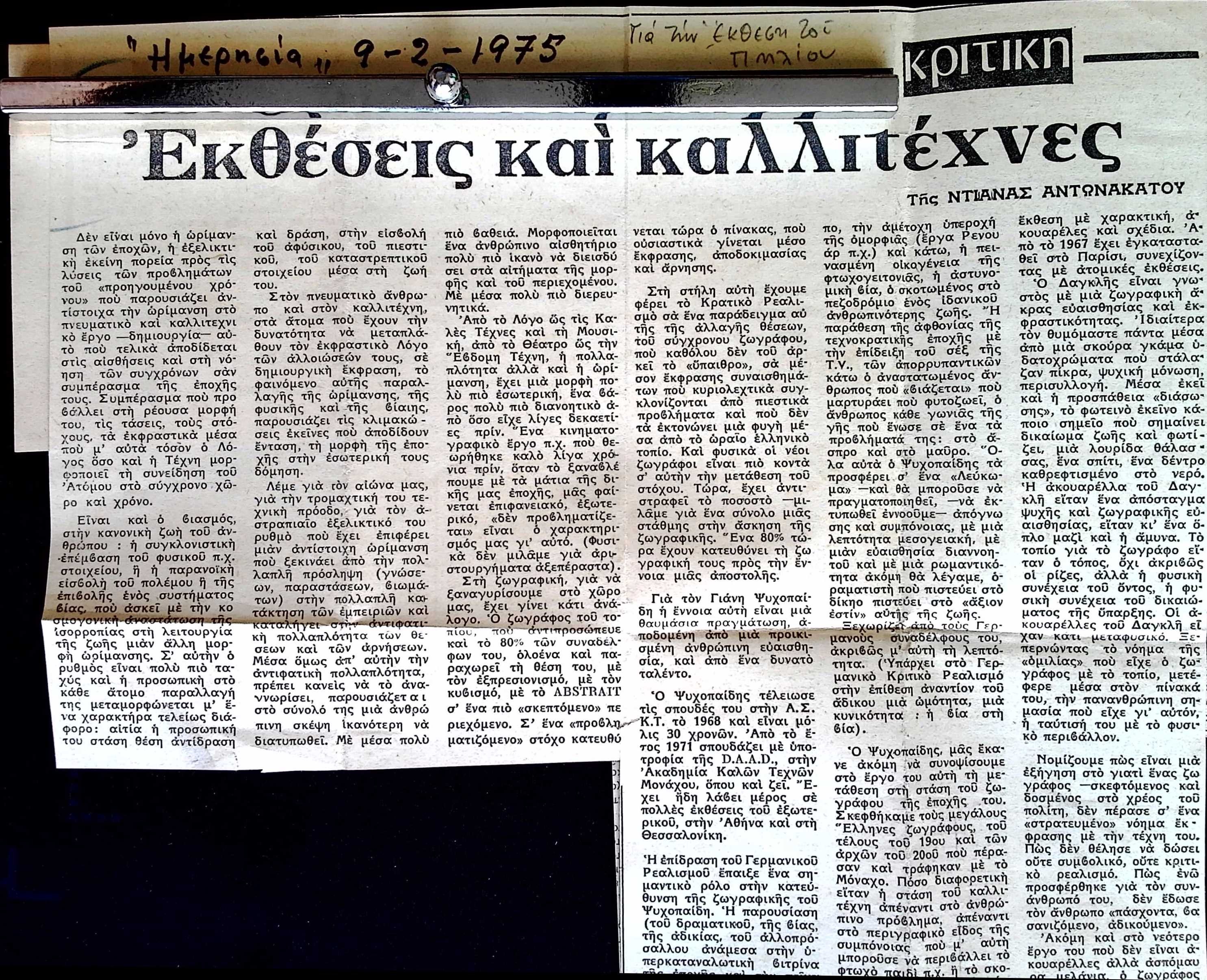
Press Clipping — 1975
Date, 9-2-1975
For the Exhibition Zos
Pimaios
CRITIQUE —
Exhibitions and Artists
BY DIANA ANTONAKATOU
It is not only the maturation of the eras, that evolutionary path toward the solutions of the problems of the “previous time” that presents the corresponding maturation in the intellectual and artistic work—creation—that is ultimately conveyed to the senses and understanding of contemporaries as the conclusion of their era. A conclusion that, in its flowing form, projects the tendencies, the goals, the expressive means through which both Reason and Art shape the consciousness of the Individual in contemporary space and time.
It is also the violence in the normal life of man: the shocking intervention of the natural element, for example, or the paranoid intrusion of war or the imposition of a system of violence, which, through the cosmogonic disruption of the balance in the functioning of life, brings about another form of maturation. In this, the rhythm is much faster and the personal variation in each individual transforms with a completely different character: cause or personal stance, position, reaction and action, in the intrusion of the unnatural, the oppressive, the destructive element into their life.
In the intellectual man and the artist, in individuals who have the ability to reshape the expressive Word of their alterations into creative expression, this phenomenon of the variation of maturation, of nature and violence, presents those gradations that convey intensity, the form of the era in their internal structure.
We speak of our century, of its terrifying technical progress, of its lightning-fast evolutionary rhythm that has brought about a corresponding maturation that begins with multiple reception (of knowledge, perceptions, ideas) and multiple ordering of experiences, and ends in the contradictory multiplicity of positions and negations. However, within this contradictory multiplicity, one must recognize, it presents as a whole a human thought capable of being formulated with much deeper means. A human sensorium is shaped that is much more capable of penetrating the demands of form and content. With much more investigative means.
From the Word to the Fine Arts and Music, from Theater to the Seventh Art, the multiplicity and also the maturation have a form that is much more internal, a weight that is much more intellectual than it had a few decades ago. A cinema
A graphic work, for instance, which was considered good a few years ago, when we look at it again through the eyes of our own era, appears superficial, external; "it does not engage with problems" is our characterization of it. (Naturally, we are not speaking of unsurpassable masterpieces).
In painting, to return to our context, something similar has occurred: what once represented 80% of his peers is constantly yielding its position to expressionism, cubism, and ABSTRACT art, in favor of a more "thoughtful" content. The painting is now directed toward a "problematic" goal, essentially becoming a means of expression, disapproval, and rejection.
In this column, we have brought up State Realism as an example of this shift in the position of the contemporary painter, for whom the "en plein air" is by no means sufficient as a means of expressing emotions that are literally shaken by pressing problems and are not relieved by an escape into the beautiful Greek landscape. And naturally, the young painters are closer to this shift in objective. Now, the percentage has reversed—we are speaking of a collective level in the practice of painting. An 80% now have directed their painting toward the notion of a mission.
For Yannis Psychopedis, this notion is a wonderful realization, underpinned by a gifted human sensitivity and a strong talent.
Psychopedis completed his studies at the Athens School of Fine Arts in 1968 and is only 30 years old. Since 1971, he has been studying on a D.A.A.D. scholarship at the Academy of Fine Arts in Munich, where he also lives. He has already participated in many exhibitions abroad, in Athens, and in Thessaloniki.
The influence of German Realism played a significant role in the direction of Psychopedis's painting. The presentation (of the dramatic, of violence, of injustice, of the contrast between the hyper-consumerist showcase of the late 19th and early 20th centuries that passed through and fed on Munich. How different was the artist's stance toward the human problem, toward the descriptive kind of sympathy that could surround, for example, the poor child or the beggar, the detached superiority of beauty (works by Renoir, for example), and below, the starving family of the slum, police violence, the person killed on the sidewalk of an ideal of a more humane life. The juxtaposition of the abundance of the technocratic era with
the exhibition of the sex of
T.Y., the detergents
below the disturbed man who
is “raped” who testifies who
lives on, the man of every corner of
the earth who united in one the
problems of it: in white and in black. "The
← View all 679 archival documents · Biography of Theodoros Markellos