
Review of Theodoros Markellos exhibition at Cultural Center (1975)
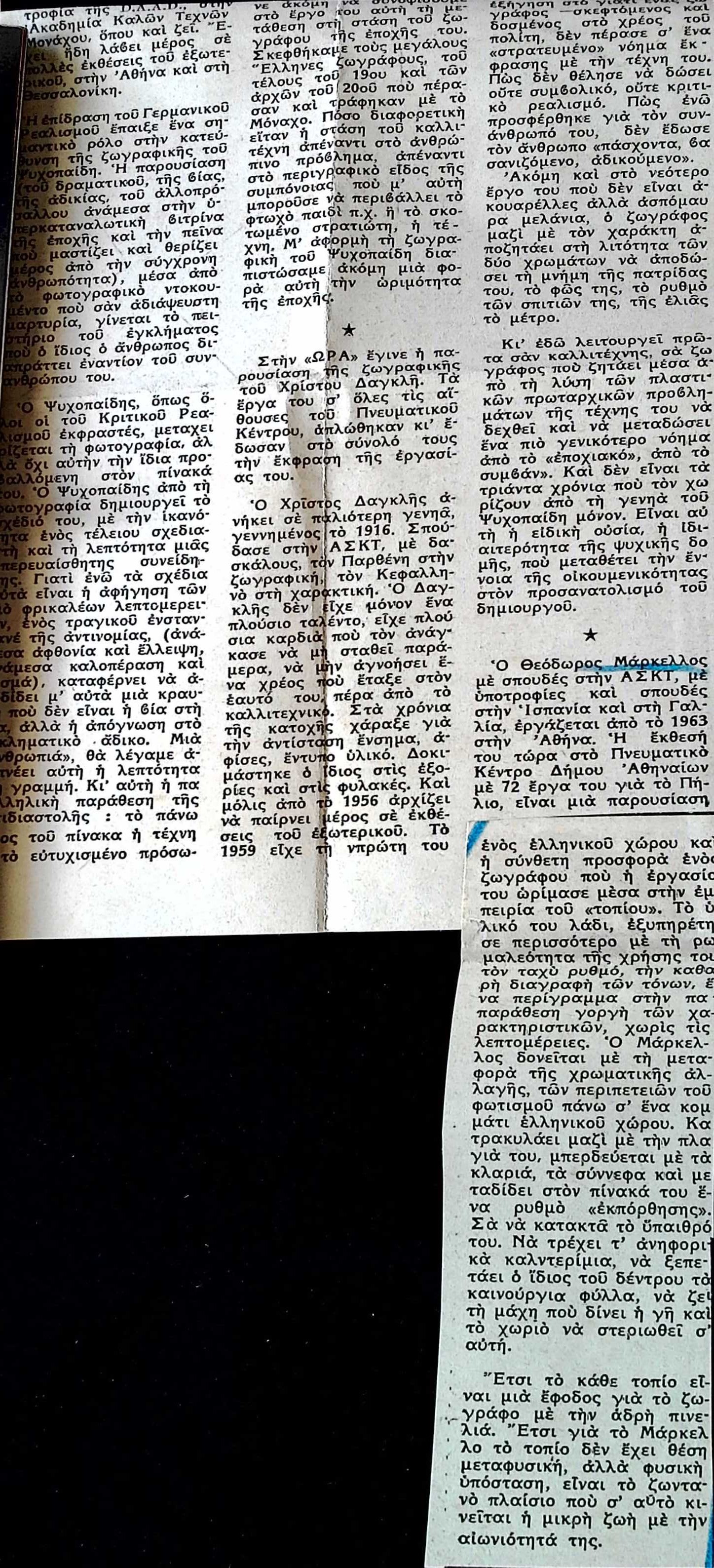
Press Clipping
— 1975
ΩΡΑ , Αθήνα
support of the D.L.A.D., at the Academy of Fine Arts in Munich, where he lives. There he has already participated in many exhibitions abroad, in Athens and Thessaloniki.
The influence of German Realism played a significant role in the direction of Psychopaides' painting. The presentation of the dramatic, of violence, injustice, and the otherness between the hyper-consumerist showcase of the era and the hunger that plagues and reaps part of modern humanity, through the photographic document that, as an irrefutable testimony, becomes the evidence of the crime that man himself commits against his fellow man.
Psychopaides, like all the exponents of Critical Realism, uses photography, but not the photograph itself displayed on his canvas. Psychopaides creates his sketch from the photograph, with the ability of a perfect draftsman and the delicacy of a highly sensitive consciousness. Because in these sketches is the narration of the gruesome details, in this tragic instant of the antinomy, (between abundance and lack, between immediate comfort and misery), he manages to convey through them a cry, but also the despair at the fundamental injustice. A "humanity," we would say, that this delicacy of line evokes. And this youthful juxtaposition of the distinctive: the upper part of the painting, the art, the happy face...
still to summarize in the work that this transposition in the attitude of the painter of his time. We thought of the great Greek painters of the late 19th and early 20th centuries who passed through and were nourished by Munich. How different was the artist's attitude towards the human problem, towards the descriptive kind of sympathy with which he could surround the poor child, for example, or the killed soldier, or art. On the occasion of Psychopaides' painting, we noticed once again this maturity of the era.
★
At "ORA" the presentation of Christos Danglis' painting took place. His works in all the halls of the Cultural Center spread out and gave, as a whole, the expression of his labor.
Christos Danglis belongs to an earlier generation, born in 1916. He studied at the Athens School of Fine Arts (ASKT), with teachers including Parthenis in painting and Kefallinos in engraving. Danglis possessed not only abundant talent but also a generous heart that compelled him not to stand aside, nor to ignore a duty he had pledged to himself, beyond his artistic obligations. During the years of occupation, he engraved badges, posters, and printed material for the resistance. He himself endured exile and imprisonment. It was only from 1956 that he began participating in exhibitions abroad. In 1959, he had his first
★
Theodoros Markellos, who studied at the Athens School of Fine Arts (ASKT) and received scholarships to study in Spain and France, has been working in Athens since 1963. His current exhibition at the Cultural Center of the Municipality of Athens, featuring 72 works on Mount Pelion, presents a Greek landscape and the complex contribution of a painter whose work matured through the experience of the “landscape.” His medium, oil, is handled with greater dexterity through the softness of application, a rapid rhythm, clear tonal distinctions, and an outline in the swift deposition of characteristics, devoid of details. Markellos vibrates with the transfer of chromatic change and the adventures of lighting upon a piece of Greek terrain. He trembles with the slope, intertwines with the branches and clouds, and imparts to his canvas a rhythm of “infiltration,” as if conquering his own outdoors. He runs up the cobblestone inclines, bursts forth with the tree’s new leaves, and lives the struggle waged by the earth and the village to take root in it.
Thus, each landscape is an assault for the painter with the coarse brush. Thus, for Markellos, the landscape holds no metaphysical position but a physical substance; it is the living framework within which small life moves with its eternity.
← View all 679 archival documents · Biography of Theodoros Markellos