
Ethnikos Kyris: Review of Theodoridis, Markellos, Moustakas exhibitions (1975)
Press Clipping
— 1975
Εθνικός Κήρυξ , Αθήνα
WEEKLY NEWSPAPER
NATIONAL HERALD
Date
Certificate
Markellos
Visual Arts
Three Painting Exhibitions
We have previously emphasized the creative role of criticism in the entire artistic (and generally technical) life of the country. Because we believe that any artwork is interpreted and elevated by the critical presence surrounding it. This, moreover, is the goal of the aesthetic interpretation of a work and the evaluative assessment of the idea—message, which exists—must exist—within it.
Individual or group exhibitions (alongside museums and sculptures in public spaces), the architectural character of a region or settlement, and other forms of art, are functions of education and teaching that shape the sensitivity of the word.
By observing the artistic life, we will endeavor to become assistants to the artist, interpreters of his work, and narrators to the average recipient of artistic expression. And primarily without prejudices or suspicious associations.
Antonis Theodoridis
“Rotonda”
Until December 20
In a “sickly” space that does injustice to the promise of an artist’s work, with poor lighting and shocking hanging of the paintings, Antonis Theodoridis strives to win over the visitor of his exhibition, which, we must say right from the start, is interesting in multiple ways: because his current work finalizes his Greek identity (9, 11, 15, 19, 24) and provides solutions to a technical school, through the use of minimalism. We saw the exhibition of Th. Markellos. On the occasion of his exhibition at the “Cultural Center” of the Municipality of Athens, we were delighted with great joy by his personal way of idealizing his artistic presentation.
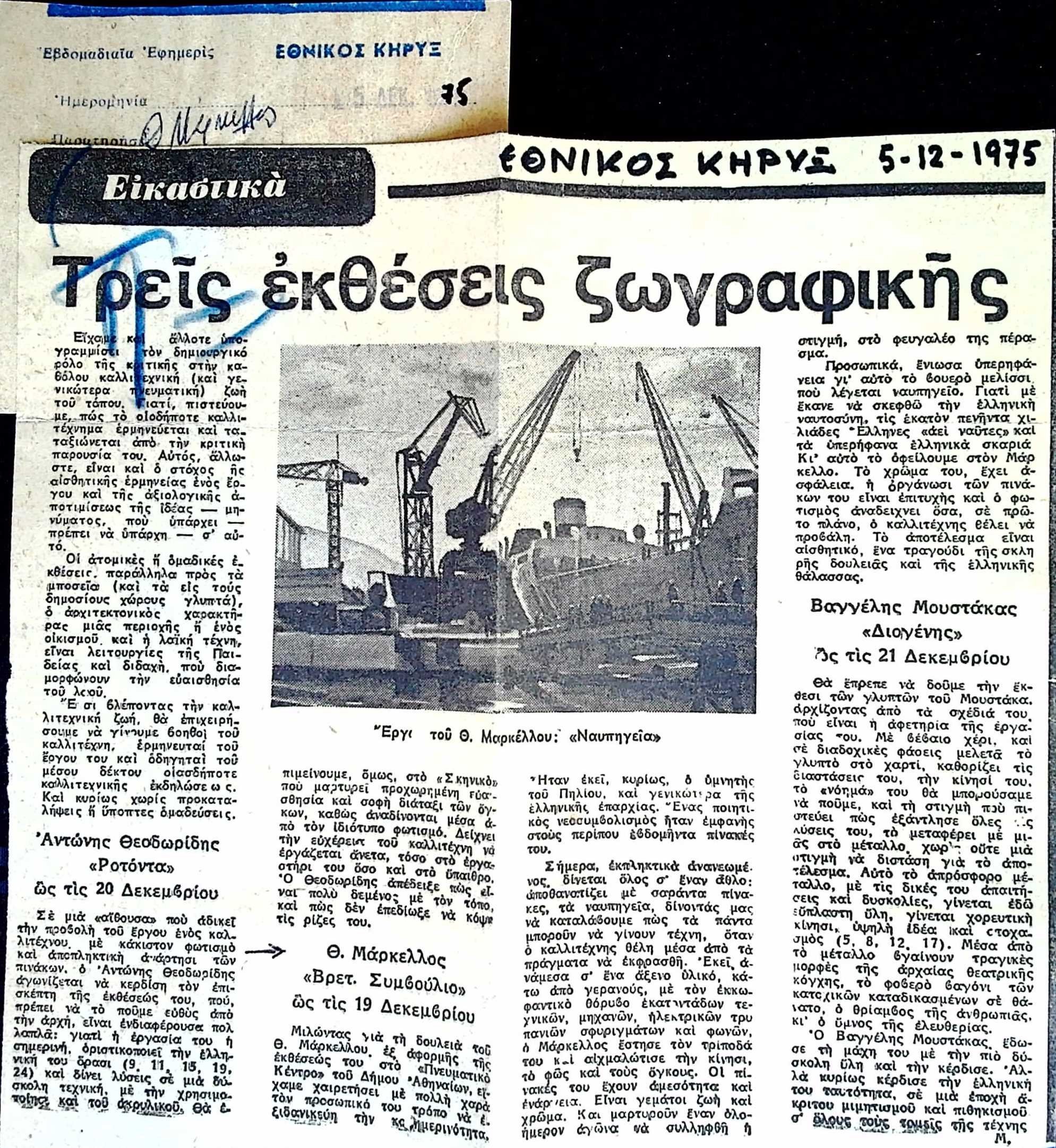
Work by Th. Markellos: “Shipyards”
However, we remain with the “Scene,” which testifies to an advanced nature of sensitivity and wise arrangement of volumes, as they emerge through the artist’s ease in working, both in his studio and outdoors. Theodoridis demonstrated that he is deeply connected to the place, and that he did not seek to cut his roots.
Th. Markellos
“British Council”
Until December 19
Speaking about the work of Th. Markellos, on the occasion of his exhibition at the “Cultural Center” of the Municipality of Athens, we were delighted with great joy by his personal way of idealizing his artistic presentation.
moment, in the fleeting passage.
Personally, I felt pride for this noisy hive called a shipyard. Because it made me think of Greek seamanship, the 150,000 “ever-seafaring” Greeks, and the proud Greek ships. And we owe this to Markellos. His color has security. The organization of his paintings is successful, and the lighting highlights what, in projection. The artist wants to project. The result is aesthetic, a song of hard work and the Greek sea.
Vangelis Moustakas
“Diogenes”
Until December 21
We should have seen the exhibition of Moustakas’s sculptures, starting from his drawings, which are the foundation of his work. With a sure hand, and in successive phases, he studies the sculpture on paper, determining its inclinations, its movement, its bloom, we could say, and at the moment he believes he has exhausted all his solutions, he transfers it all at once to metal, without hesitating for even an instant about the result. This unyielding metal, with its own demands and difficulties, becomes here malleable material, becomes choreographic movement, pure idea and thought (5, 8, 12, 17). From within the metal emerge tragic figures of the ancient theatrical niche, the terrifying wagon of the condemned to death, the triumph of humanity, and the hymn to freedom.
Vangelis Moustakas, here in his battle with the most difficult material, has won. But above all, he has won his Greek identity, in an era of blind mimicry and aping in all fields of art.
M.
← View all 679 archival documents · Biography of Theodoros Markellos