
— 1982
Event Photograph — 1982
THE ARGOS OF THE EASTERN PRESS
FOUNDED IN 1911
7 SOPHOCLES STREET
TEL. 3210.310 3253.680
CLIPPINGS FROM GREEK NEWSPAPERS AND MAGAZINES
Clipping
RIZOSPASTIS
Date .......4 JAN. 1982......
1982
13
RIZOSPASTIS
VISUAL ARTS 4-1-1982
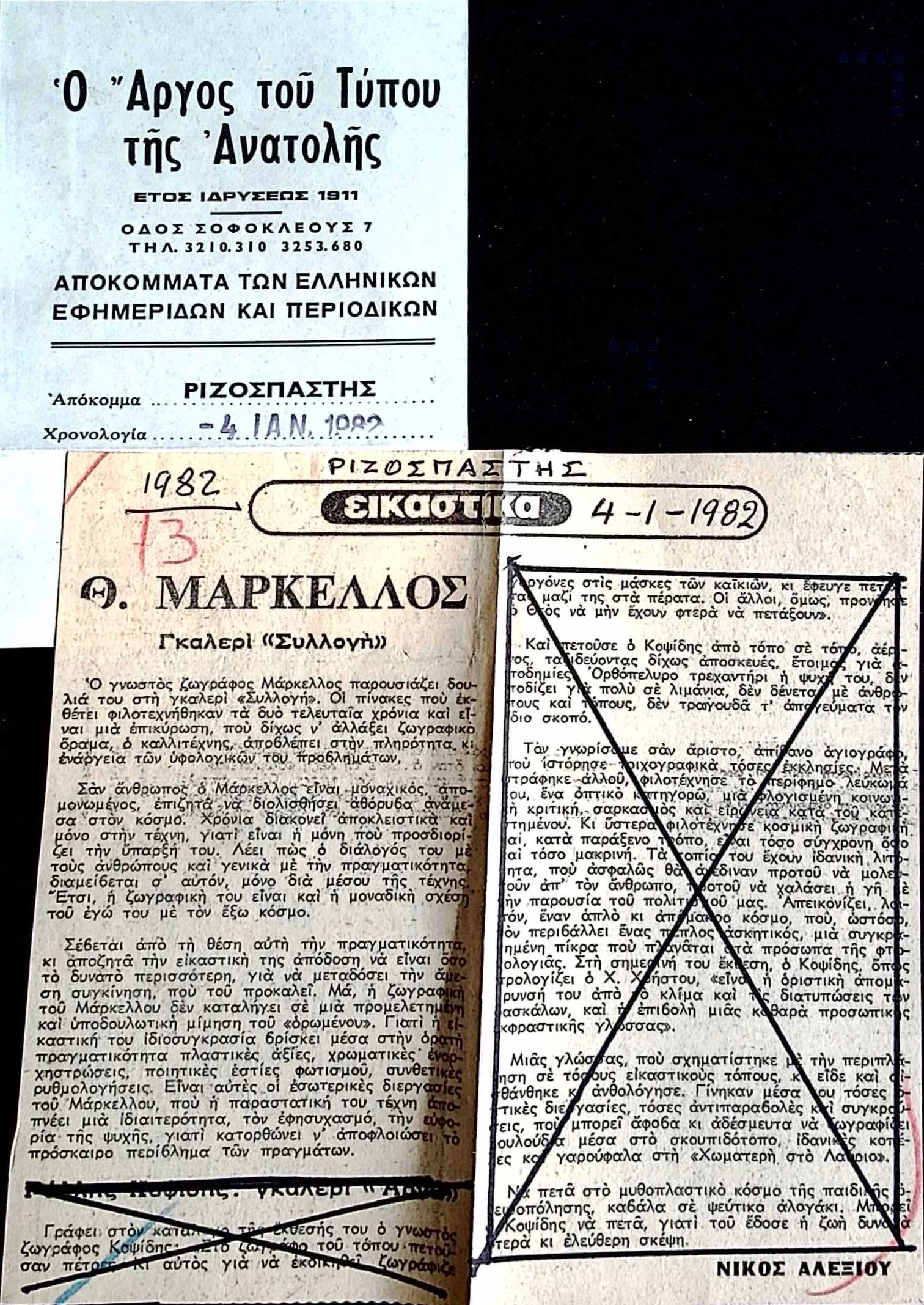
TH. MARKELOS
Gallery “Syllogi”
The well-known painter Markellos presents his works at the Gallery “Syllogi”. The paintings on display were created over the last two years and serve as a confirmation that, without altering his painterly drama, the artist anticipates the fullness and energy of his stylistic problems.
As a person, Markellos is solitary, isolated, seemingly destined to slide silently through the world. For years he has served exclusively and solely art, because it is the only thing that defines his existence. He says that his dialogue with people and, generally, with reality, is mediated within him only through art. Thus, his painting is also the only connection between his ego and the outside world.
From this position, he respects reality and seeks its visual representation to be as abundant as possible, in order to convey the immediate emotion it provokes in him. However, Markellos’s painting does not end in a premeditated and subservient imitation of the “given.” Because his visual temperament finds within the dense reality plastic values, chromatic orchestrations, poetic lighting foci, and compositional rhythms. It is these internal processes of Markellos that his representational art breathes a particularity, a serenity, a joy of the soul, because it manages to peel away the transient shell of things.
The well-known painter Kopsidis writes in the exhibition catalog: “In his painterly landscape, stones were flying and he, for the sake of picturesque painting...
And Kopsidis flew from place to place, a wanderer, traveling without luggage, ready for adventures. The upright, running spirit of his soul does not linger long in ports, does not bind itself to people and places, does not sing the afternoons for any purpose.
We knew him as an excellent, incredible icon painter, who frescoed so many churches. Later he turned to another path, creating his famous “White Wall,” a visual indictment, a burning social critique, sarcasm and irony against the established order. And then he created secular painting, which, in a strange way, is as contemporary as it is distant. His landscapes have an ideal austerity, which surely existed before they were disturbed by man, before they were ruined by the presence of our civilization. He depicts, perhaps, a simple and incredible world, which, nevertheless, is surrounded by a type of asceticism, a restrained bitterness that lingers on the faces of the photographs. In his current exhibition, Kopsidis, as H. Christou chronicles, “is the drastic reduction from the climate and formulations of the schools, and the imposition of a purely personal expressive language.”
A language that was formed through the winding path through so many visual places, and saw, bloomed, and was anthologized. So many dramatic excitations, so many comparisons and restraints occurred within him, that he can fearlessly and unboundedly paint flowers in the garbage dump, ideal hens and carnations in the “Graveyard” in Lavrion.
To fly into the fictional world of childhood fantasy, riding a mythical little horse. Kopsidis can fly because life gave him dynamic and free thought.
NIKOS ALEXIOU
← View all 679 archival documents · Biography of Theodoros Markellos