
Review of the Panhellenic Exhibition of Fine Arts by Stelios Lydakis
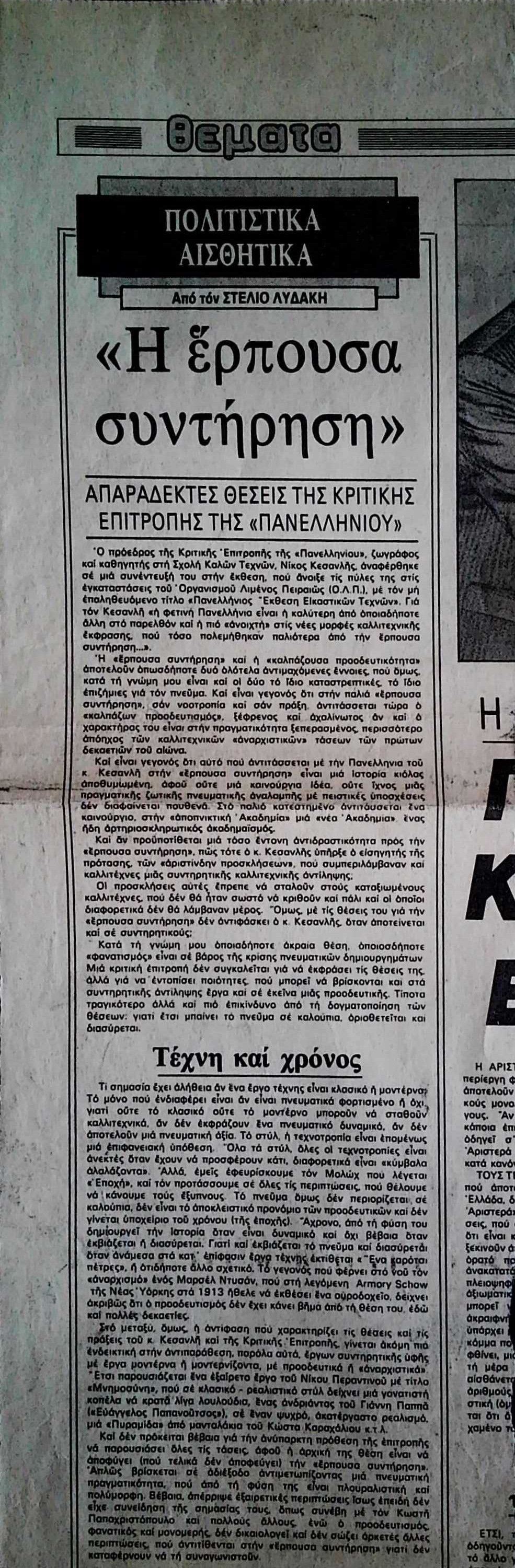
Press Clipping
Θεματα , Αθήνα
Themes
CULTURAL AESTHETICS
By STELIOS LYDAKIS
“The creeping conservatism”
UNACCEPTABLE POSITIONS OF THE CRITICAL COMMITTEE OF THE “PANHELLENIC”
The chairman of the Critical Committee of the “Panellenic,” painter and professor at the School of Fine Arts, Nikos Kesanelis, referred in an interview to the exhibition, which opened its doors at the facilities of the Piraeus Port Authority (O.L.P.), with the unverified title “Panellenic Exhibition of Visual Arts.” For Kesanelis, this year’s Panellenic is the best of any in the past and the most “open” to new forms of artistic expression, which were so fiercely fought against in the past by creeping conservatism...
The “creeping conservatism” and the “galloping progressiveness” are two entirely opposing concepts that, in my opinion, are equally destructive and equally undesirable for the spirit. And it is a fact that the old “creeping conservatism,” as a mindset and as practice, is now opposed by the “galloping progressiveness,” frenzied and unbridled, although its character is actually more outdated than the artistic “anarchistic” tendencies of the first decades of the century.
And it is a fact that what is opposed to the Panellenic of Mr. Kesanelis against the “creeping conservatism” is already a tired story, since neither a new idea nor a trace of a real vital spiritual flash with convincing promises appears anywhere. To the old establishment is opposed a new one, to the “suffocating Academy” a “new Academy,” a forgetful arteriosclerotic academicism.
And it is not assumed that such intense reactivity towards the “creeping conservatism,” how then Mr. Kesanelis was the proposer of the proposal, of the “arbitrary invitations,” which included artists of a conservative artistic perception:
These invitations should have been sent to the recognized artists, who would not be right to be hidden again and who otherwise would not participate. However, with his positions on the “creeping conservatism,” does Mr. Kesanelis not contradict himself when he also appeals to conservatives?
In my opinion, any extreme position or any kind of "fanaticism" undermines the judgment of intellectual creations. A jury is not convened to express its own positions, but to identify qualities that may be present in both conservative and progressive works. Nothing is more tragic or dangerous than the dogmatization of positions: for in doing so, the spirit is forced into molds, confined, and disgraced.
Art and Time
What difference does it make whether a work of art is classical or modern? The only thing that matters is whether it is intellectually charged or not, because neither the classical nor the modern can stand artistically if they do not express an intellectual dynamic, if they do not constitute an intellectual value. Style and technique are therefore superficial matters. All styles and techniques are acceptable when they have something to offer; otherwise, they are "clanging cymbals." But we invent the Moloch called "Epoch" and invoke it in all cases where we want to appear clever. The spirit is not confined to molds, is not the exclusive privilege of the progressives, and does not become a plaything of time (the epoch). Timeless by nature, it creates History when it is dynamic, and certainly not when it is coerced or disgraced. For the spirit is indeed coerced and disgraced when, among the so-called works of art, "A Carrot of Stones" or anything else related is exhibited. The fact that brings to mind the "anarchism" of Marcel Duchamp, who at the so-called Armory Show in New York in 1913 wanted to exhibit a urinal, confirms precisely that the progressive has not taken a step from its position for many decades.
Meanwhile, however, the contradiction characterizing the positions and actions of Mr. Kesanelis and the Jury becomes even more indicative in the confrontation, above all, between works of a conservative style and modern or modernizing works with a progressive or "anarchistic" approach. Thus, an outstanding work by Nikos Perandinos titled "Mnemosyne" is presented, which in a classical-realistic style shows a devout girl holding a few flowers; a painting by Yannis Papa ("Evangelos Papandonatos"), in a cold, unprocessed realism; a "Pyramid" of safety pins by Kostas Karachalios, etc.
And it is certainly not about the non-existent intention of the committee to present all the trends, since the principle of the position is to avoid (which ultimately it does not avoid) the "creeping conservatism." Simply put, it finds
← View all 679 archival documents · Biography of Theodoros Markellos