
NEA: N. Kessanlis interview on the Panhellenic Exhibition 1987
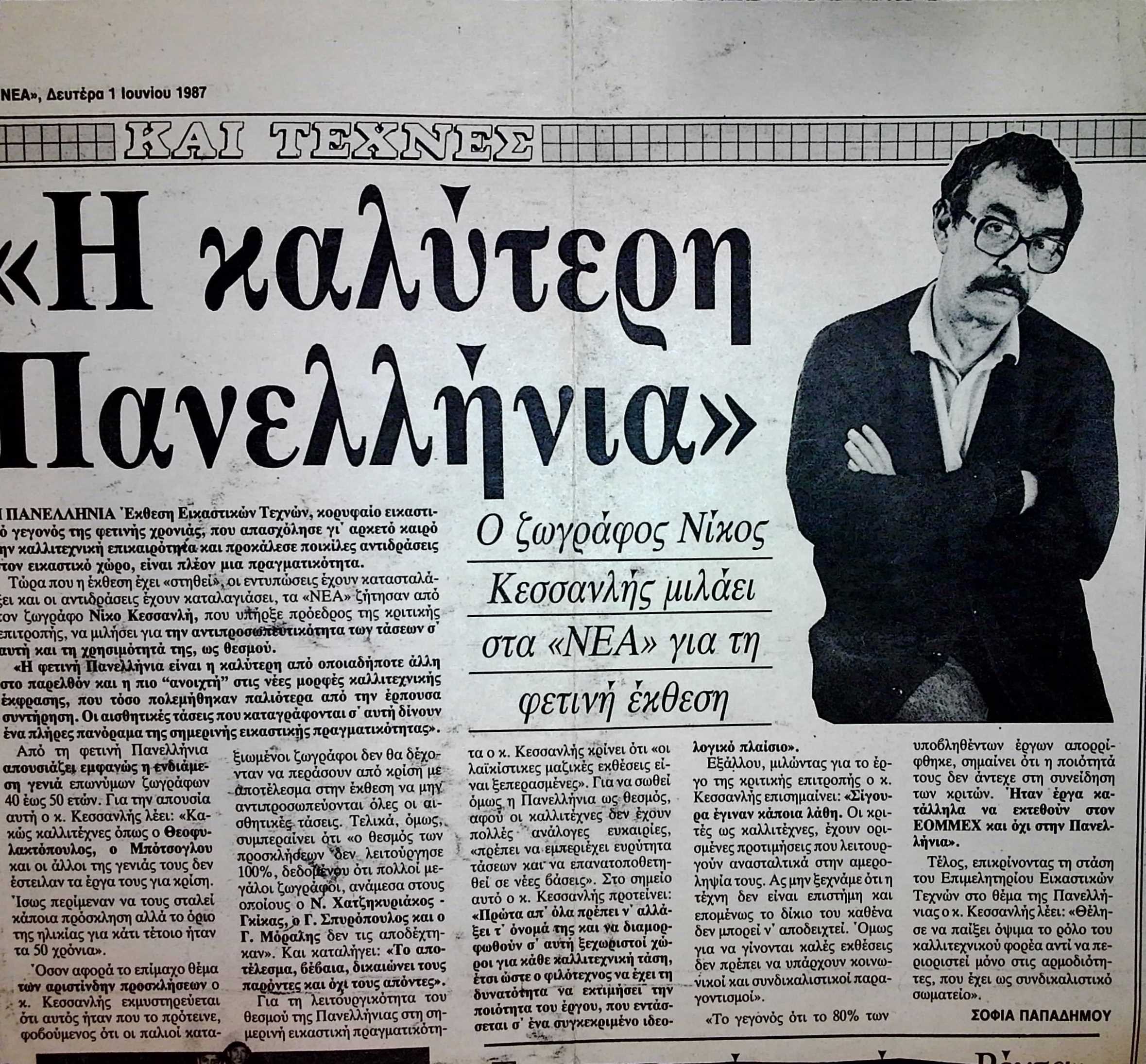
Press Clipping
NEA , Athens
NEA, Monday, June 1, 1987
AND ARTS
“The Best Panhellenic”
The Panhellenic Exhibition of Fine Arts, the premier visual arts event of this year, which occupied the artistic news cycle for quite some time and provoked varied reactions within the visual arts community, is now a reality.
Now that the exhibition has been “set up,” impressions have settled, and reactions have subsided, “NEA” asked painter Nikos Kessanlis, who served as chairman of the jury, to speak about the representativeness of the tendencies present and the utility of the exhibition as an institution.
“This year’s Panhellenic is the best of any in the past and the most ‘open’ to new forms of artistic expression, which were so fiercely fought against in the past by creeping conservatism. The aesthetic tendencies documented here provide a complete panorama of today’s visual reality.”
The intermediate generation of well-known painters aged 40 to 50 is noticeably absent from this year’s Panhellenic. Regarding this absence, Mr. Kessanlis says: “Artists such as Theofylaktopoulos, Botzoglu, and others of their generation did not submit their works for judging. Perhaps they were waiting for an invitation, but the age limit for such an invitation was 50 years.”
Regarding the controversial issue of honorary invitations, Mr. Kessanlis reveals that he was the one who proposed it, fearing that older, established painters would not agree to undergo judging, resulting in not all aesthetic tendencies being represented at the exhibition. Ultimately, however, he concludes that “the system of invitations did not work 100%, given that many major painters, among them N. Hadjikyriakos-Ghikas, G. Spyropoulos, and G. Moralis, did not accept them.” And he concludes: “The result, undoubtedly, justifies those present and not those absent.”
Regarding the functionality of the Panhellenic exhibition institution within today’s visual arts reality, Mr. Kessanlis judges that “populist mass exhibitions are outdated.” However, to save the Panhellenic as an institution, given that artists do not have many similar opportunities, “it must encompass a broad range of tendencies and be repositioned on new foundations.” At this point, Mr. Kessanlis proposes: “First of all, its name must change, and separate spaces for each artistic tendency must be established within it, so that art lovers have the opportunity to appreciate the quality of the work, which fits into a specific ideological framework.”
Furthermore, speaking about the work of the jury, Mr. Kessanlis points out: “Certainly, some mistakes were made. The judges, as artists, have certain preferences that hinder their impartiality. Let us not forget that art is not a science, and therefore, everyone’s right cannot be proven. However, for good exhibitions to take place, there should be no social or union-based influences.”
“The fact that 80% of the submitted works were rejected means that their quality did not withstand the conscience of the judges. They were works suitable for exhibition at EOMMEX and not at the Panhellenic.”
Finally, criticizing the stance of the Chamber of Visual Arts on the issue of the Panhellenic, Mr. Kessanlis says: “It wanted to play the late role of an artistic body instead of limiting itself only to the responsibilities it has as a union organization.”
SOFIA PAPADIMOU
← View all 679 archival documents · Biography of Theodoros Markellos