
Review of exhibitions by Psychopedis, Angelinou and Markellos
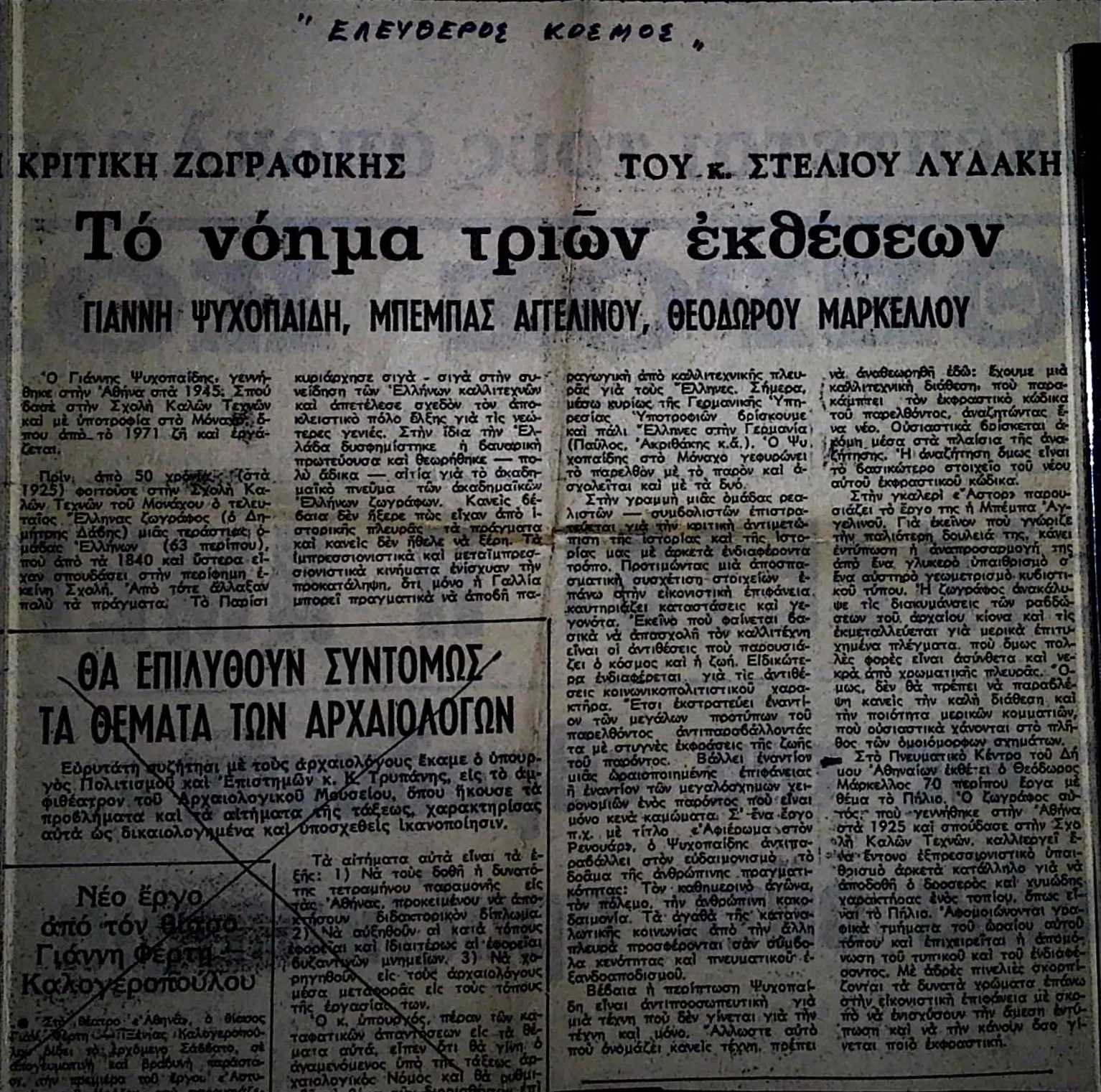
Press Clipping — 1957 , Αθήνα
CRITIQUE OF PAINTING
BY MR. STELIOS LYDAKIS
The Meaning of Three Exhibitions
YANNIS PSYCHOPAIDES, BEMBAS AGGELINOU, THEODOROS MARKELOS
Yannis Psychopaides was born in Athens in 1945. He studied at the School of Fine Arts and received a scholarship to study in Munich. Since 1971, he has lived and exhibited his works.
Fifty years ago (in 1925), the last Greek painter (Dimitris Dadis) of a huge group of Greeks (about 63) who had studied at the aforementioned School since 1840 was a student at the Munich School of Fine Arts. Since then, things have changed considerably: Paris gradually dominated the consciousness of Greek artists and became almost the definitive pole of attraction for younger generations. In Greece itself, the Munich School was discredited and considered—very unfairly—as a stigma for the academic spirit of the academic Greek painters. No one knew how things stood from a historical perspective, and no one wanted to know the truth. The Impressionist and Post-Impressionist movements reinforced the prejudice that only France could truly be productive from an artistic standpoint for Greeks. Today, mainly through the German Scholarship Service, Greeks are once again found in Germany (Pailos, Akrivakis, etc.). Psychopaides in Munich cultivates the past with the present and engages with both.
In the line of a group of realist-symbolists, he mobilizes resources for a critical approach to history and our history with quite interesting results. Preferring a fragmented correlation of elements on the pictorial surface, he deals with geographical situations and geography. What seems to fundamentally occupy the artist are the contradictions presented by the world and life. Specifically, he is interested in socio-cultural contradictions. Thus, he launches an attack against the grand models of the past, juxtaposing them with cold expressions of present-day life. He stands against a dramatized surface or against the grandiose schemes of the present, which are merely empty boasts. In a work, for example, titled "Tribute to Renoir," Psychopaides juxtaposes hedonism with the harshness of human reality: war, human misery. The goods of consumer society, on the other hand, are offered as symbols of emptiness and spiritual impoverishment.
Certainly, here is the translation of the text into English:
---
Certainly, the case of Psychopaidi is representative for an art that is not made for art's sake alone. Moreover, what is called modern art must be rethought: We have an artistic disposition that bypasses the expressive code of the past, adopting a new one. Essentially, it finds itself within the framework of repetition. Repetition is the most important element of this new expressive code.
At the gallery 'Astor', Angelina Bembas presents her work. For those who know her earlier work, there is no impression of a transformation from a sweet impressionism to a strict geometric cubist style. The painter discovers the fluctuations of the stripes of the barren column and exploits them for some successful weavings, which are often disjointed and dead from a color perspective. Similarly, one should not overlook the good intention and quality of some pieces, which essentially get lost in the multitude of monotonous statements.
At the Cultural Center of the Municipality of Athens, Theodoros Markellos exhibited about 70 works on the theme of Pelion. This painter, born in Athens in 1925 and studied at the School of Fine Arts, creates an intense planar impressionism quite suitable to convey the fresh and naked character of a landscape like Pelion. Graphic types of things from this barren place are assimilated, and an attempt is made to isolate the typical and the interesting. With bold brushstrokes, strong colors are scattered over the pictorial surface with the aim of enhancing the dimensional fall and making it the essence of expression.
THE ISSUES OF ARCHAEOLOGISTS WILL BE RESOLVED SOON
The Minister of Culture and Sciences, Mr. K. Trypanis, had a firm discussion with archaeologists in the amphitheater of the Archaeological Museum, where he listened to their problems and demands, characterizing them as justified and promising satisfaction.
These demands are as follows: 1) To give them the possibility of a four-month stay in Athens, in order to obtain a doctoral degree. 2) To discuss local theories and special rights of monument guardianship. 3) To provide archaeologists with transportation to their places of work.
New work
from the theater
Giannis Fertis
Kalogeropoulou
---
This translation preserves the original meaning while adapting it to natural English phrasing.
At the Athens Theatre, director Yannis Ferti — Pezina Kalogeropoulou, this coming Saturday, in the afternoon and evening performances, at the premiere of the work "Police", invites the audience.
← View all 679 archival documents · Biography of Theodoros Markellos