
Art Criticism Notes: Theodoros Markellos Exhibition in Akropolis (1958)
Press Clipping
— 1957
ΑΚΡΟΠΟΛΙΣ , Αθήνα
Thursday, February 27, 1958 AKROPOLIS
TECHNICAL CRITICAL NOTES
THE EXHIBITION OF TH. MARKELOS
BY OUR COLLEAGUE MR. M. H. KONSTANTOPOULOS
In the large hall of “Parnassos”, under the high patronage of the Spanish Ambassador Juan Felipe de Ranero, the new painter Th. Markellos exhibited 103 of his works (oils), inspired by Spain, Paris, and Greece. He exhibits with astonishment three copies of works by Greco, Velazquez, and Goya, which he executed in museums of Spain.
Markellos was born in 1925 in Lothina and in 1948 entered the Higher School of Fine Arts, where he studied under the instruction of Georgiadis and Kefallinos. In 1952 he received his diplomas with three honorary distinctions. He participated in the exhibition of Greek marine painters and the Panhellenic Exhibition. In 1954 he moved to Spain on a scholarship from the Spanish state and attended the Higher School of San Fernando with professors Don Francisco Soria Ayeto and Don Carlos Saenz de Tejada.
The Spanish press has been enthusiastic with comments on the work of the Greek painter.
The works from Madrid and Segovia give us impressions of real Spain, and indeed the Spanish critic wrote that the Greek artist has impressed and interpreted the country better than many Spanish masters of painting.
“The Road” (no. 1) has movement and color or simply “Spain” (no. 6) with Don Quixote and Sancho Panza is 100% Spain. “The Garden” (no. 16) is a joy to the eyes in chromatic harmony. “After Rain” (no. 21) is permeated with a wet quality. His impressions from bullfights are characteristic. I also note “Old Neighborhood” (no. 23), “Castile” (no. 31), where exhibitions are held.
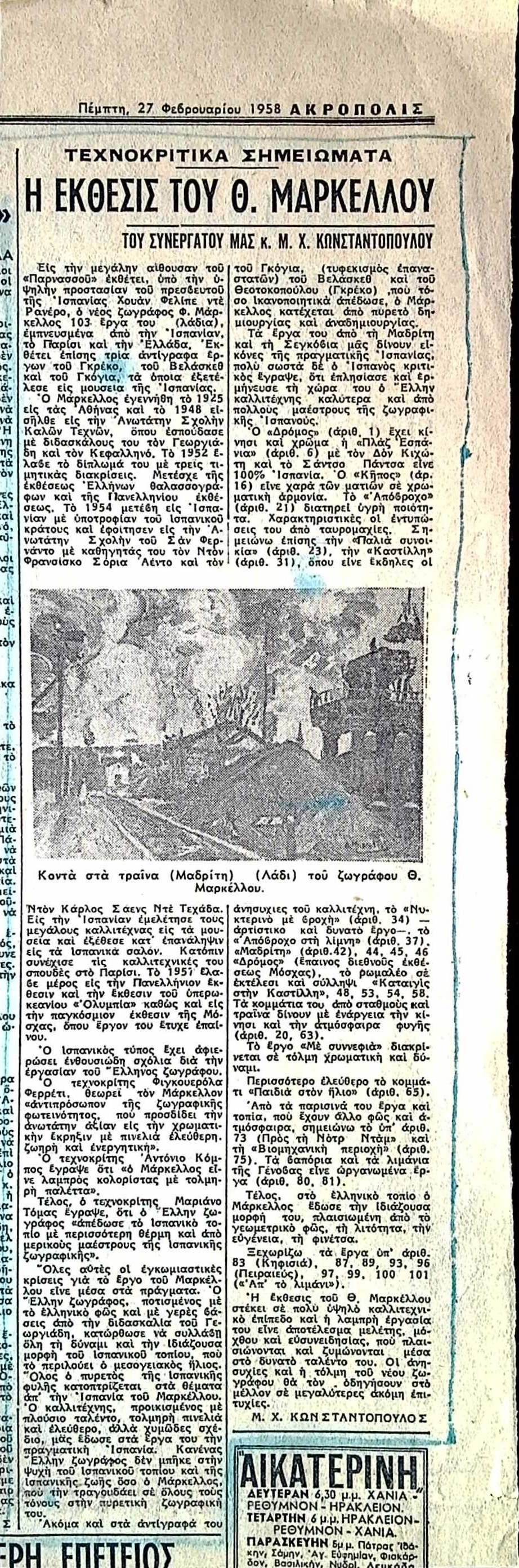
Near the trains (Madrid) (Oil) by the painter Th. Markellos.
In Spain he studied the great artists in the museums and repeatedly exhibited in Spanish salons. Afterwards he continued his artistic studies in Paris. In 1951 he took part in the Panhellenic Exhibition and the exhibition of the transatlantic “Olympia” as well as in the world exhibition in Moscow, where he was praised.
The art critic Figuerola Ferreri considers Markellos an undisputed master of luminous painting, which reaches the highest peak in chromatic explosion and dynamism.
The art critic Antonio Campos wrote that “Markellos is a brilliant colorist with a bold palette.”
Finally, the art critic Mariano Thomas wrote that the Greek painter “embraced the Spanish landscape with more warmth than some masters of Spanish painting.”
All these laudatory critiques of Markellos’s work are well-founded. The Greek painter, imbued with Greek light and with solid foundations from Georgiadis’s teaching, managed to capture the power and distinctive character of the Spanish landscape bathed in the Mediterranean sun.
The entire fervor of the Spanish race is reflected in Markellos’s themes from Spain. No Greek painter has penetrated the soul of the Spanish landscape and Spanish life as deeply as Markellos, who sings it in all tones in his feverish painting.
Even in his copies, such as “After Rain with Downpour” (no. 34) — an artistic and powerful work —, “After Rain at the Lake” (no. 37), “Madrid” (no. 42), 44, 45, 46 “Road” (from the Moscow International Exhibition), the robust in execution and conception “Cathedral in Castile,” 48, 53, 54, 58. His pieces depicting stations and trains convey with vigor the movement and atmosphere of departure (nos. 20, 63).
The work “Without Clouds” stands out for its chromatic boldness and strength.
More free is the piece “Plate in the Sun” (no. 65).
Among his Parisian works and landscapes, which have a different light and atmosphere, I note no. 73 (Towards Notre Dame) and “Industrial Area” (no. 75). The baptisteries and ports of Genoa are structured works (nos. 80, 81).
Finally, in the Greek landscape, Markellos gave its distinctive form, framed by geometric light, austerity, elegance, and finesse.
I single out the works nos. 83 (Kifissia), 87, 89, 93, 96 (Piraeus), 97, 99, 100, 101 (“From the Port”).
The exhibition of Th. Markellos stands at a very high artistic level, and his brilliant work is the result of study, struggle, and practice, which are framed and kneaded within his strong talent. The people and the boldness of the young painter will lead him
TECHNICAL CRITICAL NOTES
THE EXHIBITION OF TH. MARKELOS
BY OUR COLLEAGUE MR. M. H. KONSTANTOPOULOS
In the large hall of “Parnassos”, under the high patronage of the Spanish Ambassador Juan Felipe de Ranero, the new painter Th. Markellos exhibited 103 of his works (oils), inspired by Spain, Paris, and Greece. He exhibits with astonishment three copies of works by Greco, Velazquez, and Goya, which he executed in museums of Spain.
Markellos was born in 1925 in Lothina and in 1948 entered the Higher School of Fine Arts, where he studied under the instruction of Georgiadis and Kefallinos. In 1952 he received his diplomas with three honorary distinctions. He participated in the exhibition of Greek marine painters and the Panhellenic Exhibition. In 1954 he moved to Spain on a scholarship from the Spanish state and attended the Higher School of San Fernando with professors Don Francisco Soria Ayeto and Don Carlos Saenz de Tejada.
The Spanish press has been enthusiastic with comments on the work of the Greek painter.
The works from Madrid and Segovia give us impressions of real Spain, and indeed the Spanish critic wrote that the Greek artist has impressed and interpreted the country better than many Spanish masters of painting.
“The Road” (no. 1) has movement and color or simply “Spain” (no. 6) with Don Quixote and Sancho Panza is 100% Spain. “The Garden” (no. 16) is a joy to the eyes in chromatic harmony. “After Rain” (no. 21) is permeated with a wet quality. His impressions from bullfights are characteristic. I also note “Old Neighborhood” (no. 23), “Castile” (no. 31), where exhibitions are held.
Near the trains (Madrid) (Oil) by the painter Th. Markellos.
In Spain he studied the great artists in the museums and repeatedly exhibited in Spanish salons. Afterwards he continued his artistic studies in Paris. In 1951 he took part in the Panhellenic Exhibition and the exhibition of the transatlantic “Olympia” as well as in the world exhibition in Moscow, where he was praised.
The art critic Figuerola Ferreri considers Markellos an undisputed master of luminous painting, which reaches the highest peak in chromatic explosion and dynamism.
The art critic Antonio Campos wrote that “Markellos is a brilliant colorist with a bold palette.”
Finally, the art critic Mariano Thomas wrote that the Greek painter “embraced the Spanish landscape with more warmth than some masters of Spanish painting.”
All these laudatory critiques of Markellos’s work are well-founded. The Greek painter, imbued with Greek light and with solid foundations from Georgiadis’s teaching, managed to capture the power and distinctive character of the Spanish landscape bathed in the Mediterranean sun.
The entire fervor of the Spanish race is reflected in Markellos’s themes from Spain. No Greek painter has penetrated the soul of the Spanish landscape and Spanish life as deeply as Markellos, who sings it in all tones in his feverish painting.
Even in his copies, such as “After Rain with Downpour” (no. 34) — an artistic and powerful work —, “After Rain at the Lake” (no. 37), “Madrid” (no. 42), 44, 45, 46 “Road” (from the Moscow International Exhibition), the robust in execution and conception “Cathedral in Castile,” 48, 53, 54, 58. His pieces depicting stations and trains convey with vigor the movement and atmosphere of departure (nos. 20, 63).
The work “Without Clouds” stands out for its chromatic boldness and strength.
More free is the piece “Plate in the Sun” (no. 65).
Among his Parisian works and landscapes, which have a different light and atmosphere, I note no. 73 (Towards Notre Dame) and “Industrial Area” (no. 75). The baptisteries and ports of Genoa are structured works (nos. 80, 81).
Finally, in the Greek landscape, Markellos gave its distinctive form, framed by geometric light, austerity, elegance, and finesse.
I single out the works nos. 83 (Kifissia), 87, 89, 93, 96 (Piraeus), 97, 99, 100, 101 (“From the Port”).
The exhibition of Th. Markellos stands at a very high artistic level, and his brilliant work is the result of study, struggle, and practice, which are framed and kneaded within his strong talent. The people and the boldness of the young painter will lead him
← View all 679 archival documents · Biography of Theodoros Markellos