
Invitation to the exhibition 'Greek Island Landscape' at DADA Gallery, 1986
Exhibition Material
— 1986
Αίθουσα Τέχνης DADA , Αθήνα
INVITATION
Dear Art Lovers,
The DADA Art Gallery inaugurates its new exhibition space at 6 Nireidon Street, behind the National Gallery.
Hoping for your continued support and interest in our exhibitions,
We invite you on Wednesday, October 1, 1986, at 8:00 p.m., to the opening of the inaugural exhibition titled: “Greek Island Landscape.”
Warmly,
EVA GKIOKA
KOSTAS EVAGGELATOS
Exhibition duration: October 1–19, 1986
Visiting hours:
Daily: 10:30–1:30 & 6:30–9:30
Saturday & Sunday: 11:00–2:00
Closed Monday mornings.
“The islands of Greece,
oh enchanted islands...”
The famous poem by Lord Byron is confirmed by all who visit the Greek islands. They feel the incredible magic that characterizes them and leave with a sense of nostalgia that never fades. The coexistence of all natural elements gives them something primordial. The sea, the rocky land, the winds, and the abundant light create a world that retains the imprint of the first day of creation. Yet, this very pure world appeared inaccessible and “closed to itself” to painters of the past, mainly from an artistic perspective.
Here, the landscape is so complete that it does not easily lend itself to subjectivization, while the fixed outlines, the harshness of the light, and the strong contrasts contain something anti-pictorial. This was also emphasized by the first notable painters who attempted to depict the Greek, and particularly the island, landscape. The views of Baron Otto Magnus Freiherr von Stackelberg are well known (see Gerhard Rodenwaldt, O.M. Freiherr von Stackelberg. Der Entdecker der griechischen Landschaft. Munich 1959, p. 32), as are those of Carl Rottmann, who came to Greece specifically to depict Greek landscapes. In 1834, he wrote to his friend Karl Freiherr von Heideck that: “for a landscape painter, the Greek landscape is inaccessible.” One could argue that foreigners, coming from a completely different natural environment, cannot adapt to and understand the new and peculiar visual image offered to them here, but roughly the same thing happened with the Greeks.
Rare are the cases of 19th-century Greek painters who engaged with the Greek landscape and truly succeeded. Moreover, the Greek “academics” approached it not as natives, but through the eyes of Western Europeans.
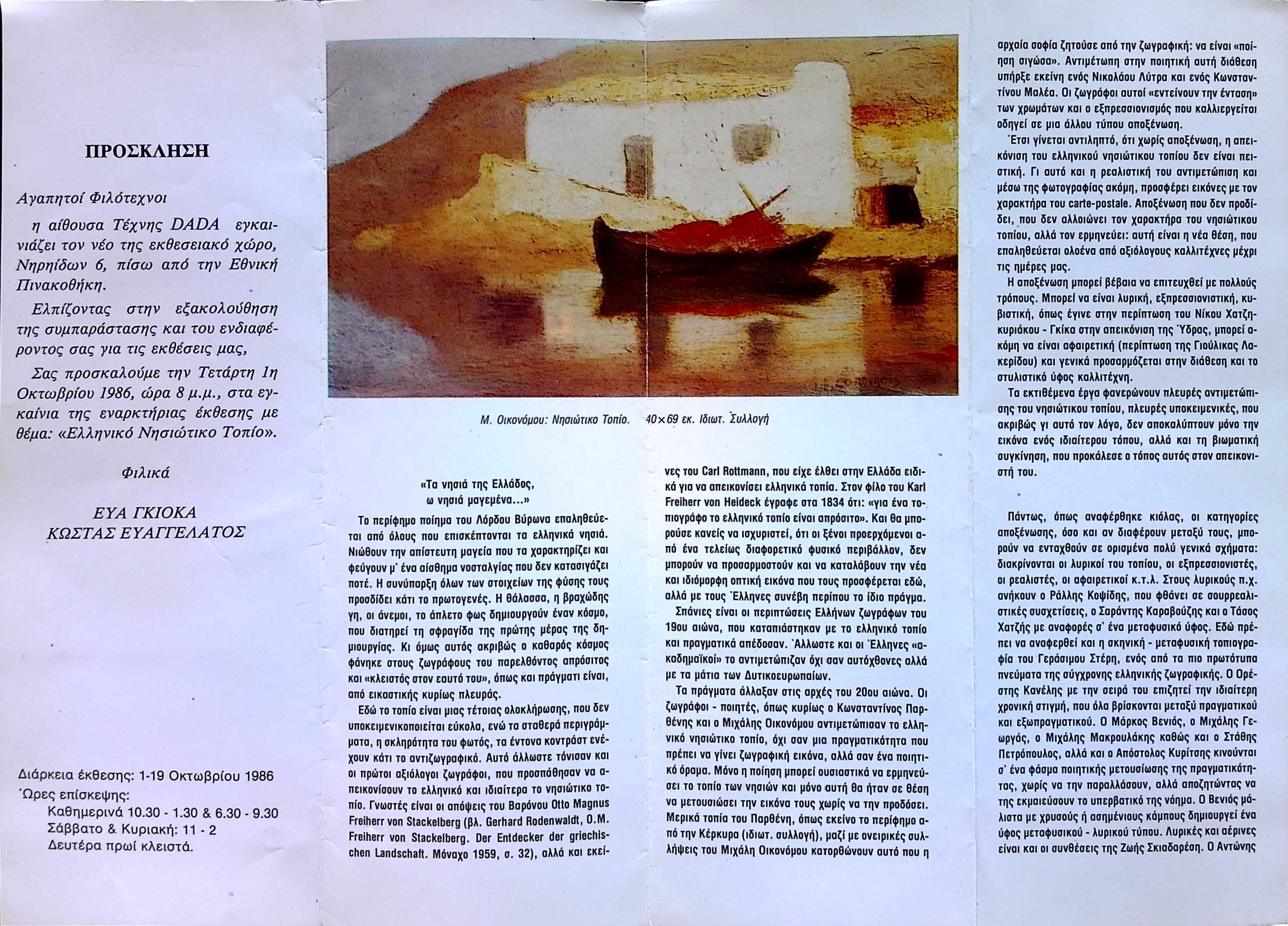
Things changed at the beginning of the 20th century. The painter-poets, primarily Konstantinos Parthenis and Michalis Ekonomou, approached the Greek island landscape not as a reality to be rendered into a painted image, but as a poetic vision. Only poetry can essentially interpret the island landscape, and only it is capable of transmuting their image without betraying it. Some of Parthenis’s landscapes, such as the famous one from Corfu (private collection), together with the dreamlike conceptions of Michalis Ekonomou, achieve what ancient wisdom demanded of painting: to be “silent poetry.” Opposed to this poetic disposition was that of Nikolaos Lytras and Konstantinos Maleas. These painters “intensify the tension” of colors, and the cultivated expressionism leads to a different kind of alienation.
Thus, it becomes apparent that without alienation, the depiction of the Greek island landscape is not convincing. This is why its realistic treatment, even through photography, offers images with the character of postcards. Alienation that does not betray, that does not distort the character of the island landscape, but interprets it: this is the new position, which is increasingly validated by notable artists up to our days.
Alienation can certainly be achieved in many ways. It can be lyrical, expressionist, cubist, as in the case of Nikos Hadjikyriakos-Ghika in the depiction of Hydra; it can even be abstract (as in the case of Yulika Lakeridou) and generally adapts to the disposition and stylistic manner of the artist.
The exhibited works reveal aspects of the approach to the island landscape, subjective aspects that, precisely for this reason, do not only disclose the image of a particular place, but also the experiential emotion that this place evoked in its depictor.
In any case, as already mentioned, the categories of alienation, however different they may be from one another, can be grouped into certain very general patterns: the lyrical landscapists, the expressionists, the realists, the abstract artists, etc., are distinguished. Among the lyrical painters, for example, belong Rallis Kopsidis, who reaches surrealist associations, Sarantis Karavouzis, and Tasos Hatzis, with references to a metaphysical style. Here, the stage-like, metaphysical landscape painting of Gerassimos Steri should also be mentioned, one of the most original minds in modern Greek painting. Orestis Kanelis, in turn, seeks the particular moment in time when everything is suspended between the real and the extra-real. Markos Venias, Michalis Georgas, Michalis Makroulakis, as well as Stathis Petropoulos and Apostolos Kyritsis, move within a spectrum of poetic transmutation of reality, without distorting it, but seeking to extract its transcendent meaning. Venias, in particular, with his golden or silver fields, creates a style of a metaphysical-lyrical type. The compositions of Zoi Skiadaresi are also lyrical and airy. Antonis
← View all 679 archival documents · Biography of Theodoros Markellos