
Review of the 7th Panhellenic Art Exhibition by M.H. Konstantopoulos
Press Clipping
ΤΕΧΝΟΚΡΙΤΙΚΑ ΣΗΜΕΙΩΜΑΤΑ , Αθήνα
TECHNOCRITICAL NOTES
THE 7th PANHELLENIC
Painting — Works and Exhibitions. — At the Zappeion Hall.
By our artistic collaborator
Mr. M. H. KONSTANTOPOULOS
We continue today our critiques of the painting works of the 7th Panhellenic:
Papá presents archaic acoustic examples from African models, color, metric abstractions, local still lifes, and a synchronized harmonic perception characterizes her works (Nos. 44, 45, and 46).
Spyros Vasiliev is a Greek writer. He has a Greek philosophy. He does not stray from following trends… “The City” (No. 49) and “Neighborhood” (No. 50). His color is pure.
Charis Voyiatzis is a worthy painter. Within his seemingly abstract works, the sea of the Aegean (No. 72) and the pure color of Attic landscapes receive their most useful painterly interpretation.
I will mention in passing the “Medieval Polity” (No. 98) by K. Giannakas. His “City of Space” is a fantastic endeavor, tri-colored in a unique hue. D. Giannoukakis is always cultivated and profound. Painting, quality in his synchronized creations.
Works perfected from every aspect (Nos. 103, 104, 105). G. Gounaropoulos is a better painter of the old guard of Greek progress, which is constantly renewing itself.
Ilias Dekoulakos has a personal touch and his own new expression within abstract painting. His palette has idiosyncratic colors, synchronized, and his brushes are rarely hesitant. “Memory 1962”.
Stavros Dalakos is an artist. His painting on the ship (No. 128) has compositional advantages, atmosphere, and chromatic quality.
K. Hiliadis has also entered the dance of the abstracts. There are in his works (Painting 1 and 2) competitions of advantages, but they do not give us anything new. I prefer, without hesitation, the old Hiliadis.
Next to the abstract perception of her work. She was a student of her works, but each path she has taken has continuity. The “Leaf Triptych” (No. 171) has dragonflies, chromatic harmony, and a heavy mood. It is sad that the other two parts of the triptych were excluded. Thus, the decoration of a creation is maimed. The selection of Zerva led her down a wrong path. Her great artistic painting is what truly convinces.
G. Evkleides is promising. He always subtracts with measure, and his works radiate with genuine chromatic elements, harmonies, and a Greek atmosphere. (Nos. 163, 164, 165).
Orestis Kanallis avoids detail. He has freed himself from the constraint of the established form. The piece (No. 202) is idyllic and rich in foliage. Rare is the chromatic harmony of this creation.
D. Kentakis is new in his new path. His works (Painting 1 and 2) are complete in their conception. His color is different.
Thalia Kleadi in plastic work No. 225 (Composition) gives us chromatic elements with personal flair. All her harmonies—a luminous existence in the Greek fire.
H. Lesakis advances with continuity. His expressive power and his color are rare in frequency. He does not work by chance. His creations are the result of deep, effective study.
Th. Markellos distances himself from Greek painting; he does not do things right. Nevertheless, his second work, “Railway Area” (No. 311), has very good chromatic and compositional elements, readability.
Koila Bikiaris paints drama and cheese. Her works live in every muse of fairy tales, between fantasy and reality. (Nos. 338, 339, 340).
G. Mouyios presents one of his works titled “Village” (No. 336). This canvas undoubtedly has compositional and chromatic advantages. His new work shows continuity and has gradually reached this point. Mouyios is a painter. He adapts easily.
Eleni Pangalou in “Eleusinion” (372) has good elements. A result of analysis.
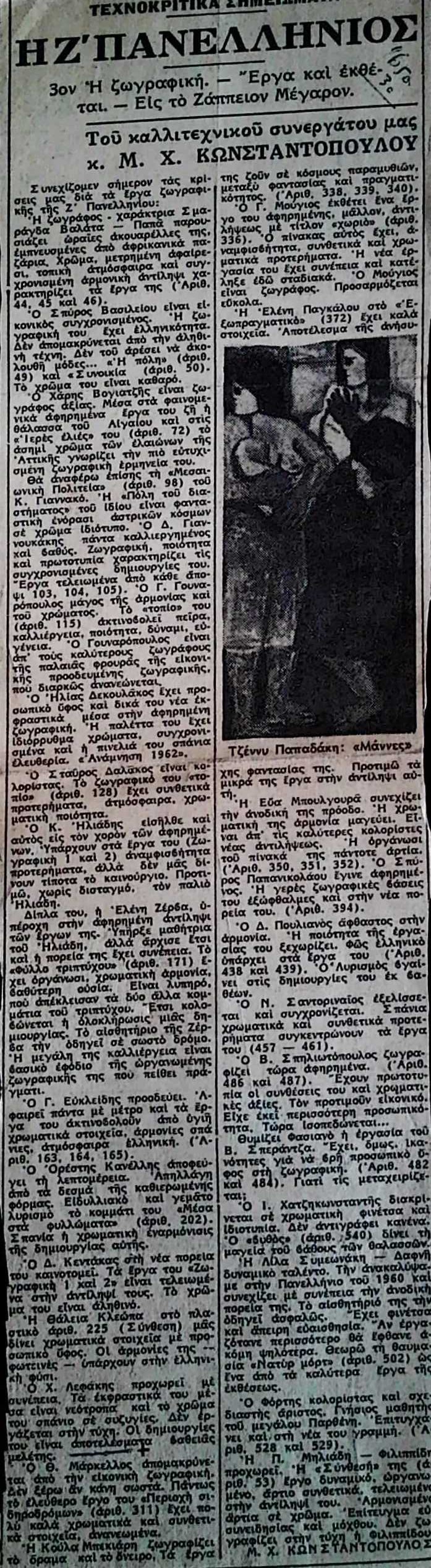
Jenny Papadaki: “Mothers”
of her imagination. I prefer her small works in this conception.
Eda Bouloura continues her upward progress. Her chromatic harmony enchants. She is one of the best painters of this conception. The drawing of her canvases is always perfect. (Nos. 350, 351, 352). Spyros Papanikolaou has become abstract. He has an outstanding work in his new path as well. (No. 394).
D. Poulianos is steadfast in harmony. The quality of his work was separating. Greek light is the weapon of his work (Nos. 438 and 439). Avrimias draws from depths in his creations.
N. Santorinaios evolves and modernizes. Rare chromatic and compositional advantages characterize his works (457–461).
V. Spiliopoulos now paints abstractly. (Nos. 486 and 487). They have originality
← View all 679 archival documents · Biography of Theodoros Markellos