
Himerisia: Critique of Celeste Polychroniadou and Efi Athanasiou (1975)
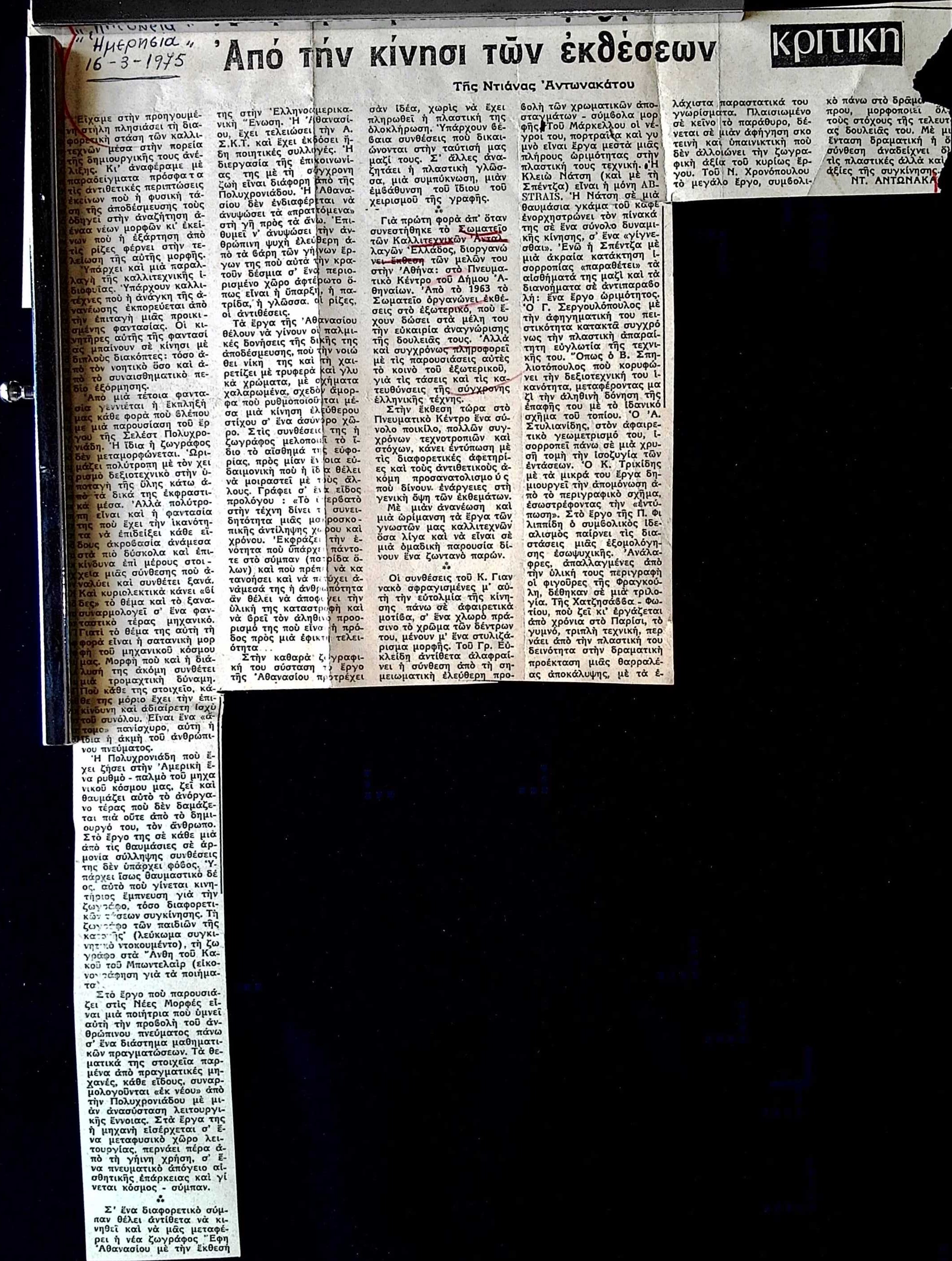
Press Clipping
— 1957
Ημερησία , Αθήνα
"Daily" 16-3-1975
From the movement of publications
By Diana Antonakatu
In the previous column, we approached the different attitudes of artists within the course of their creative evolution. And we cited recent examples of contrasting cases: those whose natural tendency toward detachment leads them to seek new forms, and those whose dependence on roots brings the same form to perfection.
There is also a variation in artistic individuality. There are artists whose drive for renewal stems from the imperative of a gifted imagination. The engines of this imagination are set in motion by dual switches: both from the intellectual and from the emotional field of departure.
From such an imagination arises our Surprise each time we see a presentation of the work of Celeste Polychroniadis. The painter herself does not transform. She matures, versatile in her skillful handling, subduing matter under her own expressive means. But her imagination is also versatile, possessing the ability to perform every kind of acrobatics among the most difficult and dangerous elements of a composition that it analyzes and recomposes. And it literally makes a "double" of the subject and reassembles it into a fantastic mechanical monster. Because the subject of this offering is the satanic form of our mechanical world. A form whose dissolution still composes a terrifying force. Where each of its elements, each of its molecules, holds the dangerous and indivisible power of the whole. It is an "untouchable" omnipotence, this edge, this peak of the human spirit.
Polychroniadis, who has lived in America, has absorbed a rhythm—the pulse of our mechanical world—and lives in awe of this monstrous giant that is no longer tamed even by its creator, man. In her work, in each of her compositions, wonderful in their harmonious conception, there is no fear. There is perhaps a reverent awe, which becomes the driving inspiration for the painter, so different in its waves of emotion. The painter of the "Children of the Dwelling" (a moving documentary album), the painter of the "Flowers of Evil" by Baudelaire (images of despair for the poems).
In the work she presents at New Forms, she is a poetess who hymns this projection of the human spirit onto a space of mathematical realizations. The themes
The elements of the machines, taken from real machines of all kinds, are “reassembled” by Polychroniadou with a reconstruction of their functional meaning. In her works, the machine enters a metaphysical space of operation, moving beyond mere utility to a spiritual zenith of aesthetics and sufficiency, becoming a world—a universe.
In a different universe, the young painter Efi Athanasiou, on the contrary, wants to move and transport us with her exhibition at the Hellenic-American Union. Athanasiou has graduated from the A.S.K.T. and has already published poetry collections. Her process of communication with contemporary life differs from that of Polychroniadou. Athanasiou is not interested in elevating earthly “doings” to the heavens. She wishes to elevate the human soul, freeing it from the burdens of the languages of her works—such as existence, homeland, language, roots, and contradictions—within an uncharted space.
Athanasiou’s works aim to become the pulsating vibrations of her own liberation, which she feels as a victory and charts with tender and sweet colors, with relaxed, almost amorphous shapes that rhythmically structure the medium into a movement of free verse within a continuous space. In her compositions, the painter sets her own feeling of euphoria to music, wishing to share it with others. She writes in a kind of preface: “The sacred gift to art gives the consciousness of a morphological perception of space and time. It expresses the unity that always exists in the universe (the homeland of all) and which humanity must understand and pause directly in, if it wishes to avoid its material destruction and find its true destination, which is the path toward an attainable perfection…”
In its purely painterly constitution, Athanasiou’s work advances as an Idea, without having achieved its plastic completion. There are foundational compositions that find justification in our identification with them. In others, she seeks a plastic language, a condensation, a deepening of the very handling of the painting.
Γ
← View all 679 archival documents · Biography of Theodoros Markellos