


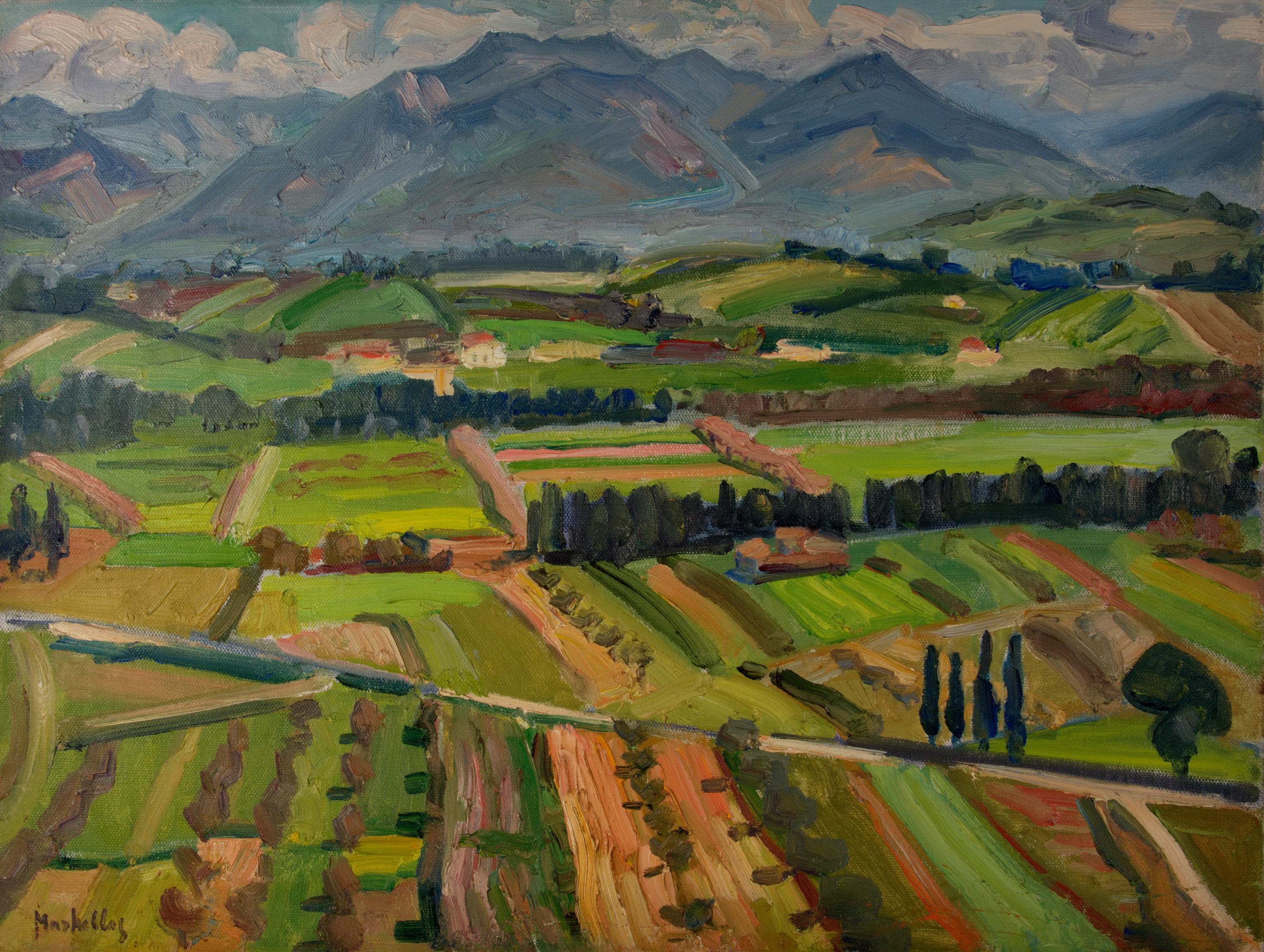
A dry-stone wall cuts across the lower canvas, its palette-knife ridges catching the gallery light at an angle that belongs as much to physics as to painting. The hill beyond it recedes in warm sienna and cadmium yellow, dissolving at its upper edge into a cerulean haze so measured it reads less like sky than like heat made visible. This is Mediterranean noon held in oil — not remembered, not imagined, but recorded with the directness of someone who has stood in it.
The Painting — From the Hill, c. 1968
This oil on canvas, measuring 60.50 by 79.50 cm, presents a sun-saturated view across a Pelion hillside toward an Aegean horizon that hovers at the painting's upper register, barely distinguishable from sky. The composition moves diagonally from the lower left — where a dry-stone wall and scattered scrub occupy the foreground with textural insistence — upward and rightward through sloping terrain, whitewashed rooftops, and a stand of vertical cypresses that anchor the scene's middle distance before everything softens into atmospheric haze.
Markellos worked alla prima, completing substantial passages in a single session to preserve the freshness that his wider body of work consistently prizes. The impasto is most forceful in the foreground — palette knife ridges of raw umber and titanium white describe the stone wall with physical conviction, so that gallery light lands on pigment the way noon light lands on actual masonry. Against this solidity, the foliage is handled with loose, wet-on-wet brushwork: viridian and olive greens applied at speed, their edges left unresolved in a way that suggests movement arrested mid-breath. The palette is deliberately constrained — cadmium yellow light, viridian, burnt sienna, cerulean blue, titanium white, raw umber — and within those limits the chromatic tension between warm sienna earth and cool cobalt shadow generates the painting's primary energy. Light here does not simply illuminate objects; it structures the entire tonal architecture of the scene, with highlights not added but preserved, held in reserve through high-key color juxtaposition and precisely calculated negative space.
The Pelion Years — Greece in the Late 1960s
This painting belongs to what is now recognized as one of the most searching decades of Markellos' career. Between 1964 and 1974 he turned sustained attention to the Greek landscape — its peninsula light, its vernacular architecture, the particular quality of a Mediterranean noon that compresses shadows into sharp-edged pools of cobalt violet beneath whitewashed eaves.
The historical circumstances are inseparable from the work. Greece in the late 1960s was under military rule, and for many artists the landscape became a form of cultural insistence — a way of asserting continuity with something older and more durable than politics. Markellos had spent the early 1960s in Paris, absorbing atmospheric nuance at the École des Beaux-Arts, and before that in Madrid, where the critic Galindo noted in 1955 a strong individuality, and Mariano Thomas wrote that Markellos felt the Castilian landscape more deeply than many Spanish painters. Returning to Greece, he brought those European lessons home — not to replicate them but to subject them to Greek light, to test whether an eye trained on the grey luminosity of northern studios could be recalibrated for a Mediterranean noon that leaves no shadow uncertain.
Where contemporaries such as Fassianos pursued decorative flatness and Tsarouchis drew on figurative classicism, Markellos remained committed to volumetric, atmospheric representation rooted in plein air observation. The critic Lydakis captured it precisely: simultaneously lyrical and energetic. From the Hill is both — the lyrical in its suspended, heat-hushed stillness, the energetic in the restless, tactile surface that refuses to let the eye simply settle.
Looking Closer — The Wall Where Paint Becomes Stone
Direct your attention to the lower foreground, where the dry-stone wall meets the picture plane. Here Markellos sets down the brush in favor of the palette knife, building pigment into physical ridges — raw umber deepened at the joints between stones, titanium white pressed along upper edges where afternoon sun strikes horizontal surfaces at its most direct. The impasto is not decorative; it performs an optical function. Actual light catches actual paint, so that the wall's materiality is felt as much as read.
This is chiaroscuro achieved through texture rather than tonal gradation alone — a technique Markellos refined consistently across his Pelion and Aegean period canvases. The contrast between this dense, knife-worked foreground and the loose, glazing-like transparency of the distant sea creates a spatial logic that pulls the viewer into the scene by degrees. It is also, in miniature, a statement about the nature of painting itself: that surface and subject are inseparable, that the pressure of a knife on canvas is part of what is being communicated about the pressure of noon on stone.
About Theodoros Markellos
Theodoros Markellos was born in Athens in 1925 and died in 2015, leaving a body of work exceeding 750 paintings. He trained at the Athens School of Fine Arts, graduating in 1953 with special distinction, before pursuing advanced study at the Royal Academy of San Fernando in Madrid from 1954 to 1957, and subsequently at the École des Beaux-Arts in Paris from 1960 to 1962. His work passed through several well-defined periods: early plein air landscapes in Spain and Greece; the atmospheric canvases of his Paris years; the luminous Pelion and Aegean paintings of 1964 to 1974; a mature phase centered on Venice and harbor subjects; and a late period marked by increasingly gestural handling. He came from a family with deep roots in Greek history — the Markellos Tower in Aegina stands as a monument to the War of Independence of 1821. Read the full biography.
There is a quality particular to paintings that hold stillness and restlessness in the same moment — that record a noon of extraordinary intensity while the surface itself vibrates with the effort of that recording. From the Hill belongs to that category: a landscape without drama or rhetoric, grounded in the specific weight of Greek light and the specific resistance of stone, making its quiet case entirely through the evidence of paint.


.jpg)