

The Painting — Storm in Skopelos
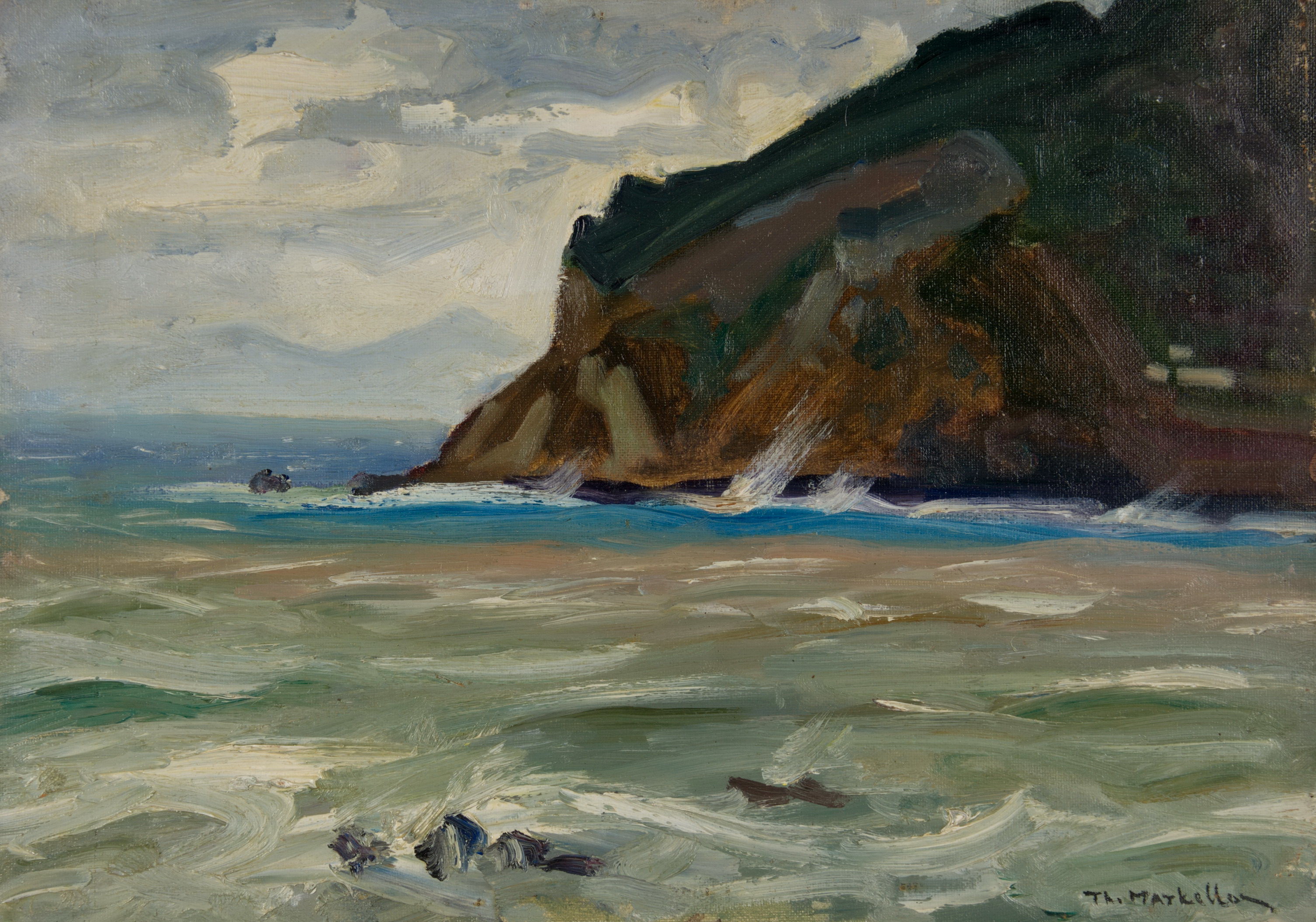
On a compact oil-on-fiberboard support measuring just 37 by 52 centimetres, Theodoros Markellos conjures a seascape of considerable force. The composition follows a bold diagonal thrust from the agitated lower-left quadrant — crowded with jagged, churning wave forms — upward and rightward into a sky heavy with wind-driven cloud. The horizon line sits just below the midpoint of the picture plane, a deliberate choice that gives the atmospheric drama above equal weight with the turbulent water below.
A dark, compact silhouette representing the island of Skopelos anchors the right edge of the composition. Its solidity — dense, almost geological — provides the single fixed point in an otherwise fluid and unstable picture. Against the surrounding chaos of water and cloud, it reads as both refuge and resistance.
The palette is saturated yet naturalistic: deep umbers, slate blues, and stormy grays dominate, punctuated by sudden flashes of cool white where light fractures through cloud breaks and catches the crests of breaking waves. These chromatic contrasts are precise rather than decorative, capturing the particular quality of Aegean light under atmospheric duress.
Markellos's brushwork is visibly energetic and purposeful throughout. Short, choppy marks define the foam and wave peaks, while broader, sweeping strokes model the cloud mass and the island's contour. Where the paint is applied most thickly on cresting wave forms, the impasto surface reinforces the physical sense of water in motion. In the sky, thinner, more atmospheric passages suggest the speed and weight of moving cloud. The texture of the fiberboard support remains perceptible beneath these varied applications, lending the work a material honesty that suits its subject entirely.
A Career Built on Atmosphere
Theodoros Markellos was born in 1925 and worked as a painter in Athens until his death in 2015, producing a catalogue of approximately 750 works across nine decades of practice. Throughout that long career, the natural world — and in particular the quality of light across land and sea — remained a persistent subject. Storm in Skopelos sits comfortably within that sustained engagement.
What distinguished Markellos from a number of his Greek contemporaries was his commitment to representational, volumetric, and atmospheric painting at a time when other significant figures in Greek art were moving toward flatter, more decorative, or more geometrically abstract modes of working. Where painters such as Fassianos pursued decorative surface and Moralis moved into geometric abstraction, Markellos remained committed to the observed world rendered with expressive force. That commitment carried its own kind of discipline — not the discipline of reduction, but of attention.
Working primarily in oil on a range of supports — canvas, fiberboard, plywood, and cardboard — he developed a practice that the visual evidence suggests balanced plein air directness with considered compositional structure. Storm in Skopelos reflects both qualities: the urgency of a scene witnessed and felt, shaped by a hand confident in how to organize a picture. The work belongs to a body of seascapes that collectively suggest a deep and recurring engagement with the Aegean coast and its unpredictable meteorological character.
You can view additional works across his practice in the full gallery collection, which brings together oils and studies spanning several decades.
Looking Closer — The Island Silhouette
The dark mass of Skopelos at the right edge of the composition deserves particular attention. In purely formal terms, it performs essential work: without it, the painting's diagonal energy would have nowhere to resolve, and the eye would simply exit the picture at the upper right. The silhouette provides what the churning sea and shifting cloud cannot — a fixed, opaque, grounded form against which all the surrounding motion becomes legible as motion.
Aesthetically, the contrast operates on a tonal as well as a spatial level. The island is painted in the deepest values in the picture — dense, almost undifferentiated dark — which places it in stark relief against both the lighter cloud passages above and the flashing foam below. This chiaroscuro relationship between the island and its surroundings gives the composition a sense of drama that goes well beyond meteorological description. The darkness of the land form does not merely represent rock and vegetation; it concentrates the emotional weight of the whole picture into a single, grounding presence. Everything else moves. This does not.
For a related work that engages similar tensions between grounded mass and open atmosphere, see this companion seascape in the collection.
About Theodoros Markellos
Theodoros Markellos (1925–2015) was an Athens-based Greek painter whose career spanned the second half of the twentieth century and extended into the early twenty-first. Working primarily in oil on a range of supports — including canvas, fiberboard, plywood, and cardboard — he produced a catalogue of approximately 750 works. His practice centred on representational and atmospheric painting, with a persistent interest in landscape, seascape, and the particular qualities of Mediterranean light. His approach combined expressive energy with careful observation, and his long commitment to the painted, visible world distinguished his work within the broader landscape of twentieth-century Greek painting.
A more complete account of his life and practice is available on the artist biography page.
Storm in Skopelos is a painting that rewards the kind of attention it demands — which is to say, an active, restless attention rather than a contemplative one. The storm it depicts does not invite reverie so much as it insists on presence: the sensation of wind, the sound of water, the particular weight of a sky about to break. In a format smaller than a sheet of A3 paper, Markellos compresses a great deal of force — and, in doing so, demonstrates that scale and intensity are entirely separate concerns.


.jpg)
