

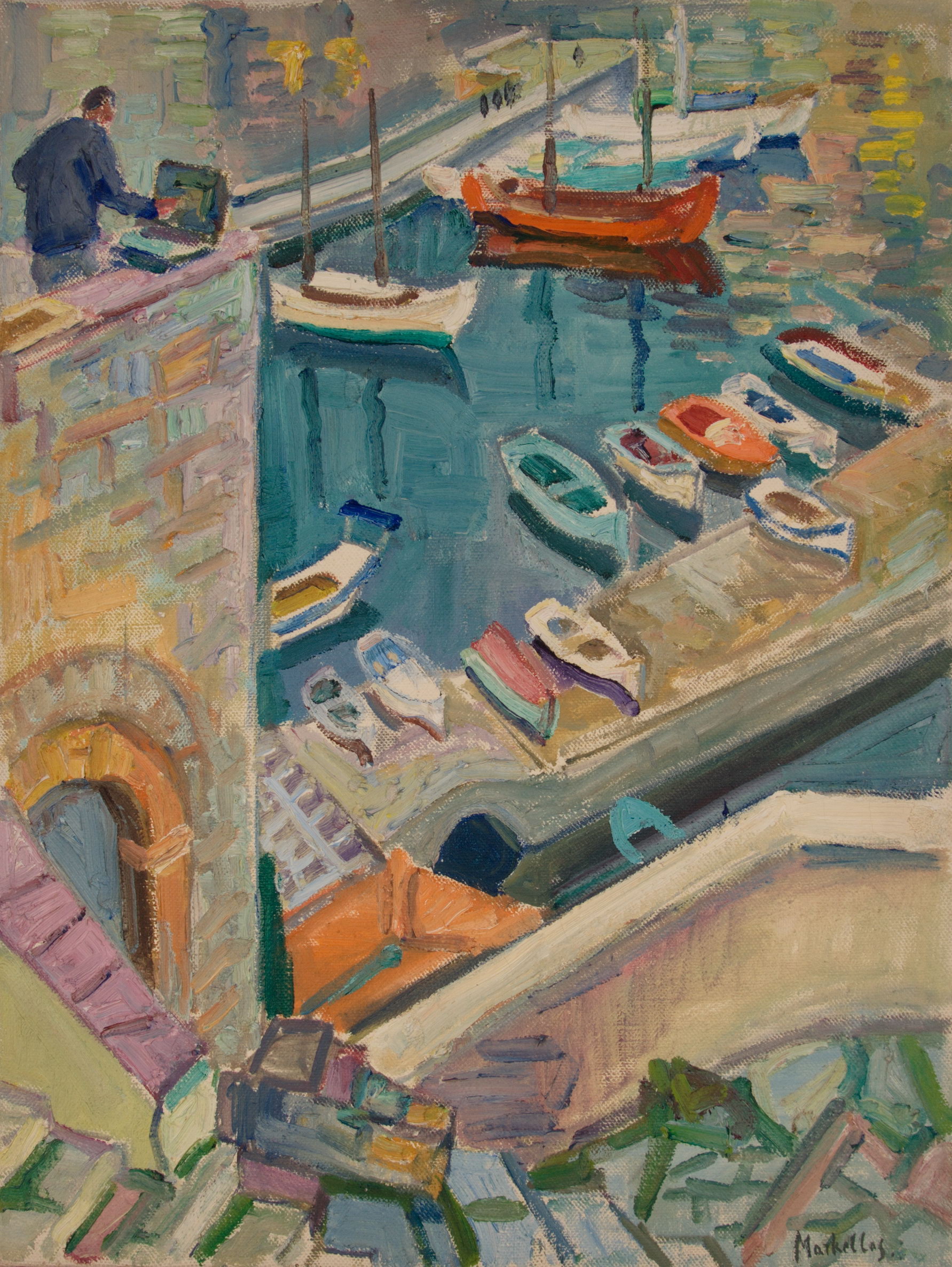
From a quiet threshold above the harbor, warm light spills across whitewashed walls and settles into the stillness of anchored boats below. Stone architecture frames the foreground like a stage wing, and beyond it, an entire island town descends in terraced layers toward a sea that mirrors the softness of the sky above. The painting does not reach for effect — it simply holds its ground, and the ground is luminous.
The Painting — Hydra from the School Entrance, Nionios Painting
Seen from an elevated vantage near a school entrance, this oil on canvas (46 × 61 cm) presents Hydra's harbor town as a study in luminous order. Architectural elements — stone steps, perhaps a columned threshold — anchor the foreground, creating a natural proscenium through which the eye travels downward and inward. Terraced whitewashed buildings cascade along steep hillsides, their geometry softened by the ambient warmth of Mediterranean light. At the base of this descent, a placid harbor holds small boats at rest, their masts rising as quiet vertical punctuation against the horizontal calm of sea and sky.
The palette is centered on luminous whites, azure blues, and warm ochre earth tones — colors that feel entirely native to Aegean coastal light. Markellos varies his paint application with evident deliberateness: thin glazing in the sky and water areas lends those passages an airy transparency, while impasto accents along sunlit architectural edges give the stonework a palpable, tactile weight. The brushwork throughout is energetic but not restless. Broad strokes define the massing of buildings and the contours of the hillside; finer, more considered marks pick out masts, window openings, and the suggestion of laundry lines strung between walls.
Light here is not dramatic — there is no theatrical chiaroscuro, no sharp division of shadow against brilliance. Instead, the scene is suffused with a warm, even clarity that emphasizes spatial recession and volume over surface incident. The painting suggests the quality of observation that comes from unhurried looking: a scene absorbed rather than seized.
A Painter's Eye for Place — The Aegean in Oil
Theodoros Markellos was born in 1925 and lived and worked in Athens until his death in 2015, producing a body of work that now numbers some 750 paintings. Over the course of a career spanning nine decades, he remained — through shifts in taste and the rise and fall of successive avant-gardes — a painter committed above all else to the visible world. That sustained fidelity is itself a kind of discipline.
This painting of Hydra's harbor illustrates the qualities that distinguish Markellos within the broader landscape of twentieth-century Greek painting. Where Alekos Fassianos favored decorative flatness and Yannis Moralis moved toward geometric abstraction, Markellos sustained a representational practice rooted in volumetric, atmospheric realism. His concern was not with stylization but with the way light actually behaves on stone and water — the way a harbor town actually sits within its landscape.
The Aegean coast offered him precisely the conditions his sensibility required: strong, clear light; architecture that casts readable shadows; water that reflects and complicates the sky above it. This work suggests a plein air origin — the directness of observation feels present in every stroke — though the compositional confidence and tonal coherence point equally to the kind of considered refinement that characterizes his resolved canvases. The result holds both the spontaneity of the observed moment and the stability of a fully worked composition, neither sacrificed to the other.
Markellos painted the island not as symbol or shorthand but as a place genuinely attended to — its stone, its water, its particular quality of afternoon light. That attentiveness is what the canvas preserves. Learn more about the artist's approach and full body of work in the Theodoros Markellos biography.
Looking Closer — The Foreground Threshold
Among the most quietly effective decisions in this composition is the presence of architectural elements in the immediate foreground — stone steps or a columned entrance — that serve as a framing device before the harbor panorama opens up. This threshold is not merely decorative. It establishes a spatial logic: the viewer is positioned within a place, not simply in front of a view. There is a sense of having paused at a doorway, of the painting beginning precisely where ordinary movement stops.
Aesthetically, this layering of foreground, middle ground, and distance gives the 46 × 61 cm canvas a sense of depth that considerably exceeds its physical dimensions. The eye is guided — through the stone frame, across the descending rooftops, and finally out to the harbor and sky — in a movement that feels natural rather than engineered. The chromatic shift that accompanies this recession, from the warmer, more textured tones of the foreground stonework to the cooler azure of the distant water, reinforces the spatial journey without announcing itself. It is compositional intelligence at work: modest in its means and precise in its effect.
Browse related works in the Markellos online gallery, including other paintings of harbors and Aegean coastal scenes.
About Theodoros Markellos
Theodoros Markellos (1925–2015) was an Athens-based Greek painter whose career spanned more than six decades. Working primarily in oil on canvas, he produced a catalogue of approximately 750 works notable for their atmospheric realism, vibrant chromatic range, and sustained commitment to representational painting. Markellos developed a personal visual language that balanced the energy of direct observation with considered compositional structure, engaging consistently with Greek landscape, architecture, and coastal light. His paintings prioritize atmosphere and volume over stylization, building their effects through careful tonal relationships and varied paint application. A full record of his life and work is available in the Theodoros Markellos biography on this site.
This painting of Hydra's harbor — seen from a school entrance, still and luminous — does not announce itself. It rewards the patient eye: the way light holds in the whitewashed walls, the way the boats rest as though they have always been there, the way a stone threshold turns a view into a place. The school entrance in the title is more than location; it implies a particular quality of seeing — attentive, unhurried, oriented toward the world as something worth knowing. That is the quality the canvas continues to offer anyone who pauses long enough before it.


.jpg)