

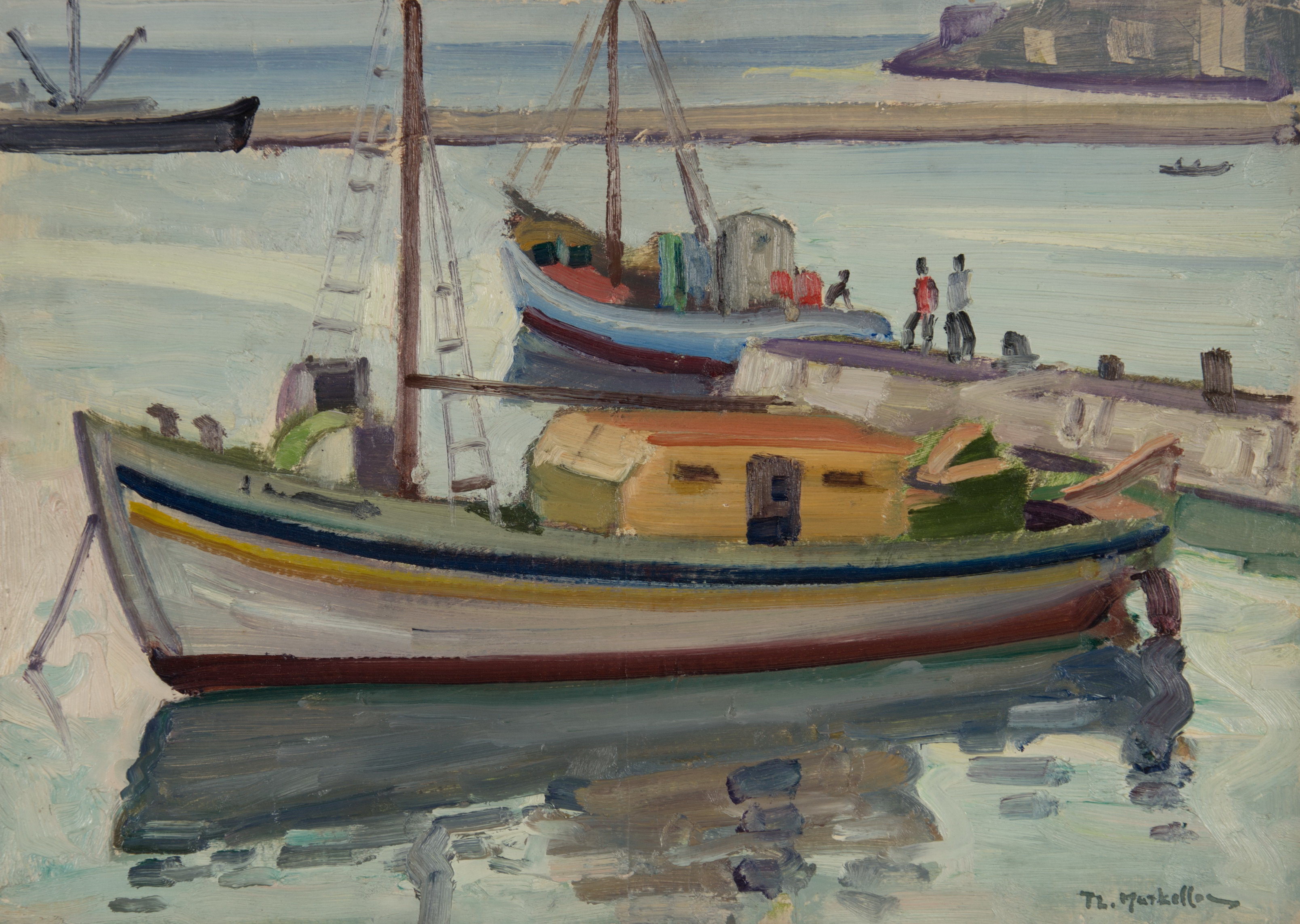
The rigging of a moored kaïki catches the eye first — taut lines crossing a luminous sky, anchoring the viewer to the quiet rhythm of a Dodecanese port. Whitewashed walls marked with cobalt blue shutters recede into the midground, and the water below holds soft, broken reflections of hull and stone. This is a harbor observed at rest, full of life that has momentarily paused.
The Painting — At Kalymnos Harbor
In this oil on fiberboard measuring 33 × 46 cm, Markellos composes a horizontal scene that moves the eye steadily from foreground water to distant cliff through layered intervals of stone, plaster, and open sky. The foreground is occupied by traditional Greek fishing boats — kaikia — their hulls textured and present, their rigging drawn as fine diagonals against the pale upper register of the composition. The boats are moored without urgency, their lines slack or coiled, suggesting the unhurried tempo of a working harbor in afternoon light.
The palette is characteristically Mediterranean: cerulean and cobalt carry the water and shutters, while ochre and warm white define the quayside buildings. Shadow is introduced sparingly — a gray-blue beneath an overhang, a darkened hull reflection — so that the overall impression remains luminous rather than dramatic. The light appears diffused, without a single harsh edge, lending the scene a unified atmospheric clarity that holds every element of the composition in the same quiet hour.
Faint human figures appear in the composition — a fisherman on the quay, perhaps another presence on a sunlit balcony — but they do not assert themselves. They function as markers of scale and of ordinary life, present without being the subject. The background dissolves into soft-edged cliffs handled with atmospheric perspective, the forms losing definition as they recede, reinforcing the sense of depth without competing with the foreground activity.
Markellos's brushwork shifts register across the surface: energetic and broken in the water reflections and rope coils, where impasto builds tactile weight on the fiberboard support, and smoother, more resolved in the sunlit walls. The result balances plein-air immediacy with a considered compositional structure — observation and arrangement held in equal proportion.
A Painter Rooted in the Observable World
Theodoros Markellos lived and worked between 1925 and 2015, spending the greater part of his career based in Athens. Across a body of work that numbers approximately 750 paintings, he remained committed to representational painting at a time when abstraction drew many of his contemporaries away from the observable world. Where painters such as Moralis moved toward geometric abstraction and Fassianos toward decorative flatness, Markellos continued to pursue what the eye actually encounters: volume, atmosphere, and the particular quality of light as it falls on a specific place at a specific hour.
A work like At Kalymnos Harbor sits naturally within that sustained commitment. The Aegean coast offered conditions that suited his approach — strong ambient light that clarifies form without eliminating nuance, vernacular architecture with its whitewash and color accents, and working harbors that provided both compositional structure and human presence. The scene is rendered with the attentiveness of someone who has looked at it carefully, not as a picturesque arrangement but as a place with its own internal logic.
The discipline visible in this work — the way the tonal structure holds across the full horizontal span, the way figures are placed rather than posed — suggests a painter who had earned his fluency and chose to spend it on quiet, observational subjects rather than on dramatic effect. At Kalymnos Harbor carries that quality: authority worn lightly, in service of the scene rather than the signature. Browse the full collection of Markellos works in the gallery to follow this commitment across different subjects and scales.
Looking Closer — The Water Reflections
The water in the lower portion of the composition rewards sustained attention. Rather than rendering the harbor surface as a smooth mirror, Markellos breaks it into short, directional strokes that suggest movement without describing waves. The chromatic range here is wider than it first appears: cerulean sits alongside cooler blue-grays, and the reflected ochres of the hull surfaces introduce warmth into what might otherwise read as a uniform expanse.
This is where the fiberboard support makes itself felt most clearly. The slight tooth of the surface catches the loaded brush and holds the marks as distinct events, each stroke retaining its identity rather than blending into its neighbor. The effect is a water surface that feels optically accurate — unstable, light-reactive — without being labored. It is a passage that demonstrates how tonal control and energetic application can coexist: the values are carefully managed even as the execution feels spontaneous.
Aesthetically, this section anchors the composition. The horizontal bands of the scene — water, quay, building, sky — might risk monotony without a foreground element that holds visual energy. The broken reflections provide exactly that: a zone of activity that draws the eye in before releasing it upward through the architecture and sky beyond.
About Theodoros Markellos
Theodoros Markellos (1925–2015) was an Athens-based Greek painter who worked primarily in oil across a career that produced approximately 750 documented works. He painted on canvas, fiberboard, plywood, and cardboard, bringing to each support an energetic brushwork that balanced plein-air directness with considered compositional structure. His work is representational and atmospheric, rooted in the observable world — landscape, harbor, coast, and the particular qualities of Mediterranean light — at a time when much Greek painting moved toward abstraction or stylization. To learn more about his life and practice, read the full biography of Theodoros Markellos. To see a related work from a similar subject, view another harbor composition from the collection.
At Kalymnos Harbor is not a painting that announces itself. It asks for the kind of looking it was itself made through — patient, unhurried, attentive to the way light organizes a familiar scene into something worth recording. What remains is the quiet assurance of a painter who trusted that attentiveness, in the end, was enough.


.jpg)