

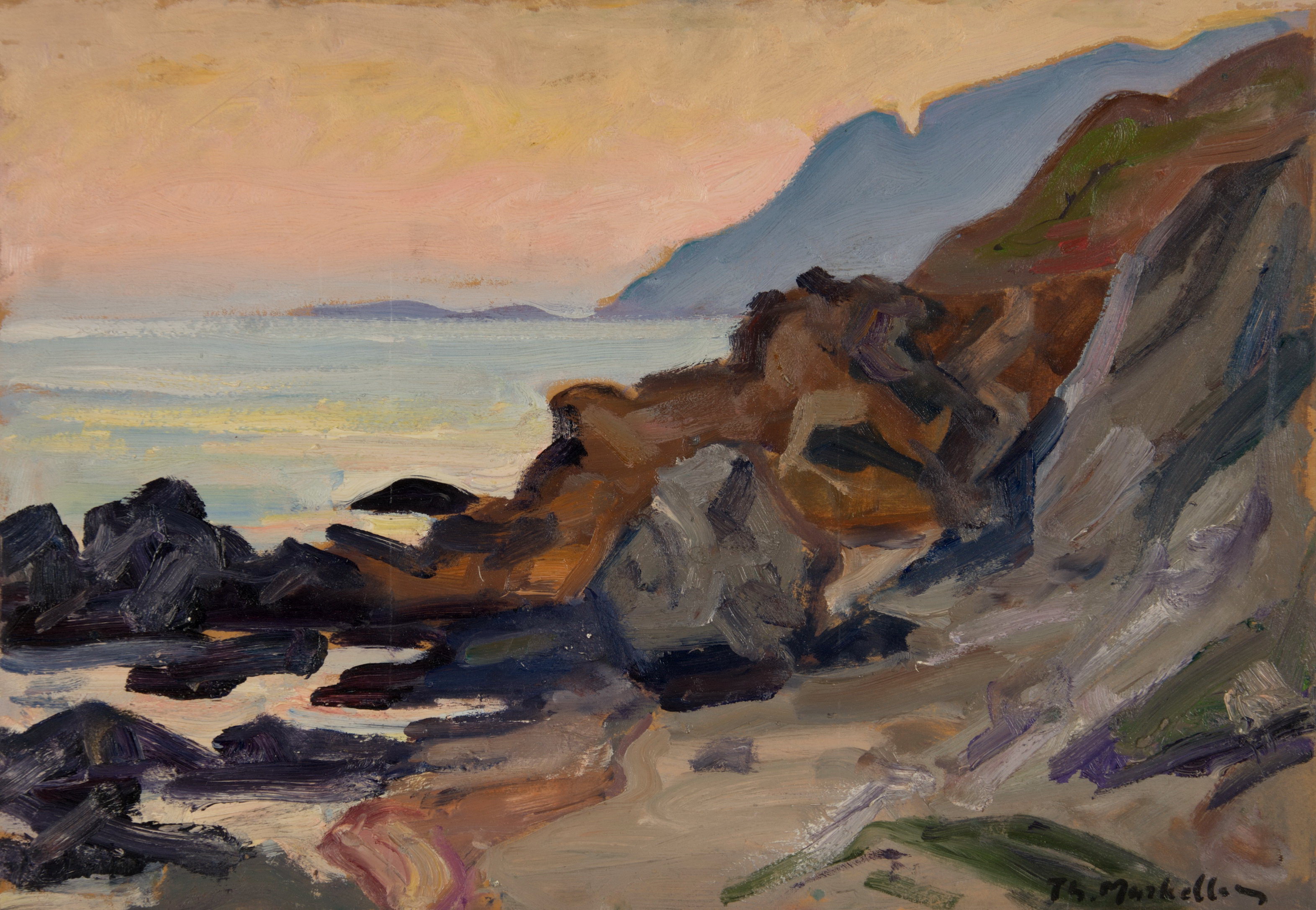
Light here doesn't fall — it lingers. In Sunset in Kalymnos, warm ochres spread across cloud edges and rooftop contours as the unseen sun recedes beyond the frame, suffusing the entire composition with a suspended, amber-tinted stillness. The sea below offers no resistance, only a quiet mirroring of what the sky chooses to give.
The Painting — Sunset in Kalymnos
Painted in oil on fiberboard and measuring 35 by 50 centimetres, Sunset in Kalymnos is a horizontally structured seascape in which sky, sea, and land arrive at a moment of delicate equilibrium. The horizon line sits just below the vertical midpoint of the composition, a deliberate decision that grants the sky its full authority. Cloud formations drift across the upper register, their edges gilded with soft pinks and warm ochres where the light catches them, while their bodies dissolve into cooler, muted tones further from the source.
To the right, a cluster of whitewashed buildings with terracotta roofs rises from rocky terrain, their architectural mass rendered not through precise draftsmanship but through abbreviated, confident dabs of pigment that suggest solidity without insisting upon it. This asymmetrical placement anchors the composition without crowding it, allowing the eye to travel freely across the broad, luminous sea that fills the lower left of the picture plane.
The absence of human figures or vessels is not an oversight — it is the painting's essential condition. Without narrative intrusion, the work becomes a study in atmospheric fidelity. The palette moves through saturated earth tones — burnt sienna, muted cobalt, warm ochre — applied in a manner consistent with wet-on-wet technique, allowing hues to blend at their edges and produce the soft, continuous transitions that characterise fading Mediterranean light. The fiberboard support lends the surface a subtle matte quality that enhances the painting's sense of absorbed, rather than reflected, warmth.
A Long Career and the Pull of Coastal Light
Theodoros Markellos lived and worked in Athens from 1925 until his death in 2015, building a body of work that spans approximately 750 paintings across canvas, fiberboard, plywood, and cardboard. Throughout that long career, the seascape occupied a recurring and significant place in his practice — not as a fixed subject so much as a recurring opportunity to confront the particular qualities of Aegean and Mediterranean light: its intensity, its rapid transformation at the margins of day, its capacity to dissolve the boundary between sky and water.
Sunset in Kalymnos reflects this preoccupation with clarity and conviction. Working in the tradition of plein air painting — direct engagement with a scene in its natural conditions — Markellos prioritised atmosphere over documentary detail. The result is a painting that feels less like a record of a specific place and more like a concentrated experience of light at a specific hour.
What distinguishes this work within his broader output is the restraint that underlies its apparent spontaneity. The composition is carefully balanced; the chromatic range, though warm and saturated, is held within a coherent tonal structure that prevents any single element from overwhelming the whole. This balance between lyrical impulse and compositional control is one of the qualities that characterises his approach to the seascape across a practice spanning nine decades.
For further context on his life and working methods, visit the artist biography page. To view related seascape works from his catalogue, see this related painting or browse the full gallery.
Looking Closer — The Gilded Cloud Edges
The most quietly arresting detail in Sunset in Kalymnos is the treatment of the cloud formations in the upper register of the composition. Rather than rendering clouds as defined, volumetric forms, Markellos approaches them as zones of tonal transition — areas where warm light from the unseen sun meets cooler atmospheric shadow. The edges of the clouds catch ochre and pale gold; their interiors shift toward grey-blue and violet. This is chromatic harmony in careful practice: warm and cool tones held in proximity without conflict, producing the visual sensation of air that is both luminous and dense.
Aesthetically, this passage does significant work. It establishes the light source — invisible, beyond the frame — as the painting's true subject. Everything else in the composition, from the reflective surface of the sea to the sun-warmed contours of the rooftops, is organised in relation to this absent centre. The cloud edges are where that relationship is most legible, and most beautiful in their suggestion of transience. In so small a format, they carry an outsized expressive weight.
About Theodoros Markellos
Theodoros Markellos was born in 1925 and died in 2015, spending the entirety of his working life based in Athens, Greece. An oil painter by primary practice, he produced a catalogue of approximately 750 works across a range of supports including canvas, fiberboard, plywood, and cardboard. His approach consistently favoured plein air engagement with landscape, seascape, and urban environment, combined with atelier refinement — a balance between observed immediacy and compositional consideration. He worked within an impressionist realist tradition, emphasising atmosphere, light, and the expressive potential of colour over the precise rendering of form.
Sunset in Kalymnos holds its moment with a kind of quiet insistence — not drama, not nostalgia, but the simple, considered fact of light withdrawing from water and stone. In a small format of 35 by 50 centimetres, it contains something larger than its dimensions might suggest: the particular stillness of a coast at the edge of dark. That stillness, rendered in warm pigment on fiberboard, continues to ask for the slow, attentive gaze it was painted to receive.


.jpg)