Greece, Late 1960s — Before Everything Changed
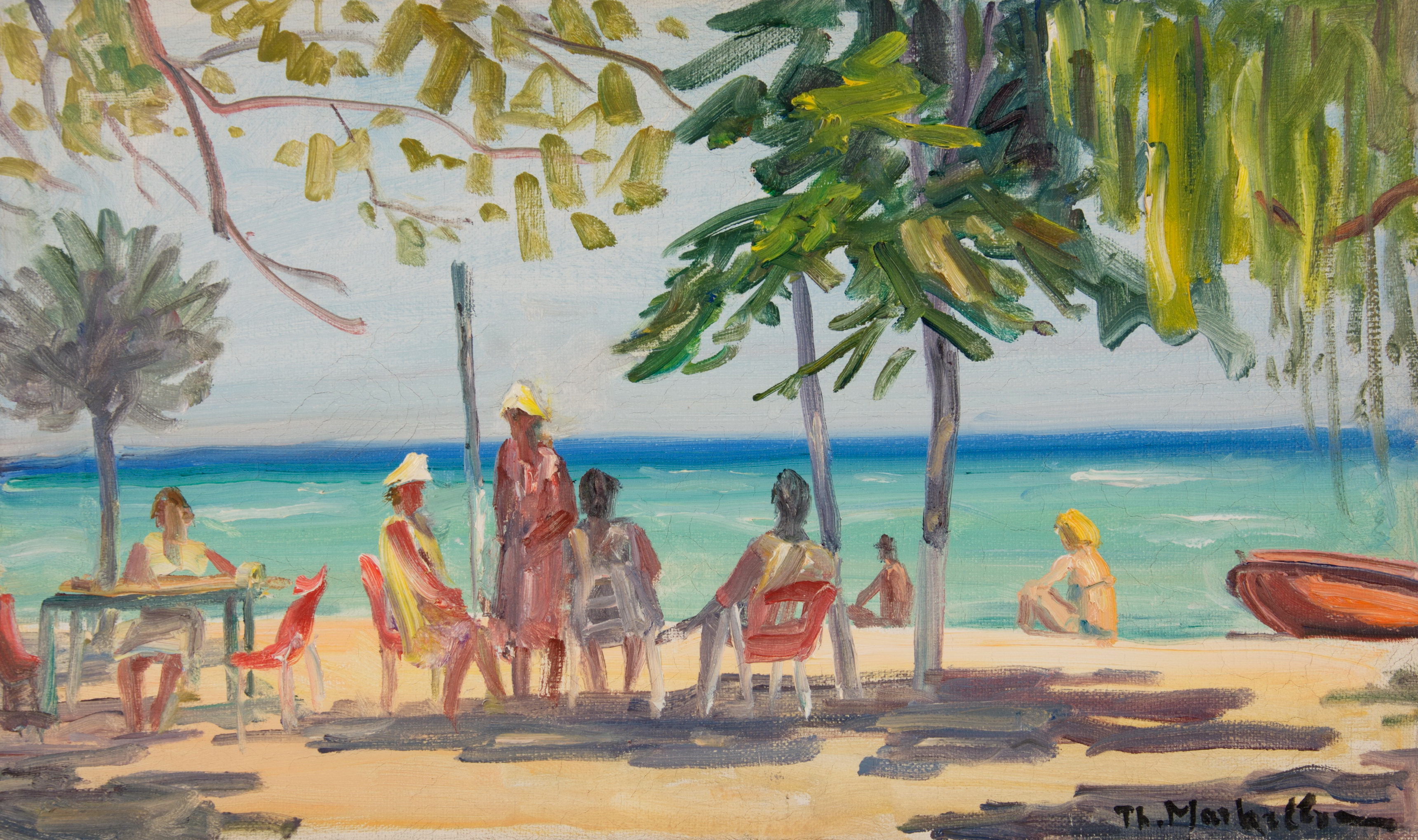
No terrace. No fence. No boundary between the café and the beach. The chairs stand directly in the sand, the tables are in the sand, and the people sit with the sea a few meters behind them. This is a specifically Greek phenomenon from the 1960s — the small café wasn't an establishment inside a building. It was simply a table and a few chairs placed wherever it was nice.
Theodoros Markellos painted Nerantza probably in the late 1960s or early 1970s, when Greece was discovering domestic leisure after the post-war decades. Beach cafés like this one were symbols of that era — simple, direct, democratic. Not luxurious. Not architectural. Just a chair where it was good to sit.
The Painting: Eight Figures, No Faces
Eight figures. Four trees. One red boat.
Markellos stood at a distance — at the level of the scene, not above it. The view is horizontal, almost panoramic. The figures are distributed across the entire canvas: from the far left (two people at a table) to the far right (a woman in a bikini alone on the sand, her café the solitude and the water).
None of them have faces. None have anatomical detail. Recognition comes from pose, color, and context. The dominant figure — a standing woman in a rose-brown dress with a wide yellow hat — is the center of the entire scene. She is the only one standing among the seated. She is the best lit, the most clearly defined. She is talking to someone just off to her left.
This is how Markellos painted people. Not by rendering them — by placing them. You've been in this scene yourself. You just didn't know you were looking at a painting.
Technique and Style: The Impressionist's Shorthand
The trees are not painted leaf by leaf. Markellos paints masses of light and shadow — wide downward and lateral brushstrokes that create a sense of movement even in a static canvas. The crowns look like they're already trembling in the heat.
The water is horizontal parallel strokes in three tones of turquoise — lighter at the horizon, deeper in the middle, lighter again at the sky's reflection. The simplicity is masterful.
The figures are color silhouettes. Resembling Degas or early Cézanne in the treatment of figures within space — recognizable from context, not from detail. The red chairs anchor the foreground with their vermillion against the ochre sand, creating a horizontal rhythm of color accents.
The Red Boat in the Corner
Far right, in the foreground: the bow of a red wooden boat.
At first glance, a secondary detail. But it performs three precise functions.
First, coloristic: the vermillion of the boat is in direct harmony with the vermillion of the chairs. Markellos linked these objects chromatically and created a rhythm of red accents across the horizontal plane.
Second, compositional: the boat closes the right side of the canvas. Without it, the space to the right would feel unresolved.
Third, narrative: it is the only object that hints at beyond the scene — the sea, a journey, tomorrow. Every other element is here and now. The boat is maybe soon.
The Work Today
Catalog M526. Oil on canvas. 50×30 cm. Estimated 1960s–1970s.
The beach café at Nerantza is gone, or transformed. The Greece that Markellos painted — before package tourism, before concrete hotels, before the coastline became a product — exists now mostly in canvases like this one.
What did the woman in the yellow hat say? What was the conversation at the table on the left about? The painting doesn't tell you. That's not an oversight. That's the point.