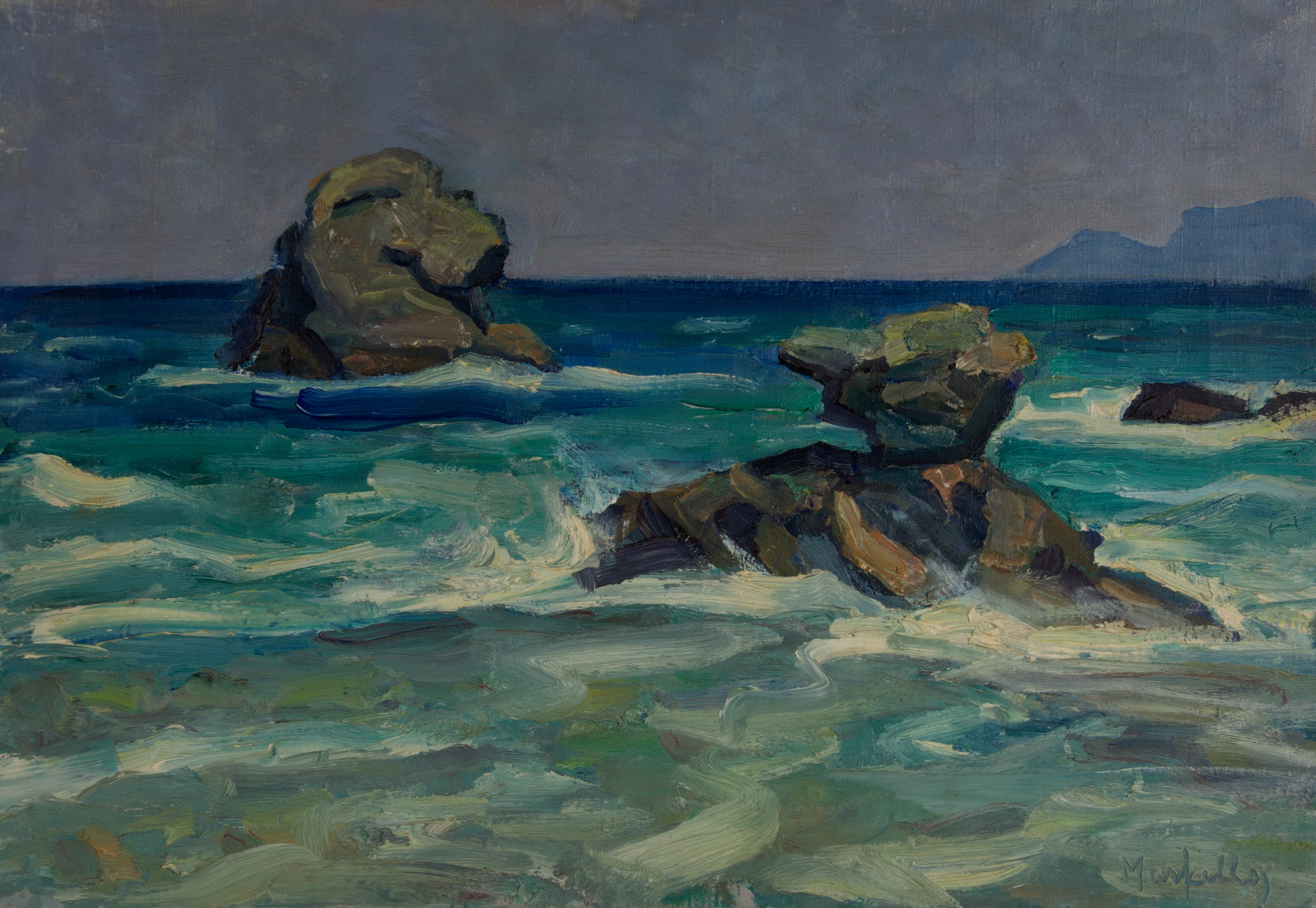
Two limestone outcrops hold their ground against a sea that refuses to be still. In Skopelos, Two Rocks in the Sea, the water moves in shifting registers of turquoise and cobalt, its surface broken by a breeze that carries light rather than obscures it. The rocks absorb the sun and give it back transformed — warm ochres and pale grays radiating the particular heat of an Aegean afternoon.
The Painting — Skopelos, Two Rocks in the Sea
On a canvas measuring just 38 by 55 centimetres, Markellos captures a composition of considerable spatial ambition. Two weathered outcrops occupy the lower portion of the picture plane — the larger anchoring the left, the smaller receding to the right — their irregular silhouettes the product of what appears to be generations of wind and saltwater erosion. The rocks are built up with impasto passages: thick, directional strokes that give the stone both physical weight and optical texture, suggesting the rough crust of lichen and mineral deposit without resorting to trompe-l'œil literalism.
The sea surrounding them is handled with altogether different means. Here the brushwork becomes fluid and layered, cerulean near the rocks giving way to deeper ultramarine where the water gathers shadow. The palette is disciplined — blues, ochres, broken whites — yet within that restraint Markellos achieves a chromatic range that reads as atmospheric rather than narrow. Tonal gradations are subtle, modelled through adjacent hues rather than stark contrast, so that the sea shifts in register without ever announcing the transition.
Light is the governing intelligence of the work. It strikes the upper faces of the rocks with hard clarity, leaving the recesses in cool violet undertones — a restrained chiaroscuro that sculpts without dramatising. The sky above, rendered in pale azure that deepens almost imperceptibly toward the upper edge of the canvas, opens the composition outward, implying space well beyond its modest format. The overall effect is of a scene observed with patience: nothing forced, nothing decorative, everything answerable to what light and water actually do when left to themselves.
A Painter of Sustained Attention
Theodoros Markellos was born in Athens in 1925 and spent the better part of nine decades looking carefully at the world. Over a working life that extended to 2015, he produced more than 750 paintings in oil — a body of work that speaks above all to consistency of purpose. He was not an artist given to dramatic reinvention; his development reads instead as a deepening, a progressive refinement of the same questions about light, form, and the relationship between observed reality and felt experience.
The Aegean coastline occupied him across many years of that career. It is not difficult to understand why. The light around the Greek islands has a quality that tests a painter's honesty — it is bright enough to flatten form if handled carelessly, yet precise enough to reward close attention with extraordinary tonal subtlety. In works such as his coastal studies, Markellos consistently chose observation over idealisation. The rocks in this painting are not symbols of Greece; they are specific outcrops of specific stone on a particular body of water, rendered with the seriousness due to things that exist in the world and deserve to be seen clearly.
That seriousness is what distinguishes his engagement with landscape from the merely picturesque. The painting offers no concession to the conventionally appealing view — no harbour, no fishing boat, no figure for scale or narrative reassurance. It asks the viewer to find sufficiency in rock and water and light, which is, in the end, a significant ask answered with quiet conviction. For a fuller account of Markellos's career and the range of his output, see the artist's biography.
Looking Closer — Where Sea Meets Stone
At the waterline, where the base of each rock meets the surface of the sea, Markellos works with particular economy. A thin stroke of near-white, applied over still-wet blue, produces the suggestion of foam without defining it — the paint blending at its edges into the surrounding water, creating a passage of luminous ambiguity that describes movement more convincingly than any precise outline could. This is wet-on-wet handling used not for bravura effect but for perceptual accuracy: the eye completes what the brush only proposes.
Adjacent hues do the structural work here. A touch of warm grey beside a stroke of titanium white implies a receding wave; a thin veil of cool blue over ochre suggests water washing across submerged stone. None of these effects announce themselves at normal viewing distance — they register as sensation before they register as technique. Aesthetically, this passage matters because it reveals where Markellos places his trust: not in the legibility of individual marks, but in the capacity of colour relationships to carry experience directly to the viewer. The approach is chromatic rather than linear, atmospheric rather than descriptive, and it is here, at this small boundary between permanence and flux, that the painting's deeper intelligence resides.
About Theodoros Markellos
Theodoros Markellos was born in Athens in 1925 and died there in 2015, a lifespan of ninety years during which he remained committed, with rare consistency, to oil painting as his primary medium. His output across those decades amounts to more than 750 works — a sustained engagement with observed reality, and in particular with landscape and light as subjects capable of bearing serious pictorial inquiry. Working in Athens throughout his career, he built a body of work that is represented across the full gallery and that rewards patient attention. He was, above all, a painter who believed that looking closely at the physical world was work enough for a lifetime.
In the end, what Skopelos, Two Rocks in the Sea offers is not scenery but presence — the specific gravity of stone, the restless intelligence of water, and the light that mediates between them. Markellos asks nothing of the viewer except attention, and gives back, in that modest exchange, something that holds.